Stock Analysis · Cognizant Technology Solutions Corp (CTSH)
Overview
Cognizant Technology Solutions is a large IT services company that helps businesses build, run, and modernize their digital systems. Its work includes consulting, software engineering, cloud projects, data and artificial intelligence, cybersecurity, automation, and the day-to-day management of technology operations. In simple terms, Cognizant is hired by enterprises that want to improve customer-facing apps, update old internal systems, move workloads to the cloud, or reduce costs through outsourcing and automation.
The company serves clients across industries, with a particularly strong presence in healthcare, financial services, and products and resources. Its customer base is mostly large organizations, especially in North America and Europe. Cognizant has also built a global delivery model, with a significant workforce in India and other offshore locations, which supports both scale and cost efficiency.
Based on the company’s latest annual reporting structure, revenue is mainly generated from the following business segments:
- Health Sciences: about 31% of revenue. This includes work for healthcare payers, providers, pharmaceuticals, biotechnology, and medical device companies.
- Financial Services: about 28% of revenue. This covers banks, insurers, capital markets firms, and payments companies.
- Products and Resources: about 21% of revenue. This segment serves manufacturers, automakers, retailers, consumer goods companies, travel and hospitality groups, and logistics businesses.
- Communications, Media and Technology: about 20% of revenue. This includes telecom, media, entertainment, education, information services, and technology companies.
Geographically, Cognizant remains heavily weighted toward North America, which typically accounts for the clear majority of sales, while Europe contributes a meaningful secondary share and the rest comes from other regions. That concentration matters because client spending trends in the U.S. have an outsized effect on results.
The company’s cost structure shows a familiar pattern for an IT services business: labor delivery costs are the largest expense, while selling and administrative costs have improved as a share of revenue over time. Revenue moved from roughly $18.5 billion in 2021 to just above $21 billion in 2025, while operating income expanded more quickly than sales, showing that recent growth has come with better efficiency rather than scale alone.
The business mix is fairly diversified across industries, and the more notable improvement in recent years has been on the profitability side, with operating income rising faster than revenue as overhead has become leaner.
Key Figures
| Metric | Value | Sector ⓘ |
|---|---|---|
| Date | Sep 12, 2026 | |
| Context | ||
| Sector | Technology | |
| Industry | Information Technology Services | |
| Market Cap ⓘ | $27.03B | |
| Beta ⓘ | 0.83 | |
Value (Cheapness) | ||
| P/E Ratio ⓘ | 12.88 | 29.51 |
| FCF Yield ⓘ | 9.61% | 4.25% |
| EBIT / EV ⓘ | 17.62% | 2.85% |
| PEG ⓘ | 0.85 | |
Growth (Business expansion) | ||
| Revenue Growth ⓘ | 4.50% | 15.40% |
| RPS Growth (5Y CAGR) ⓘ | 5.72% | 8.56% |
| EPS Growth (5Y CAGR) ⓘ | -12.40% | -11.88% |
| Margin Growth (5Y Trend) ⓘ | 1.84% | 0.46% |
| FCF Growth (5Y CAGR) ⓘ | 4.03% | 9.80% |
Quality (Business durability) | ||
| ROIC (Latest) ⓘ | 14.35% | 9.44% |
| ROIC (5Y Median) ⓘ | 16.05% | 8.30% |
| Net Debt / EBIT (Latest) ⓘ | -0.12 | 0.54 |
| Net Debt / EBIT (5Y Median) ⓘ | -0.22 | 0.44 |
| Operating Margin (Latest) ⓘ | 16.39% | 9.58% |
| Operating Margin (5Y Median) ⓘ | 15.32% | 8.25% |
| Debt to Equity (Latest) ⓘ | 14.48% | 33.33% |
| Profit Margin (Latest) ⓘ | 10.26% | 7.14% |
| Free Cash Flow (Latest) ⓘ | $2.60B | |
Momentum (Price trend) | ||
| 3Y Return ⓘ | -9.68% | +45.48% |
| 12M Return (excl. last month) ⓘ | -13.58% | +23.48% |
| 6M Return ⓘ | -0.66% | +20.93% |
| Price vs. 200-Day MA ⓘ | -2.85% | +7.43% |
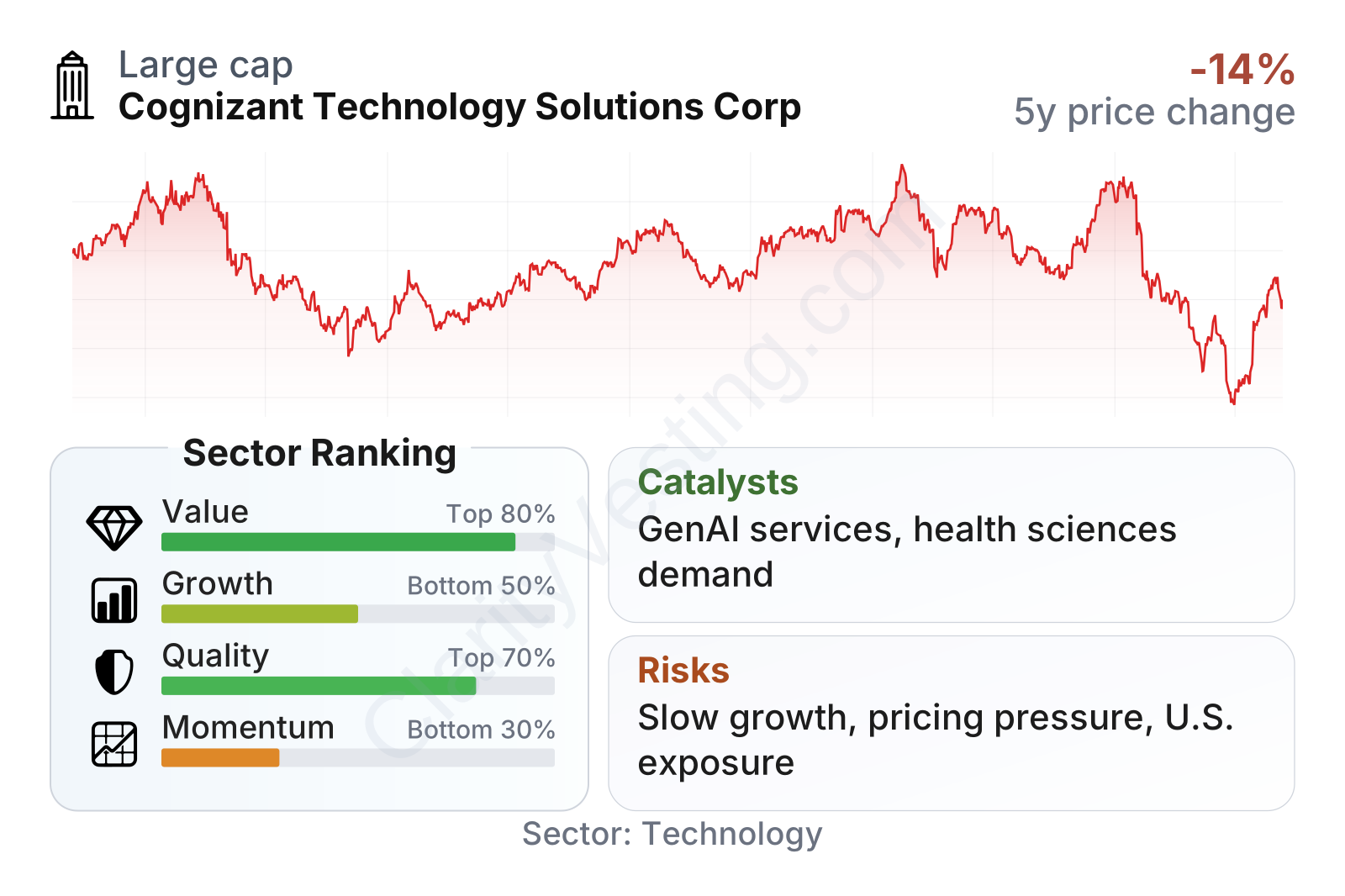
Cognizant stands out more for business quality and valuation than for speed of growth or recent stock performance. It is a large-cap company with relatively low share-price volatility, and its balance sheet remains conservative. On valuation, the earnings multiple is far below the sector median, while cash generation relative to market value is notably strong. On quality, returns on invested capital and operating margin sit comfortably above typical sector levels. The weaker areas are growth, which is below the sector median, and momentum, where the stock has significantly lagged over the past year and over a multi-year view.
Growth
Cognizant operates in a sector with durable long-term demand. Large companies still need help modernizing old systems, migrating to cloud infrastructure, improving cybersecurity, using data more effectively, and embedding artificial intelligence into internal workflows and customer experiences. Those trends are not short-lived. Even when enterprise budgets tighten, many technology projects shift from optional upgrades to operational necessities.
The challenge is that sector growth does not automatically translate into company growth. Cognizant went through a softer period in 2023 and parts of 2024 as clients delayed discretionary projects, especially in consulting and shorter-cycle digital work. More recently, growth has turned positive again, though still at a moderate pace compared with the broader technology sector.
The revenue pattern shows a clear slowdown after the post-pandemic surge, followed by a return to positive year-over-year growth. That matters because it suggests demand has stabilized, but it also shows that Cognizant is not currently expanding at the pace of the faster-growing parts of technology services.
Management’s strategy for future growth is centered on higher-value services rather than pure labor-based outsourcing. The company has been emphasizing AI-enabled software engineering, cloud modernization, platform work, industry-specific solutions, and consulting tied to business transformation. It has also used acquisitions to deepen capabilities in areas such as engineering services, life sciences, and digital transformation. For a company of Cognizant’s size, this strategy is logical: competing only on scale and labor cost would likely lead to slower growth and pricing pressure, while moving into more specialized work can support better client stickiness and margins.
One important catalyst is enterprise adoption of generative AI. Cognizant has been building partnerships with major technology vendors and rolling out AI-focused offerings that help clients deploy automation, code generation, customer service tools, and productivity solutions. The opportunity is not just in selling stand-alone AI projects, but also in using AI to improve delivery economics across existing contracts. If the company can both win more AI-related work and perform current projects more efficiently, that would support growth and profitability at the same time.
Another positive sign is cash generation. Even without rapid top-line expansion, Cognizant produces substantial free cash flow, which gives it room for acquisitions, dividends, and share repurchases while still preserving flexibility.
Free cash flow has been somewhat uneven from year to year, but the broader picture remains solid, with annualized cash generation in the multibillion-dollar range. That provides resilience if demand stays mixed and also gives management room to keep investing in new capabilities.
Recent company updates have also pointed to ongoing demand in health sciences and a gradual improvement in client spending patterns. That is not the same as a breakout growth phase, but it supports the view that Cognizant is participating in important long-term technology spending themes rather than being tied to a shrinking market.
Risks
This article is for informational purposes only and does not constitute financial advice. Some content is AI-generated. See Disclaimer


