Stock Analysis · Canadian Solar Inc (CSIQ)
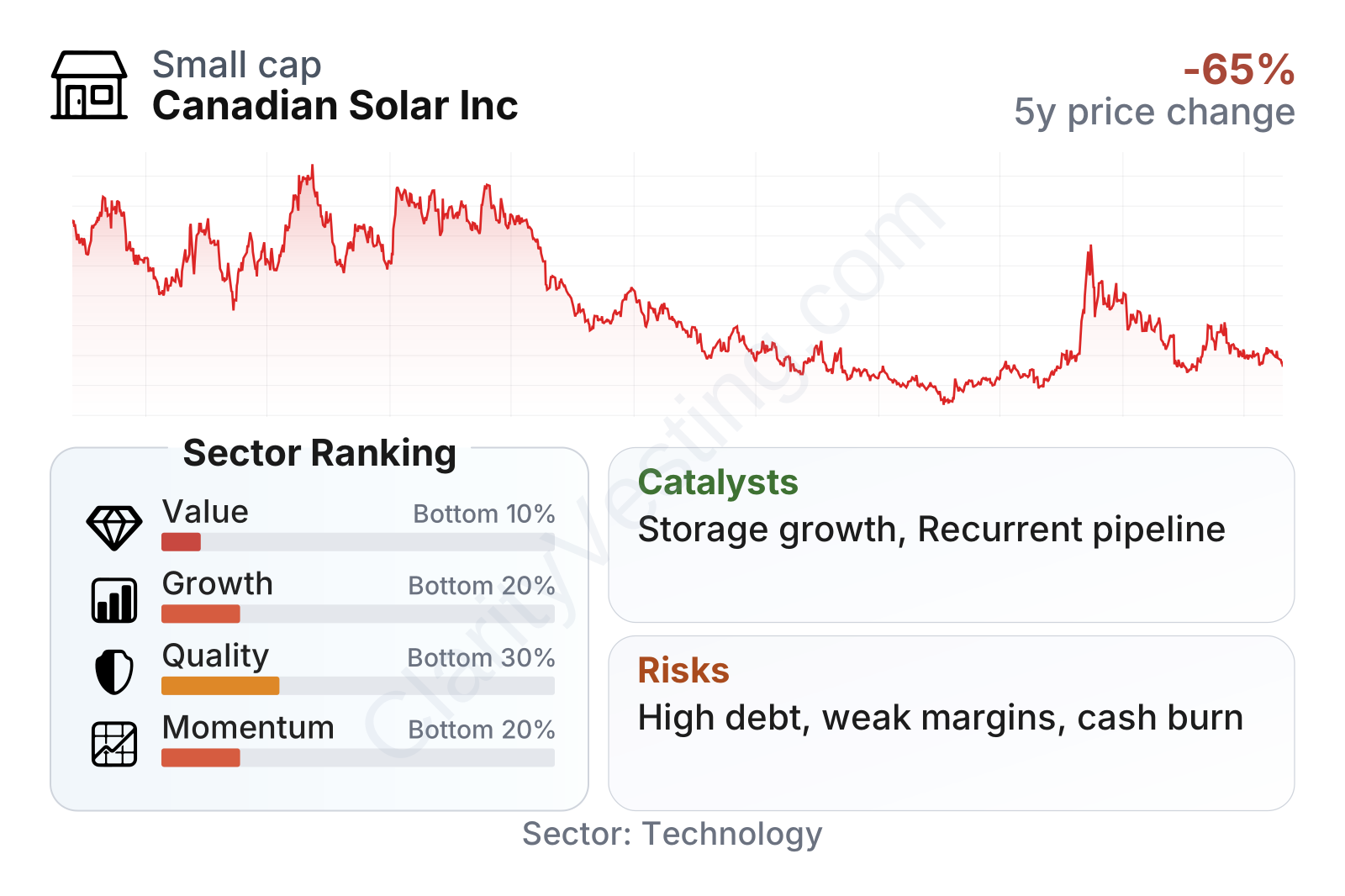
Stock Analysis · Canadian Solar Inc (CSIQ)

Overview

Canadian Solar is a solar energy company that operates across several parts of the value chain. In simple terms, it makes solar products, develops and sells large solar and battery storage projects, and also manufactures battery storage systems through its majority-owned subsidiary e-STORAGE. Although the name suggests a purely Canadian business, the company is global, with manufacturing, development, and sales activities spread across North America, Europe, Asia, and other international markets.

Its business is usually described through two main segments. The first is CSI Solar, which includes solar module manufacturing, battery energy storage products, and the sale of system kits and services. The second is Recurrent Energy, which develops, builds, sells, and sometimes retains solar and storage projects. This mix matters for long-term analysis because it gives the company exposure both to equipment sales and to higher-value infrastructure development.

Based on the company’s recent annual reporting structure, revenue is mainly generated from the sale of solar modules and other solar system products, with a growing contribution from battery storage and project-related activity. Exact shares can move sharply from year to year depending on project sales, but the revenue base can be summarized approximately as follows:

  • Solar modules and other solar system products: the largest source, likely a clear majority of sales in most periods.
  • Battery energy storage products and services: a smaller but increasingly important contributor as utility-scale storage expands.
  • Solar and storage project development, engineering, procurement, construction, and asset sales: meaningful but more uneven, depending on project timing.
  • Electricity or recurring asset-related income: comparatively small.

That revenue mix gives Canadian Solar two different profiles at once: a manufacturer exposed to pricing cycles and a developer exposed to large project wins. The benefit is diversification. The drawback is that both activities can be capital-intensive and volatile.

The multi-year income flow shows a business that scaled revenue strongly through 2023, then ran into margin pressure in 2024 and 2025. Gross profit remained meaningful, but operating income and net income weakened sharply as expenses and financing costs took a larger share of sales.

Key Figures

MetricValueSector
DateJul 18, 2026
Context
SectorTechnology
IndustrySolar
Market Cap $1.02B
Beta 1.51
Value
(Cheapness)
P/E Ratio N/A31.76
FCF Yield -138.74%4.18%
EBIT / EV N/A2.56%
PEG 0.16
Growth
(Business expansion)
Revenue Growth -9.90%13.50%
RPS Growth (5Y CAGR) 2.03%8.57%
EPS Growth (5Y CAGR) N/A-21.87%
Margin Growth (5Y Trend) -3.06%0.41%
FCF Growth (5Y CAGR) N/A9.76%
Quality
(Business durability)
ROIC (Latest) N/A8.54%
ROIC (5Y Median) 3.16%8.12%
Net Debt / EBIT (Latest) N/A0.38
Net Debt / EBIT (5Y Median) 12.150.38
Operating Margin (Latest) N/A9.58%
Operating Margin (5Y Median) 3.73%8.25%
Debt to Equity (Latest) 275.86%33.52%
Profit Margin (Latest) -1.87%6.96%
Free Cash Flow (Latest) -$1.41B
Momentum
(Price trend)
3Y Return -60.05%+30.91%
12M Return (excl. last month) +54.89%+28.90%
6M Return -30.82%+5.38%
Price vs. 200-Day MA -20.12%+7.61%
Better than sector median
Slightly worse than sector median
More than 20% worse than sector median

Canadian Solar currently sits in a weak relative position on value, growth, quality, and momentum compared with much of the broader technology sector. The market capitalization is now close to small-cap territory, and the share price has been highly volatile over the past few years. One point that stands out is the disconnect between a very low growth-adjusted multiple in the table and the company’s weaker operating profile: the stock can look statistically cheap, but that reading is heavily affected by pressured earnings, negative free cash flow, and elevated leverage.

The recent price history also shows how quickly sentiment can change in solar. After a long decline from 2023 into 2025, the stock experienced a sharp rebound and then another pullback. That pattern suggests the market is reacting not only to the company itself, but also to broader swings in solar demand, pricing, trade policy, and financing conditions.

Growth

Canadian Solar operates in a sector with long-term structural support. Solar power remains one of the cheapest sources of new electricity generation in many regions, and battery storage is becoming increasingly important as grids add more intermittent renewable energy. Over a long horizon, those are favorable industry conditions. The question is less about whether solar and storage will grow, and more about which companies can grow profitably through industry cycles.

The company’s strategy makes sense on paper. It is not relying only on commodity-like solar panel sales. It also has project development through Recurrent Energy and battery storage through e-STORAGE, both of which can offer better economics and stronger customer relationships than module manufacturing alone. In particular, grid-scale storage is one of the most important areas to watch, because utilities and power developers increasingly need batteries to balance solar generation.

Revenue growth, however, has clearly cooled. After a period of very strong expansion in 2021 through 2023, year-over-year sales turned negative in much of 2024 and remained soft into the latest period. That slowdown suggests the company is moving through a down cycle in parts of the solar market, especially where module oversupply and pricing pressure have weighed on results.

Cash generation is another key issue. Free cash flow has been deeply negative, which is not unusual for a company investing in project development, manufacturing, and working capital, but the size of the outflow is still significant. For a long-term business case, future growth looks more compelling if storage deliveries, project monetization, and margin recovery start converting into more stable cash inflows.

A meaningful catalyst is the company’s positioning in utility-scale storage and project development. Recurrent Energy has a large development pipeline, and e-STORAGE gives Canadian Solar a more direct way to participate in the rapid buildout of storage. The company has also been expanding manufacturing and supply chain presence in regions that matter for energy security and trade policy, including North America. In a more supportive pricing environment, those moves could improve its mix and reduce dependence on the toughest parts of module competition.

Recent company communications have continued to emphasize battery storage contracts, project pipeline execution, and efforts to localize manufacturing. Those are notable because they point toward areas where demand may be more durable than spot solar module pricing.

Risks

The main risks are not hard to identify. Canadian Solar is in a fiercely competitive industry where selling prices can drop fast, margins can disappear, and large capital needs can pressure the balance sheet. Solar manufacturers have to cope with changing trade rules, tariffs, policy incentives, supply-demand imbalances, and customer financing conditions. Even when end-market demand is healthy, profits can still be squeezed if the industry produces too much capacity.

Balance sheet pressure is one of the biggest issues right now. Debt to equity has climbed to roughly 276%, far above the sector median, and the trend has worsened over time. That does not automatically signal distress, because project development businesses often use more leverage than software or asset-light technology firms, but it does reduce room for error. High leverage matters even more when earnings are under pressure and interest expense is rising.

Profitability has also deteriorated materially. Profit margin moved from modestly positive levels a few years ago to negative territory recently, while the sector median stayed clearly positive. That gap suggests the current problem is not just a general industry slowdown; Canadian Solar is also dealing with company-specific pressure from business mix, execution, pricing, and financing costs.

As for competitive advantages, the company does have some strengths. It has global scale, long operating history in solar, vertical integration in selected parts of the chain, a recognized brand in modules, and a project development platform that is more substantial than many pure manufacturers. The storage business is also important because it gives Canadian Solar exposure to a faster-growing and potentially more differentiated market than standard modules.

Still, it is not the clear industry leader. In solar modules, the company competes with very large players such as JinkoSolar, Trina Solar, LONGi, JA Solar, and First Solar, among others. In project development and storage, it faces utilities, independent power producers, specialized developers, and integrated clean-energy companies. Compared with the biggest Chinese manufacturers, Canadian Solar does not appear to have the same scale advantage. Compared with First Solar, it does not have the same level of product differentiation in the U.S. market. Its position is better described as established and broad-based rather than dominant.

Another risk worth watching is the complexity of the corporate structure. With manufacturing, project development, storage systems, and listed subsidiaries or subsidiary financing structures, the company can be harder to analyze than a simpler single-segment business. That complexity can create value, but it can also obscure capital allocation quality and make results more uneven from one quarter to the next.

No major scandal or governance breakdown stands out from the core public filings reviewed, but the company remains exposed to geopolitical tension, trade barriers, and policy shifts in the U.S., China, and Europe. In this industry, those external changes can be just as important as internal execution.

Valuation

At first glance, Canadian Solar may look inexpensive relative to the broader sector because the stock trades at a much lower earnings multiple than many technology names during profitable periods. However, that impression needs caution. The latest profitability is weak, free cash flow is negative, and the most recent trailing P/E is not very meaningful because earnings have become unstable. When profits are close to zero or negative, traditional valuation ratios can swing sharply and stop being useful.

The longer P/E history shows exactly that problem. Canadian Solar once traded at clearly lower multiples than the sector median for extended periods, which could suggest skepticism from the market. More recently, the ratio became erratic and at times unusable because earnings fell too far. In other words, the stock may look cheap on some screens, but that cheapness is partly a reflection of uncertainty around the durability of earnings.

A more grounded way to view valuation is to balance the depressed market capitalization against the company’s weak financial quality. At roughly a little over $1 billion in market value, the market is assigning limited credit to the business despite its global presence and infrastructure pipeline. That may reflect concern that module oversupply, low margins, high debt, and negative cash flow could continue for longer than expected.

So the current price looks less like a straightforward bargain and more like a contested valuation. It reflects real assets, operating scale, and growth exposure to solar plus storage, but it also reflects a business that currently lacks the profitability and balance-sheet strength usually associated with durable premium valuations.

Conclusion

Canadian Solar remains a relevant global player in an industry with strong long-term demand drivers. Its combination of module manufacturing, storage systems, and project development gives it more strategic depth than a plain-vanilla solar panel producer, and the storage and development platforms are the most attractive parts of the business for the years ahead.

At the same time, the current financial profile is strained. Revenue has softened, margins have turned negative, free cash flow remains deeply negative, and leverage is high. Those factors make the company’s long-term case more dependent on execution and industry recovery than on present-day operating strength. This is not a business being valued like a steady compounder; it is being valued like a cyclical clean-energy company that still has meaningful assets but must prove that those assets can produce stronger and more consistent returns.

The overall direction is clear: Canadian Solar has credible long-range exposure to two important energy themes, solar and grid storage, but its near-term fundamentals remain fragile. That leaves the company in an interesting but demanding position, where the upside case depends on better cash generation, healthier margins, and successful conversion of its project and storage footprint into more resilient earnings.

Sources:

  • Canadian Solar Inc. — Annual Report on Form 20-F for fiscal year 2025
  • Canadian Solar Inc. — SEC filings available through the SEC EDGAR database in 2026
  • Canadian Solar Investor Relations — company press releases and presentation materials published in 2026
  • Canadian Solar Investor Relations — company-hosted earnings call materials and transcripts published in 2026
  • Wikipedia — Canadian Solar basic company background

This article is for informational purposes only and does not constitute financial advice. Some content is AI-generated. See Disclaimer


Sign up for exclusive research and insights.

Unsubscribe anytime.
