Stock Analysis · Cisco Systems Inc (CSCO)
Overview
Cisco Systems is one of the world’s largest networking companies. In simple terms, it provides the equipment and software that help businesses, governments, telecom operators, and data centers connect devices, move data securely, and manage digital infrastructure. Its products sit behind many corporate networks, internet backbones, office communications systems, and cybersecurity environments. Over time, Cisco has been shifting from being known mainly as a hardware company toward a broader platform built on networking, security, cloud-managed infrastructure, observability, and recurring software subscriptions.
Cisco’s revenue mix is spread across product categories, services, and software-related subscriptions. Based on the company’s latest annual reporting structure and recent disclosures, the main sources of revenue can be summarized approximately as follows:
- Networking – roughly half of revenue. This includes switching, routing, wireless, and data center networking products.
- Security – around 10% to 15%. This includes firewall, zero-trust, identity, and broader cybersecurity offerings, reinforced by acquisitions.
- Collaboration – around 7% to 10%. This covers Webex, calling, conferencing, and related workplace communication tools.
- Services – roughly a quarter of revenue. These are support, maintenance, technical services, and advisory offerings tied to Cisco’s installed base.
- Observability and other software platforms – still smaller, but increasingly important as Cisco expands into application monitoring, analytics, and AI-ready infrastructure management.
One of Cisco’s core strengths is the breadth of its installed base. Large organizations often already rely on Cisco gear across campuses, branch offices, and data centers, which helps the company cross-sell software, security, and support. That makes the business more durable than a pure hardware cycle would suggest, even if some parts of the portfolio still depend on enterprise spending patterns.
The long-term business model is also visible in profitability trends. Revenue has moved up and down over the last few years, but gross profit has remained strong, showing Cisco still has pricing power and a favorable product mix. At the same time, the company has been spending more on research and development, which suggests management is trying to defend its position as networking evolves toward AI workloads, automation, and cloud-connected security.
The overall picture is that Cisco remains a large, high-margin infrastructure company with a meaningful transition underway: less dependence on one-time hardware sales and more emphasis on software, subscriptions, and security.
Key Figures
| Metric | Value | Sector ⓘ |
|---|---|---|
| Date | Jul 18, 2026 | |
| Context | ||
| Sector | Technology | |
| Industry | Communication Equipment | |
| Market Cap ⓘ | $441.20B | |
| Beta ⓘ | 1.01 | |
Value (Cheapness) | ||
| P/E Ratio ⓘ | 36.46 | 31.76 |
| FCF Yield ⓘ | 2.86% | 4.18% |
| EBIT / EV ⓘ | 3.48% | 2.56% |
| PEG ⓘ | 1.52 | |
Growth (Business expansion) | ||
| Revenue Growth ⓘ | 12.00% | 13.50% |
| RPS Growth (5Y CAGR) ⓘ | 4.77% | 8.57% |
| EPS Growth (5Y CAGR) ⓘ | -2.13% | -21.87% |
| Margin Growth (5Y Trend) ⓘ | -5.40% | 0.41% |
| FCF Growth (5Y CAGR) ⓘ | -2.60% | 9.76% |
Quality (Business durability) | ||
| ROIC (Latest) ⓘ | 17.15% | 8.54% |
| ROIC (5Y Median) ⓘ | 34.16% | 8.12% |
| Net Debt / EBIT (Latest) ⓘ | 1.56 | 0.38 |
| Net Debt / EBIT (5Y Median) ⓘ | 0.23 | 0.38 |
| Operating Margin (Latest) ⓘ | 25.58% | 9.58% |
| Operating Margin (5Y Median) ⓘ | 27.49% | 8.25% |
| Debt to Equity (Latest) ⓘ | 64.07% | 33.52% |
| Profit Margin (Latest) ⓘ | 19.69% | 6.96% |
| Free Cash Flow (Latest) ⓘ | $12.62B | |
Momentum (Price trend) | ||
| 3Y Return ⓘ | +136.46% | +30.91% |
| 12M Return (excl. last month) ⓘ | +83.73% | +28.90% |
| 6M Return ⓘ | +50.12% | +5.38% |
| Price vs. 200-Day MA ⓘ | +29.29% | +7.61% |
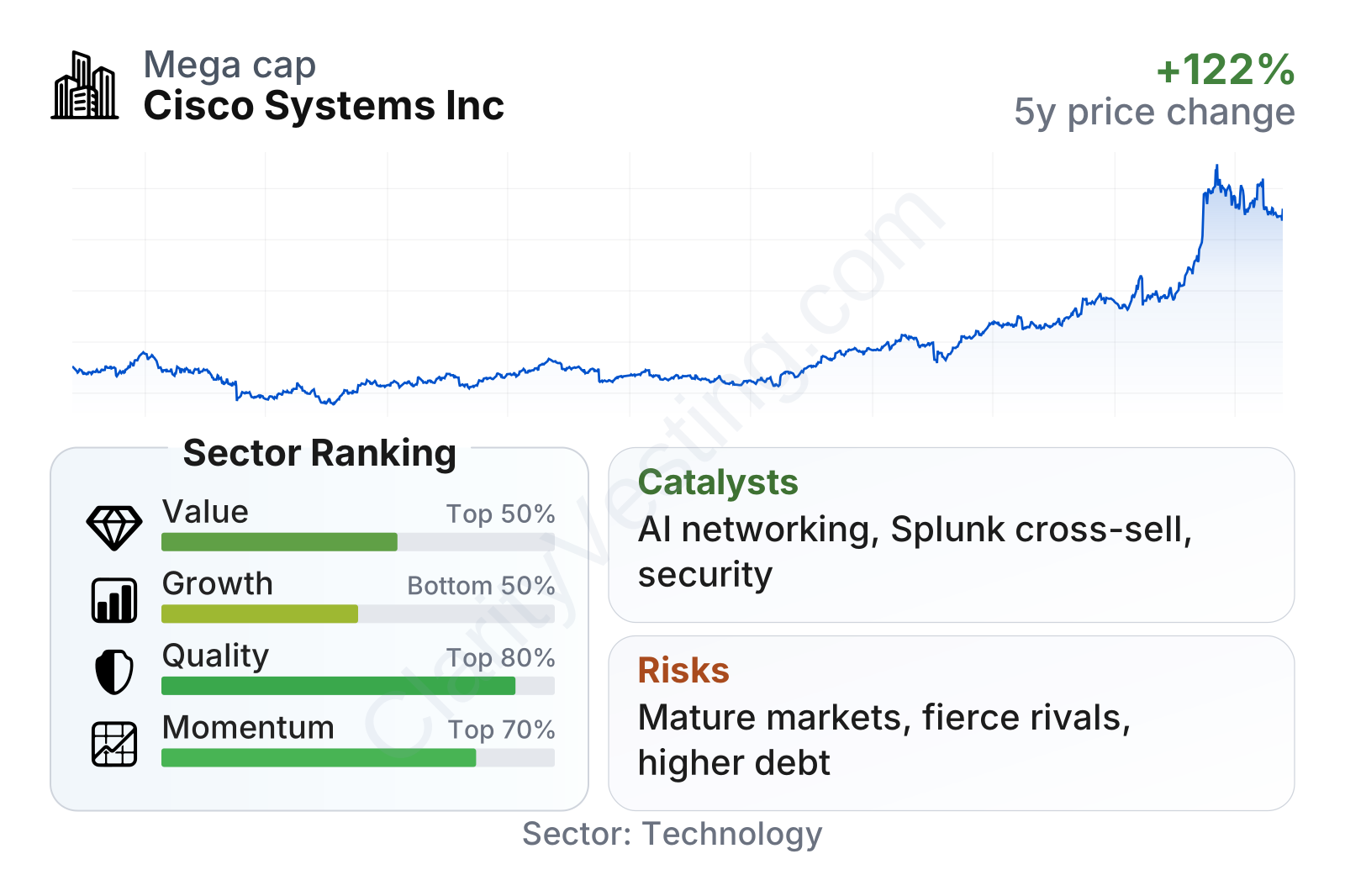
Cisco stands out more for business quality than for raw growth. Profitability remains well above much of the technology hardware universe, with operating and net margins comfortably ahead of sector medians. Returns on invested capital are also strong, which points to an efficient business with durable economics. The weaker areas are valuation and growth: the earnings multiple is above the sector median, while long-term revenue per share and free cash flow growth have been slower than many peers. Market behavior has been favorable, though, with the stock’s medium-term performance and trend strength ranking relatively high within the sector.
The stock’s longer price history also shows a change in market perception. After a weaker period in 2022, Cisco recovered steadily and then re-rated sharply through 2025 and into early 2026. That usually means the market is giving more credit to stability, recurring revenue, AI-related networking demand, and the broader software and security story than it did a few years ago.
Growth
Cisco operates in a sector that should remain strategically important for years: digital infrastructure. Even as cloud computing expanded, networking never became less necessary. In fact, rising data traffic, cybersecurity needs, hybrid work, connected devices, and now AI workloads all increase the need for fast, secure, and manageable networks. That does not automatically make Cisco a fast-growth company, but it does mean the company participates in a market with durable long-term demand.
Cisco’s growth strategy is sensible because it builds on areas where it already has relationships and technical credibility. Management has been pushing three major themes: expanding recurring software and subscription revenue, strengthening cybersecurity, and positioning Cisco equipment for AI-era data center upgrades. The company’s acquisitions, including Splunk, support this direction by adding observability, analytics, and security capabilities that are useful to large enterprise customers already running complex networks.
Revenue growth has been uneven. There was a clear slowdown and contraction during 2024, followed by a return to positive growth that has recently moved back toward low-double-digit territory. That pattern suggests Cisco is still exposed to order timing and customer spending cycles, but also that demand has not structurally broken. The rebound matters because it shows the company can resume expansion after digestion periods, especially when backlog normalizes and enterprise and service-provider spending improves.
Cash generation remains one of Cisco’s most important strengths. Free cash flow has stayed in a very large annual range even through uneven revenue periods. That gives the company flexibility to invest in research, acquisitions, and platform development without depending heavily on outside financing. For a long-term business analysis, that kind of consistency is valuable because it suggests Cisco can keep adapting even if growth is not spectacular every year.
A major catalyst is AI infrastructure. Cisco has been emphasizing higher-speed networking, secure data center connectivity, silicon, and partnerships tied to AI deployments. As organizations build out AI-capable infrastructure, networking upgrades become necessary because models, storage, and compute clusters require faster and more reliable data movement. Cisco is not the only company addressing that need, but its enterprise reach and installed base give it a credible path to participate. Another meaningful opportunity comes from integrating networking, security, and observability into broader platforms, which can raise switching costs and deepen customer relationships.
Risks
The biggest risk is that Cisco is still not a high-growth company relative to many technology names. Its recent revenue recovery is encouraging, but over a five-year period, top-line growth has been modest and free cash flow growth has not kept pace with stronger areas of the sector. That means a lot of the long-term case depends on steady execution, margin discipline, and success in expanding software and security rather than on explosive sales growth.
Competition is another important issue. In core networking, Cisco remains one of the most established names, but the market is highly competitive. Arista is particularly strong in high-performance cloud and data center networking. Hewlett Packard Enterprise, including Aruba, is a major rival in enterprise networking. Juniper Networks competes in routing, switching, and AI-driven network operations. In cybersecurity, Cisco also faces powerful specialists such as Palo Alto Networks, Fortinet, CrowdStrike, and Zscaler. These competitors are often seen as more focused or faster-moving in their niches, so Cisco must prove that an integrated platform can compete effectively against best-of-breed products.
Cisco does still have real competitive advantages. It has a massive installed base, long enterprise relationships, a broad product catalog, certification ecosystems, and global support capabilities that are difficult to replicate. It is not the undisputed leader in every category, but it remains one of the central players in enterprise networking overall. That scale supports margins and helps the company remain relevant even when individual product lines face pressure.
Balance-sheet risk deserves attention mainly because leverage increased materially after being quite conservative in earlier years. Debt to equity is now noticeably above the sector median and well above Cisco’s own historical level. That does not appear to be an immediate financial stress issue given the company’s cash generation, but it does reduce some flexibility and raises the importance of disciplined capital allocation after large acquisitions.
Profitability remains a clear offset to many of these risks. Even with some margin compression from prior peaks, Cisco’s net margin is still far above the industry median. In other words, the company is operating from a position of financial strength, but the trend is worth monitoring because declining margins over time could signal heavier competition, weaker mix, or integration costs from strategic expansion.
Another risk is execution around transformation. Cisco has been trying to become more software-centric while preserving its hardware leadership. That is the right direction strategically, but it is not simple. Integrating acquisitions, keeping products relevant, and convincing customers to consolidate more tools under Cisco all require consistent execution. Any slowdown in enterprise IT budgets or failure to monetize these newer platforms could limit the payoff from that transition.
Valuation
Cisco’s valuation looks mixed rather than obviously cheap. The current earnings multiple is above the sector median in the latest comparison, while the company’s free cash flow yield is lower than the median. That usually means the market is assigning a premium for durability, margins, and strategic positioning rather than pricing Cisco as a no-growth hardware vendor.
Looking at the longer trend, Cisco spent much of the last several years trading at a discount to the broader technology sector on earnings. More recently, that discount narrowed as the share price climbed and the market became more constructive on AI networking, recurring revenue, and the company’s broader platform ambitions. Even so, the valuation does not look stretched in the way some faster-growing technology companies do. It appears more like a mature business that has been re-rated upward as confidence improved.
Whether the current price is fully justified depends on the weight given to business quality versus growth limitations. Cisco has unusually strong margins, substantial cash flow, and a durable market position, which support a premium to slower, lower-quality hardware peers. On the other hand, its long-term growth profile remains moderate, and leverage is higher than before. That makes the valuation easier to support if the company continues executing on security, software, and AI-related networking demand, but less comfortable if growth slips back toward stagnation.
Conclusion
Cisco today looks less like an aging networking vendor than a large infrastructure platform trying to turn scale, customer trust, and technical depth into a broader software-and-security story. The company’s strongest features are clear: high profitability, powerful cash generation, a deep enterprise footprint, and a central role in the digital networks that businesses still need to run. Those traits give it resilience and make the business easier to understand than many more speculative technology names.
The main challenge is that Cisco is still in a transition, not at the end of one. Growth has improved again, but the longer arc remains moderate, and the company must keep proving that AI infrastructure, observability, and security can lift results beyond the old pattern of cyclical hardware spending. Rising leverage and intense competition add pressure, especially in markets where faster-moving specialists are strong.
Overall, Cisco appears well-positioned rather than deeply underappreciated. The company combines above-average business quality with a more demanding valuation than it had a few years ago. That leaves the long-term picture constructive, but increasingly tied to successful execution in software, security, and AI-connected networking rather than to legacy hardware alone.
Sources:
- Cisco Systems, Inc. — Annual Report on Form 10-K for fiscal year ended July 26, 2025
- Cisco Systems, Inc. — Quarterly Report on Form 10-Q for the quarter ended January 24, 2026
- SEC EDGAR — Cisco Systems, Inc. filings database
- Cisco Investor Relations — Fiscal Second Quarter 2026 Results press release
- Cisco Investor Relations — earnings presentation materials and shareholder information
- Cisco Newsroom — company announcements on AI infrastructure, security, and product strategy
- Wikipedia — Cisco Systems basic company history and business overview
This article is for informational purposes only and does not constitute financial advice. Some content is AI-generated. See Disclaimer