Stock Analysis · CoreWeave Inc (CRWV)
Overview
CoreWeave is a cloud infrastructure company focused on high-performance computing, especially workloads tied to artificial intelligence. In simple terms, it rents access to large clusters of advanced graphics processing units, or GPUs, along with software and related services that help customers train and run AI models. Its clients include AI developers, enterprises, and other organizations that need computing power without building their own data center footprint.
The business is built around specialized cloud capacity rather than broad general-purpose cloud services. That matters because AI training and inference require large amounts of compute, fast networking, and reliable power delivery. CoreWeave has positioned itself as a focused provider in that niche, competing on speed of deployment, access to scarce GPU hardware, and infrastructure designed specifically for AI workloads.
Public filings indicate that revenue is still highly concentrated in a small number of customers and is reported largely as cloud platform and infrastructure services rather than a wide spread of separate product lines. Based on the company’s disclosures, the main economic drivers can be summarized this way:
- GPU cloud infrastructure services: the large majority of revenue, likely well above 90%. This includes leasing access to compute clusters, storage, and networking for AI and high-performance workloads.
- Related platform and support services: a small share of revenue. This can include managed infrastructure capabilities, software tooling, and customer support tied to deployed workloads.
- Other arrangements tied to dedicated capacity: limited but strategically important, especially where large customers reserve capacity under longer-term contracts.
One notable pattern in the business is the speed of scale-up. Revenue expanded from a very small base in 2022 to more than $5 billion in 2025, while gross profit also rose sharply. At the same time, financing costs and expansion spending remained heavy, showing that the company is still in a buildout phase rather than a mature, cash-harvesting phase.
The flow of revenue and expenses shows a company that has dramatically expanded its top line and gross profit in a short period. The important nuance is that operating performance improved substantially by 2025, but interest expense still consumed a very large amount of that progress, helping explain why net income remained deeply negative despite fast growth.
Key Figures
| Metric | Value | Sector ⓘ |
|---|---|---|
| Date | Sep 12, 2026 | |
| Context | ||
| Sector | Technology | |
| Industry | Software - Infrastructure | |
| Market Cap ⓘ | $49.08B | |
| Beta ⓘ | N/A | |
Value (Cheapness) | ||
| P/E Ratio ⓘ | N/A | 29.51 |
| FCF Yield ⓘ | -27.82% | 4.25% |
| EBIT / EV ⓘ | -0.14% | 2.85% |
| PEG ⓘ | N/A | |
Growth (Business expansion) | ||
| Revenue Growth ⓘ | 112.50% | 15.40% |
| RPS Growth (5Y CAGR) ⓘ | 569.25% | 8.56% |
| EPS Growth (5Y CAGR) ⓘ | N/A | -11.88% |
| Margin Growth (5Y Trend) ⓘ | N/A | 0.46% |
| FCF Growth (5Y CAGR) ⓘ | N/A | 9.80% |
Quality (Business durability) | ||
| ROIC (Latest) ⓘ | -0.36% | 9.44% |
| ROIC (5Y Median) ⓘ | N/A | 8.30% |
| Net Debt / EBIT (Latest) ⓘ | N/A | 0.54 |
| Net Debt / EBIT (5Y Median) ⓘ | N/A | 0.44 |
| Operating Margin (Latest) ⓘ | -1.63% | 9.58% |
| Operating Margin (5Y Median) ⓘ | -90.78% | 8.25% |
| Debt to Equity (Latest) ⓘ | 1027.23% | 33.33% |
| Profit Margin (Latest) ⓘ | -25.40% | 7.14% |
| Free Cash Flow (Latest) ⓘ | -$13.65B | |
Momentum (Price trend) | ||
| 3Y Return ⓘ | N/A | +45.48% |
| 12M Return (excl. last month) ⓘ | -27.58% | +23.48% |
| 6M Return ⓘ | +11.43% | +20.93% |
| Price vs. 200-Day MA ⓘ | -3.15% | +7.43% |
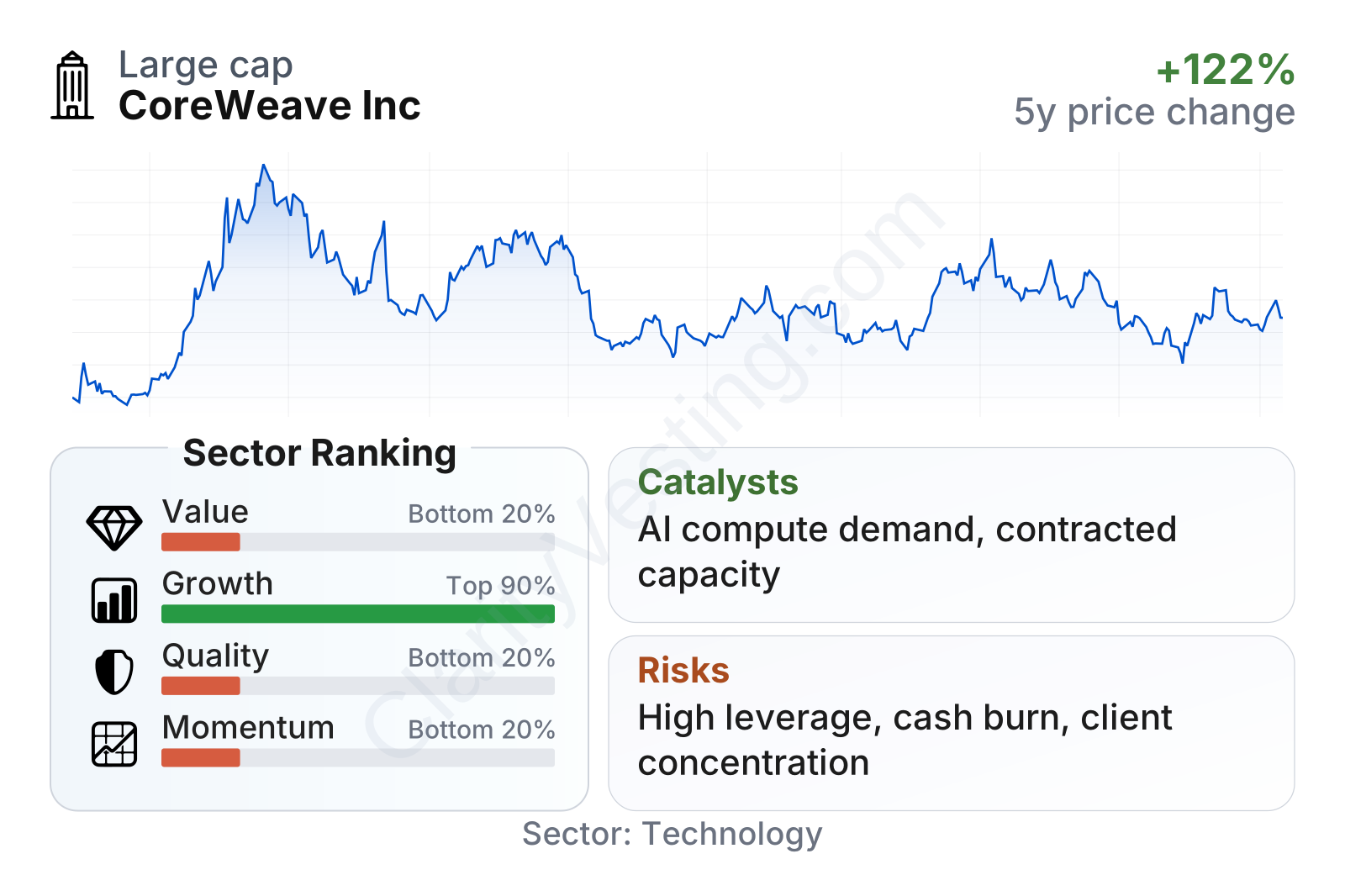
The overall picture is unusual even by technology-sector standards. Growth ranks near the top of the sector, but value, quality, and momentum all sit near the bottom. That combination usually points to a business scaling very quickly while still carrying weak profitability, heavy capital needs, and a stock price that has already gone through a large swing since listing.
The share-price history also highlights how volatile market expectations have been. After a sharp early move higher, the stock gave back a large part of those gains before stabilizing somewhat in 2026. That kind of trading pattern often appears when a newly public company is tied to a fast-growing theme but still has unresolved questions around earnings power and balance-sheet structure.
Growth
CoreWeave operates in one of the strongest infrastructure markets in technology. Demand for AI training and inference has pushed customers to secure more advanced compute capacity, and supply has often been constrained by GPU availability, power access, and data center readiness. That backdrop is favorable for companies able to bring capacity online quickly.
The company’s strategy broadly fits that environment. Instead of trying to become a full-scale consumer cloud platform, it has concentrated on a narrower but highly demanded layer of the market: AI-focused compute infrastructure. That specialization can help with execution because customers in this segment often care more about fast deployment, performance, and hardware availability than about the wide product menus offered by larger cloud vendors.
Revenue growth has cooled from extremely high levels reached during the earlier surge, but it remains exceptional. Recent year-over-year growth has still been above 100%, far ahead of the broader software-infrastructure sector. For long-term analysis, that slowdown is not necessarily negative on its own; it is a normal effect of scaling from a larger base. The more important question is whether new capacity keeps filling at attractive economics.
A major catalyst is the company’s backlog of contracted demand and the broader race to build AI infrastructure. Large enterprises and model developers increasingly want dedicated or reserved access to advanced compute. If CoreWeave continues converting contracted capacity into recognized revenue, the business could remain one of the fastest growers in its peer group.
Another important catalyst is the ongoing expansion of inference workloads. Training large AI models attracted the earliest attention, but inference, the process of running models in real products and services, can create more persistent usage over time. If that shift strengthens, providers with dense GPU infrastructure and strong scheduling software may benefit from more recurring demand.
The caution inside the growth profile is cash consumption. Free cash flow remains deeply negative and has become more negative as the company expands its infrastructure base. In practical terms, CoreWeave is growing fast because it is spending heavily ahead of demand. That can work very well if utilization stays high, but it also means growth is not yet self-funding.
Recent company updates and filings have continued to emphasize infrastructure expansion, strategic customer relationships, and financing arrangements to support additional capacity. Those developments suggest that the opportunity set is real, especially while AI compute remains a bottleneck across the industry.
Risks
This article is for informational purposes only and does not constitute financial advice. Some content is AI-generated. See Disclaimer


