Stock Analysis · Crowdstrike Holdings Inc (CRWD)
Overview
CrowdStrike Holdings is a cybersecurity software company best known for its Falcon platform, a cloud-based system used to protect computers, servers, cloud workloads, identities, and data from cyberattacks. In simple terms, the company helps organizations prevent, detect, investigate, and respond to digital threats. Its customers include large enterprises, government entities, and smaller businesses that increasingly need security tools as more work, software, and infrastructure move online.
The business model is largely subscription-based. Customers typically pay recurring fees to use one or more Falcon modules, which creates predictable revenue and gives CrowdStrike room to expand within existing accounts over time. The company has also built adjacent offerings in areas such as identity protection, cloud security, next-generation SIEM, managed detection and response, and log management, all tied together through the same platform.
Based on recent company filings, CrowdStrike generates the large majority of its revenue from subscription services, with a much smaller contribution from professional services.
- Subscription revenue: about 94% of total revenue. This includes access to Falcon modules for endpoint security, cloud security, identity protection, log management, threat intelligence, incident response subscriptions, and managed security offerings.
- Professional services revenue: about 6% of total revenue. This mainly includes incident response work, forensic services, and other security-related consulting and support engagements.
The broader financial picture shows a company with strong gross profit generation but continued heavy spending on product development and sales expansion. Revenue has scaled rapidly over the last several years, while operating and net profitability have remained less stable than cash generation.
CrowdStrike’s revenue mix remains heavily tilted toward recurring subscriptions, which is usually a favorable trait in software. At the same time, the flow from gross profit to net income shows that the company is still prioritizing expansion and innovation, especially through research and development.
Key Figures
| Metric | Value | Sector ⓘ |
|---|---|---|
| Date | Sep 12, 2026 | |
| Context | ||
| Sector | Technology | |
| Industry | Software - Infrastructure | |
| Market Cap ⓘ | $211.69B | |
| Beta ⓘ | 1.25 | |
Value (Cheapness) | ||
| P/E Ratio ⓘ | N/A | 29.51 |
| FCF Yield ⓘ | 0.74% | 4.25% |
| EBIT / EV ⓘ | 0.05% | 2.85% |
| PEG ⓘ | 6.68 | |
Growth (Business expansion) | ||
| Revenue Growth ⓘ | 25.80% | 15.40% |
| RPS Growth (5Y CAGR) ⓘ | 30.69% | 8.56% |
| EPS Growth (5Y CAGR) ⓘ | -8.12% | -11.88% |
| Margin Growth (5Y Trend) ⓘ | N/A | 0.46% |
| FCF Growth (5Y CAGR) ⓘ | 31.28% | 9.80% |
Quality (Business durability) | ||
| ROIC (Latest) ⓘ | 2.33% | 9.44% |
| ROIC (5Y Median) ⓘ | -1.68% | 8.30% |
| Net Debt / EBIT (Latest) ⓘ | -40.24 | 0.54 |
| Net Debt / EBIT (5Y Median) ⓘ | N/A | 0.44 |
| Operating Margin (Latest) ⓘ | 1.93% | 9.58% |
| Operating Margin (5Y Median) ⓘ | -2.06% | 8.25% |
| Debt to Equity (Latest) ⓘ | 16.08% | 33.33% |
| Profit Margin (Latest) ⓘ | 0.83% | 7.14% |
| Free Cash Flow (Latest) ⓘ | $1.57B | |
Momentum (Price trend) | ||
| 3Y Return ⓘ | +387.36% | +45.48% |
| 12M Return (excl. last month) ⓘ | +103.56% | +23.48% |
| 6M Return ⓘ | +87.29% | +20.93% |
| Price vs. 200-Day MA ⓘ | +43.45% | +7.43% |
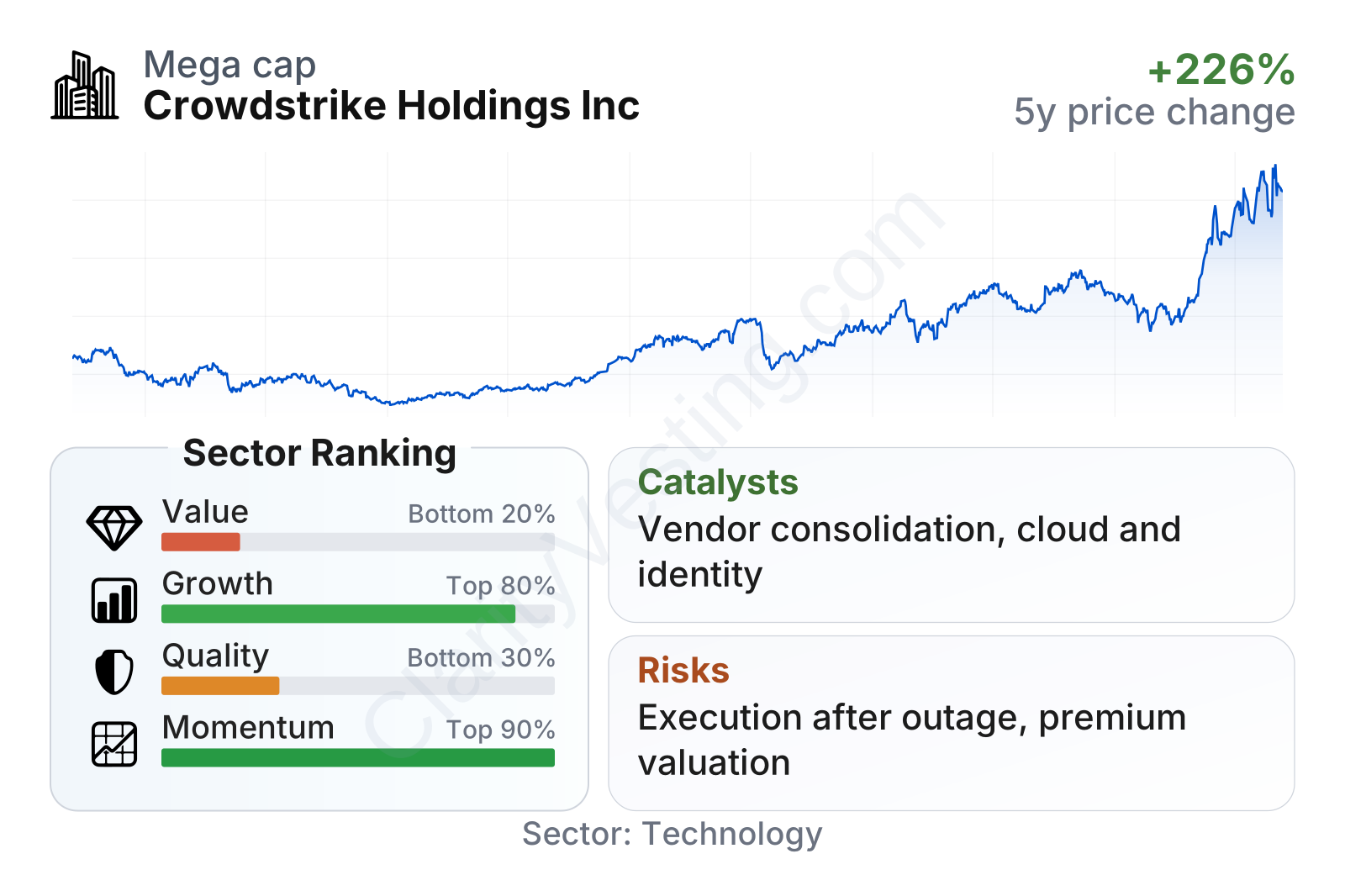
CrowdStrike is now a very large software company by market value, and its share price momentum has been exceptionally strong versus the broader technology software group. Growth metrics remain clearly above the sector median, especially on a multi-year basis for revenue and free cash flow. The weaker area is valuation, where the company screens as expensive on most conventional measures, while profitability ratios still lag mature software peers despite a very strong balance sheet position.
The stock price history also highlights how volatile sentiment can be. After a major drawdown in 2022, the shares recovered sharply and then continued climbing, reflecting both the market’s enthusiasm for cybersecurity and the premium attached to CrowdStrike’s growth profile.
Growth
Cybersecurity remains one of the more durable growth segments in enterprise software. The main reason is straightforward: attacks continue to increase in frequency and cost, while companies are managing a more complex mix of devices, users, cloud applications, and artificial intelligence tools. That creates ongoing demand for security products that can cover multiple risk areas from a single platform.
CrowdStrike’s strategy fits that environment well. Rather than selling one isolated tool, it aims to become a broader security platform. This matters because a platform can be easier for customers to deploy, can reduce vendor sprawl, and can increase switching costs once multiple modules are embedded in daily operations. That expansion approach has been a major part of the company’s growth engine.
Revenue growth has slowed from the exceptionally high rates seen a few years ago, which is normal as the business gets larger, but recent growth has remained in the mid-20% range and still stands above the sector median. For a company already at multi-billion-dollar annual revenue scale, that is a meaningful sign that demand remains strong.
Cash generation has improved steadily over time, with trailing free cash flow rising from well under $0.5 billion a few years ago to well above $1.0 billion more recently. That is important because it shows the company is not only growing revenue, but also converting a meaningful portion of that expansion into cash, even when accounting earnings remain uneven.
Several catalysts support the long-term outlook. First, enterprises are increasingly consolidating cybersecurity vendors, and CrowdStrike’s broadening product lineup makes it a candidate to benefit from that shift. Second, cloud security, identity security, and next-generation SIEM are all large categories where spending is still growing. Third, the company has been embedding artificial intelligence into threat detection, automation, and analyst workflows, which could strengthen its product differentiation if adoption expands.
One major recent development also matters for future growth: the global outage tied to a faulty CrowdStrike software update in mid-2024 created short-term disruption and reputational damage, but it also pushed the company to improve resilience, quality controls, and customer support processes. If execution stabilizes and retention stays strong, the business may emerge with a more disciplined operating model while still participating in a structurally growing market.
Risks
This article is for informational purposes only and does not constitute financial advice. Some content is AI-generated. See Disclaimer