Stock Analysis · Cirrus Logic Inc (CRUS)
Overview
Cirrus Logic is a semiconductor company that designs specialized chips used mainly in consumer electronics. Its best-known products are audio components, power and battery-related chips, and mixed-signal processors that help devices manage sound, sensing, and power efficiently. The company does not run its own chip factories; instead, it focuses on design, software, and close engineering work with device makers, while manufacturing is outsourced to foundry partners.
The business is still heavily tied to smartphones, especially premium handsets, although management has been working to widen the product mix into areas such as laptop audio, camera controllers, haptics, and power conversion. In simple terms, Cirrus Logic sells high-value chips that improve how devices sound, feel, and manage energy, rather than basic commodity chips.
Its revenue base is concentrated in a few product families and a small number of large customers. Based on recent annual filings and management commentary, the main sources of revenue can be summarized as follows:
- Audio products: approximately 75% to 85% of revenue. This includes amplifiers, codecs, smart audio chips, boosted amplifiers, and related components used mainly in smartphones, tablets, laptops, and other consumer devices.
- High-performance mixed-signal products: approximately 15% to 25% of revenue. This category includes camera controllers, haptics and sensing solutions, battery and power-related chips, and other custom mixed-signal components.
- By customer concentration: one very large customer has historically represented a substantial majority of sales, often around 80% or more in some fiscal years. Cirrus does not always name the customer in plain language, but this concentration is one of the central facts of the business.
The profit structure has improved meaningfully over the last several years. Revenue has moved up only moderately, but operating income, net income, and free cash flow have expanded faster, suggesting that product mix and execution have become more favorable. Research and development remains a major spending item, which fits a chip designer that depends on staying embedded in future device generations.
The operating picture shows a business with solid gross profit and a disciplined cost base. Research spending has remained high in absolute dollars, while revenue and operating profit have recovered from the 2023 slowdown, indicating that Cirrus kept investing through a weaker period instead of pulling back sharply.
Key Figures
| Metric | Value | Sector ⓘ |
|---|---|---|
| Date | Sep 12, 2026 | |
| Context | ||
| Sector | Technology | |
| Industry | Semiconductors | |
| Market Cap ⓘ | $5.84B | |
| Beta ⓘ | 1.16 | |
Value (Cheapness) | ||
| P/E Ratio ⓘ | 13.53 | 29.51 |
| FCF Yield ⓘ | 9.80% | 4.25% |
| EBIT / EV ⓘ | 10.48% | 2.85% |
| PEG ⓘ | 9.35 | |
Growth (Business expansion) | ||
| Revenue Growth ⓘ | 12.90% | 15.40% |
| RPS Growth (5Y CAGR) ⓘ | 6.08% | 8.56% |
| EPS Growth (5Y CAGR) ⓘ | -36.10% | -11.88% |
| Margin Growth (5Y Trend) ⓘ | 4.17% | 0.46% |
| FCF Growth (5Y CAGR) ⓘ | 61.00% | 9.80% |
Quality (Business durability) | ||
| ROIC (Latest) ⓘ | 20.02% | 9.44% |
| ROIC (5Y Median) ⓘ | 17.64% | 8.30% |
| Net Debt / EBIT (Latest) ⓘ | -1.27 | 0.54 |
| Net Debt / EBIT (5Y Median) ⓘ | -0.95 | 0.44 |
| Operating Margin (Latest) ⓘ | 24.47% | 9.58% |
| Operating Margin (5Y Median) ⓘ | 20.75% | 8.25% |
| Debt to Equity (Latest) ⓘ | 7.87% | 33.33% |
| Profit Margin (Latest) ⓘ | 21.00% | 7.14% |
| Free Cash Flow (Latest) ⓘ | $572.10M | |
Momentum (Price trend) | ||
| 3Y Return ⓘ | +61.42% | +45.48% |
| 12M Return (excl. last month) ⓘ | +12.20% | +23.48% |
| 6M Return ⓘ | -10.41% | +20.93% |
| Price vs. 200-Day MA ⓘ | -15.13% | +7.43% |
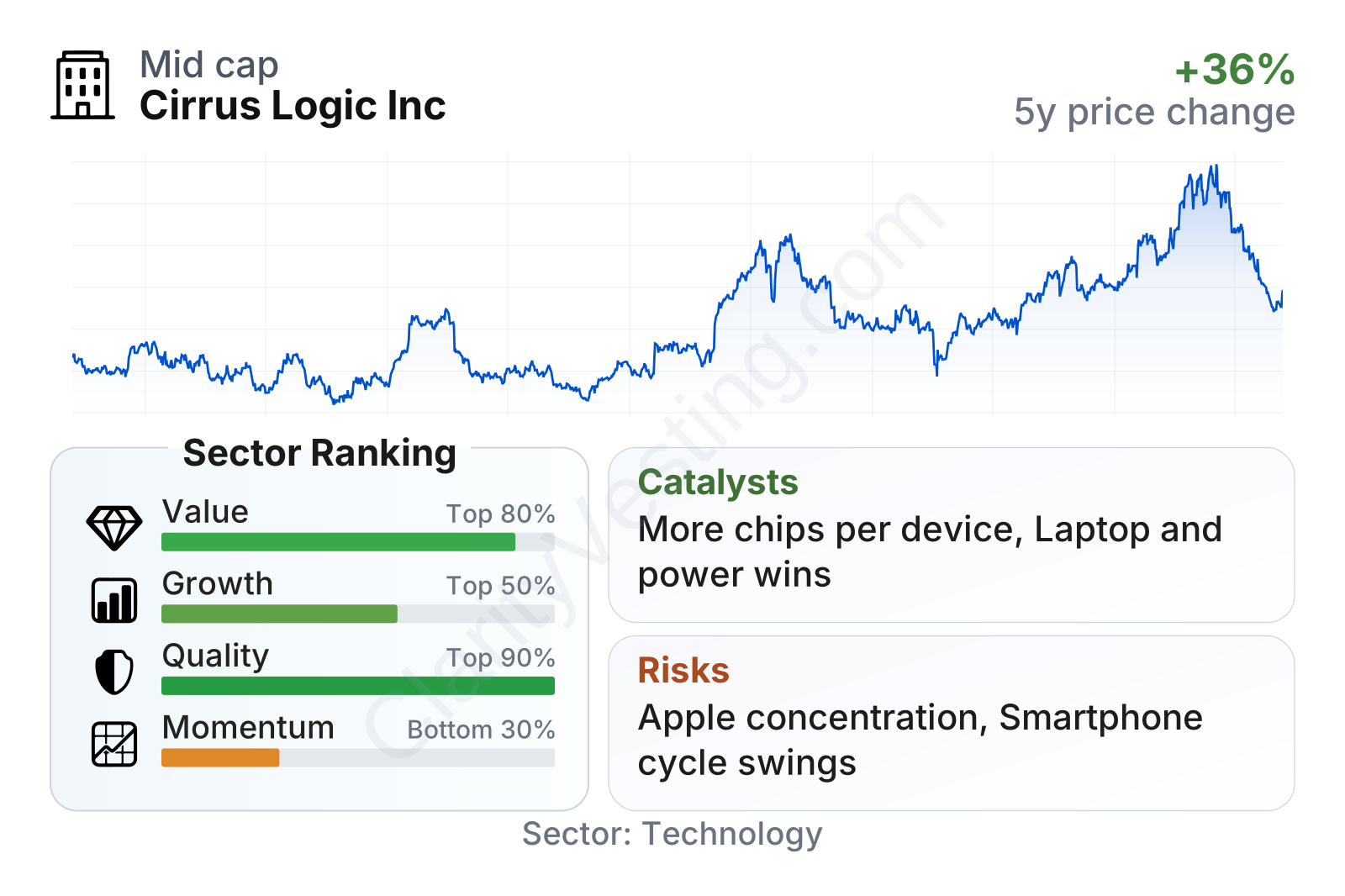
Cirrus Logic stands out on profitability, cash generation, and balance sheet strength. Returns on invested capital are well above the sector median, operating and profit margins are much stronger than typical semiconductor peers, and leverage is very low. The weaker areas are growth consistency and recent share-price momentum: revenue growth has recovered, but longer-term earnings growth has been uneven, and the stock has recently lagged the broader technology group despite a strong multi-year advance.
Growth
Cirrus Logic operates in a sector with attractive long-term demand drivers. Devices continue to require better audio quality, more efficient power management, richer user interfaces, and more compact chip integration. Even in a mature smartphone market, the amount of specialized silicon inside premium devices can still rise. That matters for Cirrus because its strategy is not based on unit volume alone; it is based on winning more content per device.
The company’s growth plan appears logically built around that idea. First, it aims to deepen its role inside existing flagship devices by expanding from audio into adjacent functions such as power conversion, camera-related control, sensing, and haptics. Second, it is trying to extend its technology into laptops and other portable electronics. For a company with a concentrated customer base, expanding the number of chips sold into each generation of products can be as important as winning entirely new customers.
Recent revenue growth has been volatile rather than smooth. The business went through a clear downcycle in 2023, then returned to positive growth and entered 2026 with year-over-year gains back in the low-teens range. That pattern fits the reality of consumer electronics exposure: demand can swing, but Cirrus has shown it can recover as customer launches and product mix improve.
Free cash flow has improved sharply over the last few years, rising from under $100 million in fiscal 2022 to well above $600 million by fiscal 2026 on a trailing basis. That is one of the strongest signals in the case. It suggests the company is not just reporting accounting profits, but is also turning them into cash while keeping capital intensity low because it uses external manufacturing partners.
A meaningful catalyst is the continued expansion of Cirrus content in premium mobile devices. Another is the broadening of mixed-signal products beyond legacy audio sockets. Management has also highlighted product areas such as laptop amplification, power technologies, and camera controllers as opportunities to enlarge its addressable market. In practical terms, each successful design win can raise revenue per device without requiring a major increase in industry unit shipments.
Recent company updates have also pointed to improving demand patterns and continued product engagement with major customers. That does not remove cyclicality, but it supports the idea that Cirrus is still relevant in next-generation device designs rather than simply harvesting older products.
Risks
This article is for informational purposes only and does not constitute financial advice. Some content is AI-generated. See Disclaimer


