Stock Analysis · Criteo Sa (CRTO)
Overview
Criteo is a digital advertising technology company that helps brands, retailers, and media owners buy and sell ads with a strong focus on commerce-related advertising. In simple terms, it uses data, software, and automated ad buying to show shoppers more relevant ads across the open internet, mobile apps, retail media networks, and connected TV. The company is best known for performance advertising, where advertisers pay to drive measurable results such as clicks, visits, or sales.
Its business has changed meaningfully over the last few years. Criteo used to be heavily associated with retargeting ads, but it has been repositioning itself as a broader commerce media platform. That matters because the digital ad market is evolving away from older cookie-based targeting toward retailer data, first-party customer information, and ad placements closer to the point of purchase.
Based on recent company disclosures, Criteo’s revenue mix is best understood through its main solution families rather than through many small product lines.
- Retail Media: approximately 35% to 40% of contribution ex-TAC in recent periods. This includes sponsored product ads and related retailer advertising tools used on retailer websites and apps.
- Performance Media: approximately 50% to 55%. This remains the largest activity and includes commerce-focused display, video, app, and other performance campaigns designed to generate sales or customer actions.
- Audience and other platform services: approximately 10% to 15%. This includes audience targeting, measurement, and other commerce media capabilities that support advertisers and retailers.
Criteo often emphasizes contribution ex-TAC rather than headline revenue. That measure removes traffic acquisition costs, which are payments to media owners or partners, and gives a clearer picture of the economics of the platform. Over time, the business mix has been shifting toward higher-quality revenue sources tied to software, retailer relationships, and commerce data.
The company’s cost structure also shows this transition. Gross profit has held up better than total revenue over the last several years, while research and development spending has remained substantial, reflecting continued investment in the platform. At the same time, profitability recovered after a weak 2022 and improved through 2024 and 2025, suggesting that the newer business mix has been more resilient than the older model.
The operating picture points to a business that is no longer expanding quickly at the top line, but is extracting better margins from a more focused model. That is an important distinction for long-term analysis: Criteo looks less like a high-growth ad disruptor and more like a specialized commerce advertising platform with improving discipline.
Key Figures
| Metric | Value | Sector ⓘ |
|---|---|---|
| Date | Jul 18, 2026 | |
| Context | ||
| Sector | Communication Services | |
| Industry | Advertising Agencies | |
| Market Cap ⓘ | $1.15B | |
| Beta ⓘ | 0.30 | |
Value (Cheapness) | ||
| P/E Ratio ⓘ | 10.77 | 19.52 |
| FCF Yield ⓘ | 15.51% | 12.73% |
| EBIT / EV ⓘ | 17.86% | 4.37% |
| PEG ⓘ | 0.89 | |
Growth (Business expansion) | ||
| Revenue Growth ⓘ | -5.90% | 6.10% |
| RPS Growth (5Y CAGR) ⓘ | 1.07% | 5.02% |
| EPS Growth (5Y CAGR) ⓘ | -29.52% | -26.68% |
| Margin Growth (5Y Trend) ⓘ | 3.63% | 0.79% |
| FCF Growth (5Y CAGR) ⓘ | 5.88% | 5.18% |
Quality (Business durability) | ||
| ROIC (Latest) ⓘ | 10.62% | 8.74% |
| ROIC (5Y Median) ⓘ | 11.03% | 8.07% |
| Net Debt / EBIT (Latest) ⓘ | -1.11 | 2.09 |
| Net Debt / EBIT (5Y Median) ⓘ | -2.48 | 3.02 |
| Operating Margin (Latest) ⓘ | 8.73% | 15.46% |
| Operating Margin (5Y Median) ⓘ | 6.92% | 13.17% |
| Debt to Equity (Latest) ⓘ | 11.80% | 59.09% |
| Profit Margin (Latest) ⓘ | 5.97% | 9.11% |
| Free Cash Flow (Latest) ⓘ | $178.66M | |
Momentum (Price trend) | ||
| 3Y Return ⓘ | -34.08% | +36.38% |
| 12M Return (excl. last month) ⓘ | -25.51% | +8.16% |
| 6M Return ⓘ | +9.71% | +2.31% |
| Price vs. 200-Day MA ⓘ | +16.09% | +1.57% |
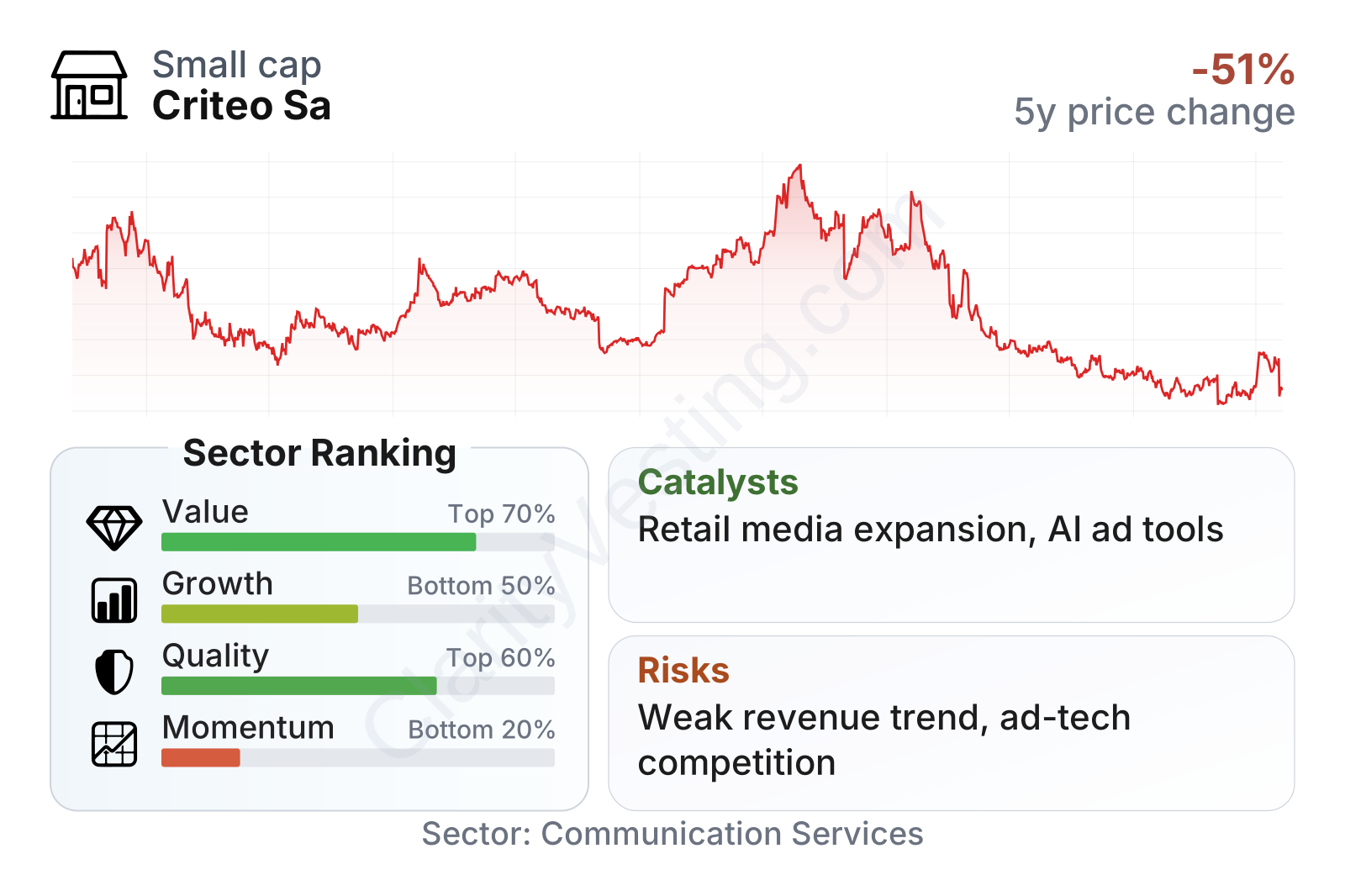
Criteo is a mid-sized company in its sector, and its share price history has been volatile. After trading above $40 in 2021, the stock fell sharply, recovered during 2024, and then moved back toward the high teens by early 2026. That uneven path fits a company whose business model has been undergoing a transition.
The latest metrics paint a mixed but understandable picture. Valuation appears light relative to the sector, with a P/E ratio well below the median and a strong free cash flow yield. Balance sheet quality stands out more clearly: debt is low, net cash is positive, and returns on invested capital are above the sector median. The weaker area is growth, where revenue trends and long-term per-share expansion have lagged many peers. Momentum is also still soft over longer periods despite a better short-term technical rebound.
Growth
The broader sector remains attractive over the long run. Digital advertising continues to take share from traditional channels, and within digital, spending is moving toward formats that are measurable, automated, and tied directly to transactions. Retail media is one of the most important parts of that shift because retailers now own valuable first-party shopping data and can monetize their digital properties more effectively. Criteo’s strategy is aligned with that direction.
The company’s push into commerce media and retail media makes strategic sense. Retailers increasingly want ad technology that helps them build their own advertising businesses, while brands want closed-loop measurement that connects ad spending to actual purchases. Criteo sits between those two groups and benefits if it can provide neutral infrastructure outside the largest closed ecosystems.
Another growth support is the company’s product breadth across the open internet. Many advertisers do not want to rely entirely on a few giant platforms. Criteo’s value proposition is that it can help them reach shoppers across many publishers, retailers, and devices while using commerce data to improve targeting and measurement.
That said, recent growth has been uneven. Revenue growth turned negative during the 2022 downturn, later stabilized, and then slipped again in the latest period. This suggests that the company is still in the middle of a transition rather than in a clean acceleration phase. The more encouraging point is that operational progress has been stronger than revenue growth alone would suggest.
Cash generation has generally remained solid, with trailing free cash flow still high by the standards of a company of this size even after coming down from a stronger 2025 level. That supports the idea that Criteo’s platform can produce meaningful cash despite modest top-line growth. For long-term analysis, this matters because it gives the company room to invest in product development, acquisitions, and shareholder returns without leaning heavily on debt.
A notable catalyst is the continued buildout of retail media networks by retailers around the world. As more merchants look to monetize on-site search, display placements, and shopper data, Criteo has an opportunity to deepen relationships and become part of the infrastructure layer behind those ad businesses. The company has also been expanding in newer channels such as connected TV and off-site retail media, which could enlarge the addressable market if adoption continues.
Recent company updates have also highlighted ongoing share repurchases and operational execution around profitability. While buybacks do not create demand for the core business, they can improve per-share economics if the business remains stable and cash generation stays healthy.
Risks
The biggest business risk is that Criteo operates in a highly competitive and rapidly changing advertising market. It does have real strengths, especially in commerce-focused advertising and relationships with retailers, but it is not the dominant global platform in digital ads. The industry’s power centers remain much larger companies with broader ecosystems, deeper data pools, and stronger control over consumer traffic.
Main competitors include large ad platforms such as Alphabet and Amazon, retail media and ad tech specialists such as The Trade Desk, and various retailer-owned ad offerings. Criteo’s position is more specialized: it is strongest where commerce intent, performance measurement, and retail media infrastructure intersect. That specialization is useful, but it also means the company must execute well in a narrower lane rather than relying on overall market dominance.
Its competitive advantage comes from commerce data assets, long-standing advertiser relationships, retailer integrations, and a platform built specifically around shopping outcomes. The company’s neutrality can also help because many retailers and brands prefer partners that are not trying to own the entire consumer ecosystem. Still, these advantages are practical rather than absolute; they can support retention and niche leadership, but they do not eliminate the pressure from much larger rivals.
Financial risk looks relatively low. Debt to equity has stayed close to 10% to 13% for several years, far below the sector median, and net debt relative to EBIT is negative, which points to a net cash position. This gives Criteo flexibility if advertising demand weakens or if it wants to keep investing through a soft market.
Profitability is more nuanced. Profit margin improved materially from the weak 2022-2023 period and moved above much of the sector during 2024 and 2025, but the latest reading is roughly in line with the sector median and still below some stronger peers on an operating margin basis. In other words, the recovery is real, yet it is not a clear sign of durable margin leadership.
Another important risk is industry dependence on privacy rules, platform policies, and measurement standards. Changes in browser behavior, mobile tracking restrictions, and data usage rules can all reshape ad performance and targeting economics. Criteo has already spent years adapting to this environment, but the ad tech industry remains exposed to rule changes that can alter campaign effectiveness and customer demand.
There is also execution risk in the strategic shift itself. If retail media growth slows, if retailers choose in-house tools, or if advertisers concentrate spending more heavily inside giant closed platforms, Criteo’s transition may not deliver the scale that management is targeting. The latest negative year-over-year revenue reading is a reminder that this remains a live issue rather than a solved one.
Valuation
Criteo currently screens as inexpensive on traditional earnings and cash flow measures compared with much of the Communication Services sector. The P/E ratio is around 11, well below the sector median near 19, and free cash flow yield is also stronger than the median. On an enterprise-value-to-EBIT basis, the discount looks even more pronounced.
The market’s caution appears tied less to balance sheet concerns and more to uncertainty around sustainable growth. Over the past few years, the valuation multiple has compressed sharply from much higher levels to single digits or low teens, reflecting lower enthusiasm about the speed of expansion and the company’s place in a competitive ad ecosystem. That lower multiple is understandable given the recent revenue softness and uneven stock performance.
At the same time, the current valuation does look supported by the company’s healthier financial profile. Criteo is profitable, generates solid cash flow, carries low leverage, and has improved margins from the trough period. A PEG ratio below 1 also suggests that the market is not assigning a demanding premium to the company’s earnings outlook. The central valuation question is therefore not whether the business is financially stressed, but whether the platform can resume steadier growth as retail media and commerce advertising develop further.
Viewed in context, the stock does not appear priced for a strong growth revival. It appears priced more like a stable but strategically debated platform. That leaves room for re-rating if execution improves, but it also explains why the discount persists.
Conclusion
Criteo stands out as a specialized digital advertising company that has moved beyond its old retargeting identity and is trying to anchor itself in the more durable parts of commerce media. The most encouraging elements are its low leverage, strong cash generation, improving profitability over the last two years, and its exposure to retail media, which remains one of the more attractive niches in digital advertising.
The main limitation is that this progress has not yet translated into consistently strong revenue growth. Criteo appears financially sturdier than the market gives it credit for, but strategically it still needs to prove that its newer platform can deliver sustained expansion rather than just better efficiency. That tension explains much of the current valuation discount.
Overall, the company looks more compelling on business quality and valuation support than on near-term growth momentum. The long-term picture is therefore tilted by execution: if Criteo keeps deepening its role in retail media and maintains healthy cash production, the current profile looks more resilient than the share price history suggests. If growth remains patchy, the stock may continue to be treated as a discounted ad tech name rather than a higher-confidence platform compounder.
Sources:
- Criteo S.A. — Form 10-K for fiscal year 2025
- Criteo S.A. — Form 10-Q for quarter ended March 31, 2026
- SEC EDGAR — Criteo S.A. filings database
- Criteo Investor Relations — Quarterly earnings materials and shareholder letters
- Criteo Investor Relations — Press releases on financial results and capital allocation
- Wikipedia — Criteo
This article is for informational purposes only and does not constitute financial advice. Some content is AI-generated. See Disclaimer