Stock Analysis · Corsair Gaming Inc (CRSR)
Stock Analysis · Corsair Gaming Inc (CRSR)

Overview

Corsair Gaming is a consumer hardware company focused on PC gaming, content creation, and live streaming. It sells branded equipment used by gamers, streamers, and performance-PC enthusiasts, including memory, PC components, gaming peripherals, and streaming gear. The company operates mainly through two reporting segments that cover most of its business: Gamer and Creator Peripherals, and Gaming Components and Systems.

Its revenue mix is fairly well defined in company reporting. Based on recent annual results, the largest sources of revenue are:

  • Gaming Components and Systems: about 66% of revenue. This includes high-performance memory, solid-state drives, power supply units, cooling products, PC cases, gaming monitors, custom gaming PCs, and gaming PC components.
  • Gamer and Creator Peripherals: about 34% of revenue. This includes gaming keyboards, mice, headsets, controllers, microphones, audio interfaces, streaming accessories, and software-related products tied to the Elgato, SCUF, Drop, and Corsair brands.

Corsair’s business model is relatively easy to understand: it designs and markets enthusiast-focused hardware under recognizable brands, then sells through online channels, retailers, distributors, and direct-to-consumer platforms. One important point for long-term readers is that much of the company’s business is tied to discretionary spending. People usually replace gaming gear and PC parts when they feel confident enough to upgrade, which can make demand swing more than it does for essential technology products.

The financial flow over the last several years shows a company that was much more profitable during the pandemic hardware boom, then went through a sharp reset as sales normalized. Revenue has recovered from the 2022 drop, and gross profit improved in 2025, but operating expenses have continued to absorb most of that improvement. In other words, Corsair has rebuilt sales faster than it has rebuilt durable profitability.

Key Figures

MetricValueSector
DateJul 18, 2026
Context
SectorTechnology
IndustryComputer Hardware
Market Cap $1.00B
Beta 1.85
Value
(Cheapness)
P/E Ratio 104.0031.76
FCF Yield 4.51%4.18%
EBIT / EV 1.59%2.56%
PEG N/A
Growth
(Business expansion)
Revenue Growth -4.10%13.50%
RPS Growth (5Y CAGR) -7.58%8.57%
EPS Growth (5Y CAGR) 14.15%-21.87%
Margin Growth (5Y Trend) N/A0.41%
FCF Growth (5Y CAGR) 39.34%9.76%
Quality
(Business durability)
ROIC (Latest) 3.20%8.54%
ROIC (5Y Median) -0.28%8.12%
Net Debt / EBIT (Latest) -6.520.38
Net Debt / EBIT (5Y Median) N/A0.38
Operating Margin (Latest) 1.18%9.58%
Operating Margin (5Y Median) -0.19%8.25%
Debt to Equity (Latest) 0.95%33.52%
Profit Margin (Latest) 0.49%6.96%
Free Cash Flow (Latest) $45.13M
Momentum
(Price trend)
3Y Return -43.97%+30.91%
12M Return (excl. last month) -6.81%+28.90%
6M Return +65.53%+5.38%
Price vs. 200-Day MA +41.07%+7.61%
Better than sector median
Slightly worse than sector median
More than 20% worse than sector median

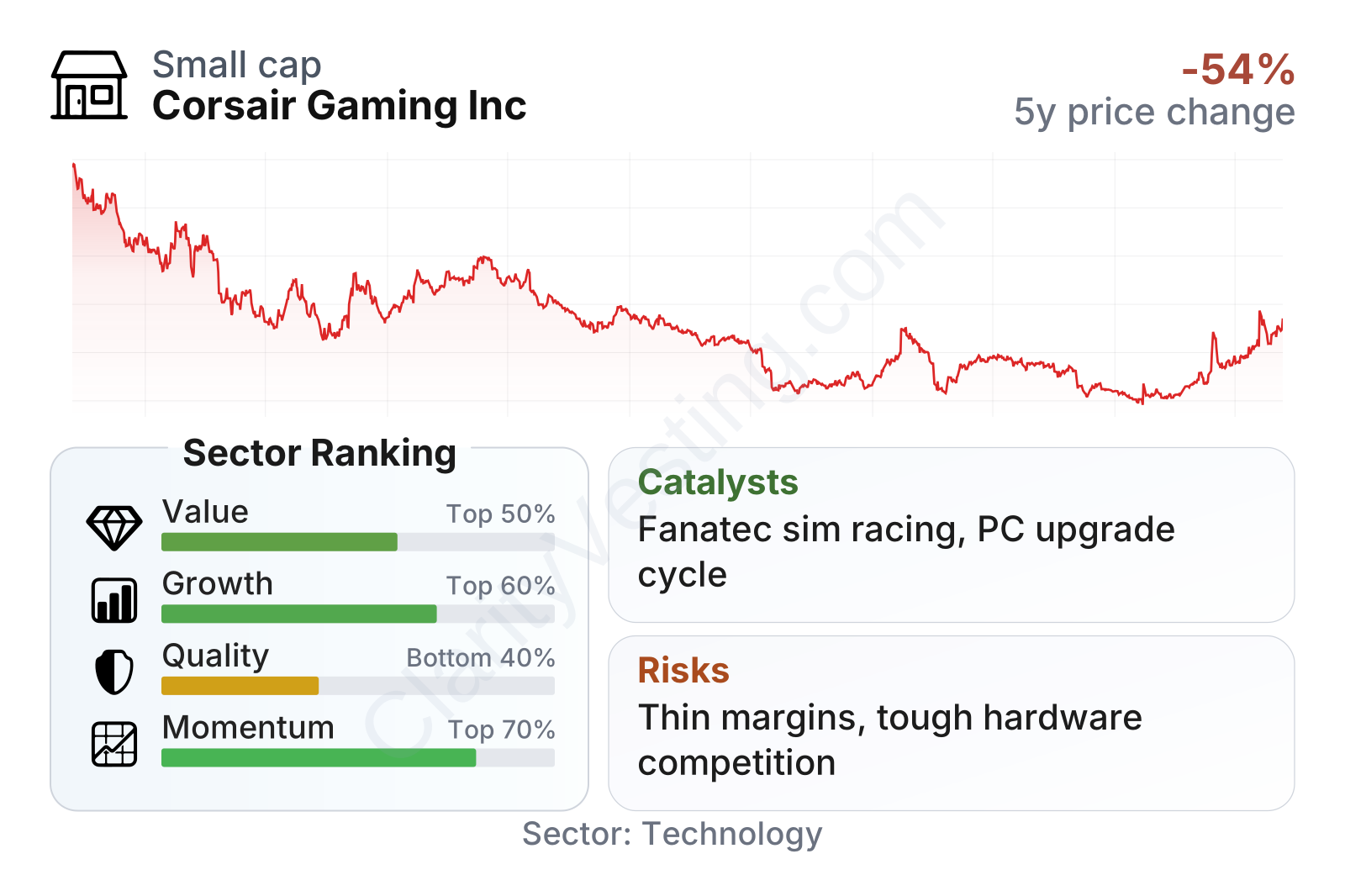
Corsair is a small-cap technology hardware company with above-average share price volatility, reflected in a beta near 1.9. The overall factor picture is mixed. Growth and cash generation look better than profitability, while quality metrics remain weak versus the broader technology sector. Value signals are also mixed: free cash flow yield is around the sector median, but earnings-based valuation looks stretched because profits are still very low. Momentum has improved recently after a long period of weak stock performance, which suggests the market has started to react to operational stabilization, but not yet to a full earnings recovery.

Growth

Corsair operates in markets that still have long-term relevance. PC gaming remains a large global category, and adjacent activities such as game streaming, creator tools, customized PCs, and premium accessories continue to attract spending. The broad sector is not a straight-line growth market every year, but the structural direction remains favorable: more users game on PC, more creators need audio and streaming equipment, and higher-performance hardware continues to support upgrades over time.

The company’s strategy also makes logical sense for future growth because it is built around an ecosystem rather than a single product. A Corsair customer may start with memory or a power supply, then later add a case, cooling system, keyboard, headset, microphone, or controller. That cross-selling potential matters because branded ecosystems can raise repeat purchases and improve shelf presence with retailers. The company has also broadened its reach through acquired and established brands such as Elgato, SCUF, and Drop, which give it access to creators, streamers, and enthusiast communities beyond traditional PC components.

Recent revenue trends show a business that has been trying to exit a long post-boom correction. After steep declines in 2022, sales improved through parts of 2023 and 2025, although the latest year-over-year reading has slipped slightly negative again, around 4%. That suggests demand recovery is real but not yet steady. Over a five-year view, revenue growth still trails the sector median, so the core question is not whether Corsair has growth exposure, but whether it can convert that exposure into sustained and less cyclical expansion.

One of the more encouraging signs is cash generation. Free cash flow turned strongly positive after the difficult 2022 period and has remained positive, even though the level has moved around from year to year. Over five years, free cash flow growth has been substantially stronger than the sector median. That matters because it suggests operational discipline, inventory normalization, and working-capital improvement have helped the company regain financial flexibility even before earnings margins have fully recovered.

A meaningful catalyst is the continued normalization of the PC upgrade cycle. Corsair is highly exposed to enthusiast demand, so a healthier environment for gaming components, custom builds, and premium peripherals could lift both sales and margins. Another potential growth driver is creator hardware and software-linked accessories through Elgato, where demand is tied not only to gaming but also to podcasting, streaming, and home content production. Management has also emphasized product refreshes and premium categories, which could help mix and pricing if execution improves.

Recent company communications in 2026 point more toward operational recovery than transformation. The opportunity appears to be a cleaner balance sheet, positive cash generation, and a business that could benefit if consumer demand for gaming and creator equipment continues to normalize. That is a credible setup, but it is still more of a recovery case than a high-visibility compounding machine at this stage.

Risks

The biggest risk is weak profitability. Corsair’s latest operating margin is a little above 1%, compared with roughly 10% for the sector median, and net profit margin is still only around 0.5%, far below typical technology peers. That means even modest cost pressure, discounting, or sales weakness can have an outsized effect on earnings. The company has shown that it can generate gross profit, but not yet that it can consistently turn that into strong bottom-line results.

Balance-sheet risk has improved sharply, which is a positive offset. Debt to equity has fallen from levels above 50% in 2021-2022 to roughly 1% recently, well below the sector median. Net debt relative to EBIT is also favorable because the company is currently in a net cash position. This does not eliminate business risk, but it reduces the chance that leverage becomes the main problem during a slower period.

Margin history remains a concern. Profitability fell deeply negative after the pandemic demand surge faded, and only recently moved back to slightly positive territory. The longer trend shows that Corsair is not yet operating with the kind of margin resilience seen in stronger hardware franchises. That makes the stock more dependent on execution improvements and better market conditions than on an already proven earnings engine.

Competition is intense across nearly every category. In gaming peripherals, Corsair competes with Logitech, Razer, SteelSeries, HyperX, and others. In components and systems, it faces brands such as ASUS, MSI, Cooler Master, NZXT, Kingston, G.Skill, Samsung, Western Digital, and numerous specialist PC hardware vendors. In streaming gear and creator tools, Elgato has a strong niche position, but it still competes with a wide range of audio, camera, and creator-equipment brands.

Corsair does have competitive advantages, but they are narrower than those of the largest industry leaders. Its brand portfolio is well known among PC enthusiasts, especially in memory, power supplies, cases, cooling, and streaming accessories. Elgato is particularly valuable because it has strong recognition in creator hardware. However, Corsair is not the clear overall leader across the full gaming hardware market. Logitech has greater scale in peripherals, and several larger electronics companies have broader distribution, stronger margins, or deeper research budgets. Corsair’s edge is best described as a strong enthusiast brand ecosystem rather than dominant market leadership.

There is no widely reported recent public scandal or reputational event that stands out as a major red flag from official disclosures. The more important risk is execution: inventory management, product mix, promotional intensity, and consumer demand swings can all affect results quickly. The company is also exposed to tariffs, sourcing concentration in Asia, retailer relationships, and foreign exchange effects, all of which are common but meaningful risks for a global hardware supplier.

Valuation

Valuation looks complicated rather than obviously cheap or obviously expensive. On earnings, the stock appears expensive: the current price-to-earnings ratio is above 100, versus a sector median around 30. That usually signals either an overstretched valuation or, in Corsair’s case, a company with depressed earnings where even a modest share price creates a very high multiple. Because profit margins are still near break-even, the P/E ratio is not the cleanest way to judge the business right now.

Cash-flow-based measures are more balanced. Free cash flow yield is slightly above the sector median, which suggests the company is not richly priced if cash generation remains intact. At the same time, EBIT relative to enterprise value is below the sector median, pointing to weaker operating profitability than many peers. Put simply, the market is not valuing Corsair like a high-quality compounder, but it also is not giving it full credit for a major earnings recovery.

The current price seems to reflect a business in transition: cleaner finances, recovering demand, and positive cash flow on one side; thin margins, inconsistent growth, and heavy competition on the other. That creates a valuation profile that depends heavily on whether Corsair can convert its brand strength and category exposure into sustainably better operating margins. Without that margin improvement, the stock can look statistically inexpensive on some measures while still being fundamentally demanding.

Conclusion

Corsair remains an understandable business with recognizable brands, exposure to PC gaming and creator equipment, and a much healthier balance sheet than it had a few years ago. Those are meaningful positives, especially for a company that has already gone through a painful post-pandemic reset. The return of positive free cash flow and the sharp reduction in leverage show that the business has regained some financial stability.

The challenge is that stability has not yet turned into strong profitability. Revenue has recovered unevenly, margins are still far below sector norms, and Corsair operates in categories where competition is relentless and customer demand can be cyclical. That leaves the company in a middle ground: stronger than it looked during the downturn, but not yet proven as a consistently efficient earnings business.

Overall, Corsair currently looks more like a recovering enthusiast-hardware franchise with real brand value than a fully established long-term quality leader. The company’s position is improving, but the valuation case still rests heavily on margin repair and steadier execution rather than on an already demonstrated record of durable high returns.

Sources:

  • U.S. Securities and Exchange Commission (SEC) — Corsair Gaming, Inc. Annual Report on Form 10-K for fiscal year 2025
  • U.S. Securities and Exchange Commission (SEC) — Corsair Gaming, Inc. Quarterly Report on Form 10-Q for quarter ended March 31, 2026
  • Corsair Gaming Investor Relations — Earnings Release for First Quarter 2026
  • Corsair Gaming Investor Relations — Annual Reports and SEC Filings
  • Wikipedia — Corsair Gaming

This article is for informational purposes only and does not constitute financial advice. Some content is AI-generated. See Disclaimer


Sign up for exclusive research and insights.

Unsubscribe anytime.
