Stock Analysis · Crocs Inc (CROX)
Stock Analysis · Crocs Inc (CROX)

Overview

Crocs, Inc. is a footwear company best known for its colorful molded clogs, but the business is broader than that simple image suggests. The company designs, markets, and sells casual footwear and accessories through wholesale partners, company-operated stores, e-commerce sites, and third-party digital marketplaces. Its portfolio is centered on two brands: the core Crocs brand and HEYDUDE, a more casual lightweight shoe label acquired in late 2021.

For long-term analysis, the most important point is that Crocs is not a diversified apparel giant. It is a focused footwear company whose performance depends heavily on brand strength, product relevance, pricing power, and inventory discipline. That focus has worked well when demand is strong, because the business has historically converted a large portion of sales into cash.

The company’s revenue mix is dominated by the Crocs brand, with HEYDUDE as the second pillar. Based on recent annual reporting, the approximate revenue split is:

  • Crocs brand: roughly 70% to 75% of total revenue
  • HEYDUDE brand: roughly 25% to 30% of total revenue

Within those brands, Crocs also benefits from a balanced channel mix. Direct-to-consumer sales, especially digital, are strategically important because they usually carry higher margins and provide more control over the customer relationship, while wholesale remains useful for broad reach and brand visibility.

The multi-year earnings flow shows a business that expanded strongly from 2021 through 2024, with gross profit rising faster than cost of revenue. The more recent picture is less comfortable: 2025 shows a sharp drop in operating income and a swing to a net loss, largely because expenses rose much faster than sales. That contrast is central to understanding the stock today: Crocs still has a powerful brand engine, but recent execution has been much less clean than in prior years.

Key Figures

MetricValueSector
DateJul 18, 2026
Context
SectorConsumer Cyclical
IndustryFootwear & Accessories
Market Cap $6.81B
Beta 1.55
Value
(Cheapness)
P/E Ratio N/A18.58
FCF Yield 9.84%7.99%
EBIT / EV 1.56%5.91%
PEG 1.39
Growth
(Business expansion)
Revenue Growth -1.70%5.50%
RPS Growth (5Y CAGR) 19.70%9.20%
EPS Growth (5Y CAGR) -30.94%-26.43%
Margin Growth (5Y Trend) -25.64%-0.18%
FCF Growth (5Y CAGR) 6.56%5.02%
Quality
(Business durability)
ROIC (Latest) 3.95%12.03%
ROIC (5Y Median) 32.73%10.82%
Net Debt / EBIT (Latest) 12.002.12
Net Debt / EBIT (5Y Median) 1.782.25
Operating Margin (Latest) 3.30%9.28%
Operating Margin (5Y Median) 24.86%9.64%
Debt to Equity (Latest) 120.88%75.23%
Profit Margin (Latest) -2.58%5.28%
Free Cash Flow (Latest) $670.66M
Momentum
(Price trend)
3Y Return +7.69%+10.68%
12M Return (excl. last month) +23.30%+5.26%
6M Return +65.20%-2.41%
Price vs. 200-Day MA +44.43%+1.55%
Better than sector median
Slightly worse than sector median
More than 20% worse than sector median

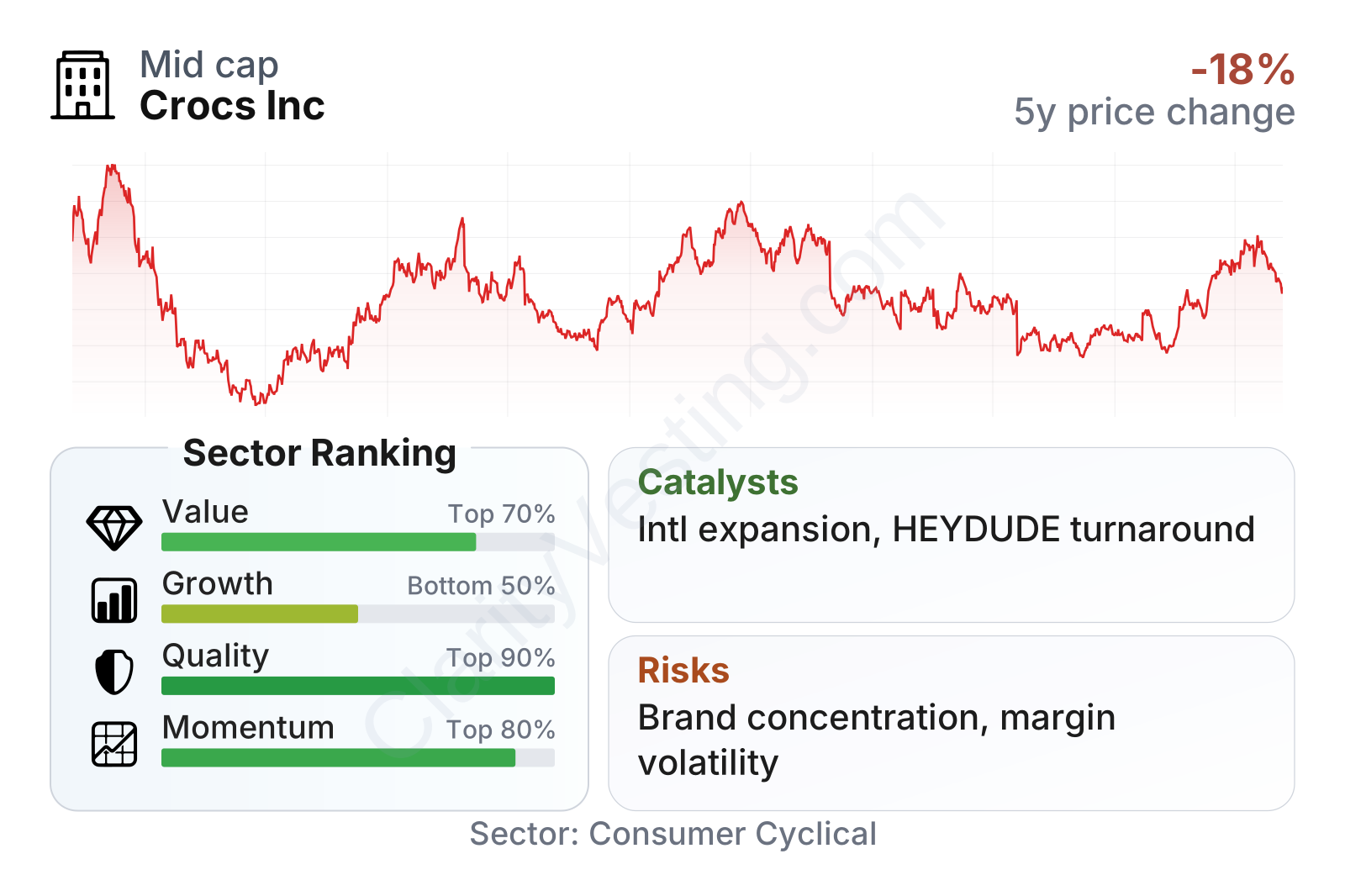
Crocs sits in the mid-cap range, with a market value a little above $6 billion, and the shares have shown above-average volatility, reflected in a beta around 1.6. The broader picture from the latest metrics is mixed. Cash generation remains a real strength, and longer-term revenue growth is still better than much of the sector. However, recent profitability and balance-sheet measures are weaker than they used to be, which explains why the company no longer screens as consistently strong across all categories.

The stock’s trading pattern also shows this split personality. Over several years, the share price has delivered gains, but the path has been uneven, with large drawdowns and rebounds. More recently, momentum has improved versus much of the sector, suggesting the market has started to recognize some stabilization, even though the operating picture is not yet fully back to prior levels.

Growth

Crocs operates in a large and still relevant segment of the consumer market: casual footwear with strong brand identity, comfort positioning, and growing digital influence. This is not a fast-changing technology field, but it is a category where durable brands can keep growing for years through new styles, international expansion, personalization, and repeat purchases. Comfort footwear also tends to benefit from a broad demographic appeal, which gives Crocs access to children, teens, adults, and lifestyle consumers rather than a narrow niche.

The company’s strategy broadly makes sense for long-term expansion. Management has emphasized brand building, international growth, product extensions beyond the classic clog, and direct-to-consumer channels. Crocs has also leaned heavily on collaborations and limited-edition launches, which help keep the brand culturally visible and support premium pricing. That model has already shown it can travel internationally, and the Crocs brand in particular still appears to have room to deepen penetration outside the United States.

Revenue growth has clearly cooled after the exceptional post-pandemic surge. The business moved from very high double-digit gains in 2021 and 2022 to low single-digit growth and then slight declines more recently. That does not automatically mean the brand has peaked, but it does mean Crocs is now in a harder phase where growth has to come from execution rather than momentum alone. The more encouraging point is that over a five-year view, revenue per share growth remains well ahead of the sector median, showing that the company did build substantial scale before the recent slowdown.

Free cash flow remains one of the main reasons the company continues to attract attention. Even after coming down from its peak, trailing free cash flow is still substantial, at roughly two-thirds of a billion dollars. That matters because cash can be used to reduce debt, support buybacks, invest in marketing, and improve resilience during softer periods. In consumer brands, strong cash generation often matters as much as accounting earnings, and Crocs still looks meaningfully better on that front than its recent net income line alone would suggest.

A major catalyst is the possibility of operational normalization after the difficult 2025 period. If HEYDUDE stabilizes, if selling expenses come back under control, and if Crocs continues to defend its core brand margins, the earnings base could recover faster than headline revenue suggests. The company has also continued to highlight international opportunity and product diversification, both of which can help offset slower growth in mature categories.

Recent company communications have also pointed to continued focus on debt reduction, brand investment, and improving the mix toward stronger channels and geographies. For a consumer business, that is the right playbook: protect the brand, preserve cash, and rebuild profitability before chasing aggressive expansion.

Risks

The main risk is that Crocs is still a brand-driven fashion business, even if it sells comfort footwear. Consumer tastes can change quickly, and a company with a concentrated product identity always faces the danger of losing relevance. The classic clog has proven far more durable than many expected, but concentration remains a structural issue. If demand cools or collaborations lose impact, growth can flatten quickly.

Another major concern is HEYDUDE. The acquisition added scale and diversification, but it also introduced execution risk and debt. Recent results suggest this second brand has not performed as smoothly as originally hoped. If HEYDUDE continues to lag, Crocs could remain dependent on one standout brand while still carrying the integration and financing consequences of the acquisition.

Leverage is better than the stressed levels seen after the acquisition period, but it is still elevated relative to the sector. Debt-to-equity is now around 120%, above the industry median, even though it has improved materially from prior peaks. That trend shows progress, but it also means the balance sheet is not as forgiving as that of some competitors if demand weakens again or if margins stay under pressure.

Profitability has become the most visible financial warning sign. Crocs had unusually strong margins for several years, well above typical sector levels, but that advantage has reversed sharply in the latest period, with trailing profit margin turning negative. The longer-term record still shows a business capable of excellent economics, yet the recent drop indicates that those economics are not untouchable. For a consumer brand company, a sudden margin compression often reflects a mix of discounting, weaker sell-through, higher operating costs, or brand-specific problems.

On competition, Crocs does have real advantages. Its brand is distinctive, globally recognized, hard to confuse with rivals, and supported by high-visibility collaborations. It also has scale in a niche where brand personality matters more than pure performance specs. That said, it is not the overall leader in global footwear. Giants such as Nike, Adidas, Skechers, Deckers, Birkenstock, and VF’s footwear brands compete for shelf space, online attention, and consumer wallet share. In casual comfort footwear specifically, Crocs is one of the most recognizable names, but the broader market remains crowded and highly promotional.

The competitive comparison is therefore nuanced. Crocs is stronger than many smaller footwear labels in branding efficiency and cash conversion, but weaker than the largest global players in diversification. It can outperform when its core products resonate, yet it has fewer buffers if one brand stumbles.

There is also a reputational and demand risk tied to trend sensitivity. Crocs has successfully turned an initially polarizing design into mainstream appeal, but that same unconventional image means sentiment can shift sharply. No major scandal stands out as the defining recent issue; the more relevant risk has been operational underperformance and margin deterioration rather than governance drama.

Valuation

Crocs’ valuation is harder to read than usual because the earnings base has become distorted. Historically, the shares often traded at a price-to-earnings ratio below the sector median, and for much of the past few years the market applied a discount despite strong profitability and cash generation. That discount reflected concerns about fashion risk, the HEYDUDE acquisition, and leverage.

At the moment, the usual P/E lens is less dependable because trailing earnings have been hit so hard that the ratio has become unstable. That is why cash-flow-based measures are especially useful here. On free cash flow yield, Crocs still looks stronger than the sector median, which suggests the market is not giving full credit to the company’s cash production. At the same time, weaker operating profit and higher debt justify part of that skepticism.

In simple terms, the stock does not appear richly valued relative to the company’s own history as a high-margin cash generator, but it also is not obviously cheap if the recent earnings pressure proves more than temporary. The present valuation seems to reflect a market that still believes in the Crocs brand, while assigning caution to HEYDUDE, margin recovery, and leverage. That makes the current price easier to defend if profitability rebounds, and harder to defend if the weaker trend persists.

Conclusion

Crocs remains an unusual public company: a focused footwear brand with a history of exceptional margins, strong cash generation, and a product that has shown much more staying power than critics expected. The core Crocs brand still looks like a genuine asset, supported by global recognition, channel flexibility, and continued room for international and category expansion.

The challenge is that the clean investment picture of earlier years has become more complicated. Revenue growth has slowed sharply, profit margins have deteriorated, net income has turned negative on a trailing basis, and the balance sheet still carries above-average leverage. HEYDUDE, which was supposed to strengthen the platform, has instead become a key source of uncertainty.

That leaves Crocs in a position where the business quality is best judged through two lenses at once: the proven earnings power of the core brand, and the recent evidence that execution can deteriorate quickly. The market is not treating the company like a premium consumer compounder, and that restraint makes sense given the volatility in results. Even so, Crocs still stands out as a company with stronger underlying brand economics than its latest headline earnings imply, provided the recent weakness turns out to be a difficult phase rather than a lasting reset.

Sources:

  • Crocs, Inc. – Form 10-K for fiscal year 2025, filed in 2026
  • Crocs, Inc. – Form 10-Q for quarter ended March 31, 2026
  • Crocs, Inc. – SEC EDGAR company filings
  • Crocs, Inc. Investor Relations – earnings releases and presentations published in 2026
  • Crocs, Inc. Investor Relations – company-hosted earnings call materials published in 2026
  • Wikipedia – Crocs basic company history and brand overview

This article is for informational purposes only and does not constitute financial advice. Some content is AI-generated. See Disclaimer


Sign up for exclusive research and insights.

Unsubscribe anytime.
