Stock Analysis · Salesforce.com Inc (CRM)
Overview
Salesforce.com is one of the largest business software companies in the world. Its core product is customer relationship management, usually shortened to CRM, which helps companies track sales leads, manage customer service, run marketing campaigns, analyze data, and increasingly automate work with artificial intelligence. In simple terms, Salesforce sells software that helps businesses organize customer-facing activities in one place.
The company mainly operates through cloud-based subscriptions, which means customers usually pay recurring fees rather than making a one-time purchase. That business model tends to create stable and visible revenue. Over time, Salesforce has expanded from its original sales software into a broad platform that includes service, marketing, commerce, data integration, analytics, and app-building tools. Its strategy is to become a central system for customer data and workflow across large organizations.
Based on Salesforce’s latest fiscal year reporting for 2026, revenue is overwhelmingly subscription and support driven, with a much smaller contribution from professional services and other activities. Within subscriptions, the biggest product families are the company’s customer service, sales, platform, and marketing-related offerings.
- Subscription and support: roughly 94% to 95% of total revenue
- Professional services and other: roughly 5% to 6% of total revenue
By major cloud category, approximate revenue weight is commonly led by:
- Service Cloud: about one-quarter of total revenue
- Sales Cloud: about one-fifth
- Platform and Other: about one-fifth
- Marketing and Commerce: roughly mid-teens
- Data: roughly around a tenth
- Integration and Analytics: single-digit percentages each
What stands out in Salesforce’s financial structure is how much of each sales dollar remains after direct delivery costs. Gross profit has stayed very high while operating income has improved sharply over the last several years, showing a company that is no longer focused only on scale, but also on turning scale into stronger earnings and cash generation.
Key Figures
| Metric | Value | Sector ⓘ |
|---|---|---|
| Date | Jul 18, 2026 | |
| Context | ||
| Sector | Technology | |
| Industry | Software - Application | |
| Market Cap ⓘ | $139.86B | |
| Beta ⓘ | 1.18 | |
Value (Cheapness) | ||
| P/E Ratio ⓘ | 20.00 | 31.76 |
| FCF Yield ⓘ | 10.48% | 4.18% |
| EBIT / EV ⓘ | 5.96% | 2.56% |
| PEG ⓘ | 0.72 | |
Growth (Business expansion) | ||
| Revenue Growth ⓘ | 13.30% | 13.50% |
| RPS Growth (5Y CAGR) ⓘ | 12.41% | 8.57% |
| EPS Growth (5Y CAGR) ⓘ | -8.90% | -21.87% |
| Margin Growth (5Y Trend) ⓘ | 25.43% | 0.41% |
| FCF Growth (5Y CAGR) ⓘ | 28.49% | 9.76% |
Quality (Business durability) | ||
| ROIC (Latest) ⓘ | 11.18% | 8.54% |
| ROIC (5Y Median) ⓘ | 7.26% | 8.12% |
| Net Debt / EBIT (Latest) ⓘ | 3.22 | 0.38 |
| Net Debt / EBIT (5Y Median) ⓘ | 0.86 | 0.38 |
| Operating Margin (Latest) ⓘ | 23.88% | 9.58% |
| Operating Margin (5Y Median) ⓘ | 17.21% | 8.25% |
| Debt to Equity (Latest) ⓘ | 122.34% | 33.52% |
| Profit Margin (Latest) ⓘ | 18.73% | 6.96% |
| Free Cash Flow (Latest) ⓘ | $14.66B | |
Momentum (Price trend) | ||
| 3Y Return ⓘ | -23.68% | +30.91% |
| 12M Return (excl. last month) ⓘ | -40.41% | +28.90% |
| 6M Return ⓘ | -26.50% | +5.38% |
| Price vs. 200-Day MA ⓘ | -17.69% | +7.61% |
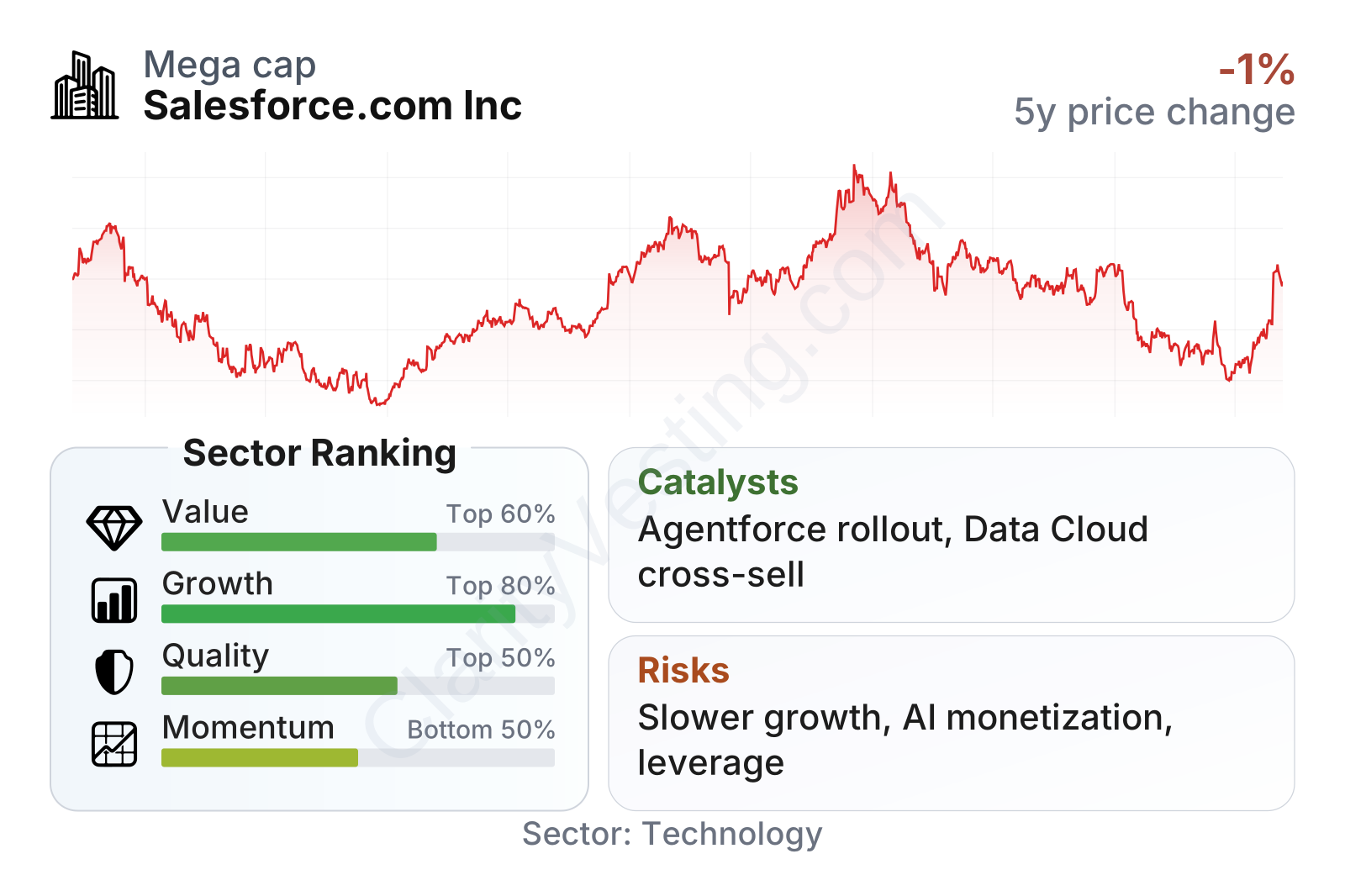
Salesforce remains a very large software company, with a market value above $120 billion, but its recent profile is mixed. On one side, profitability, cash generation, and multi-year operating improvement rank well against much of the software sector. On the other, recent share price momentum has been weak, meaning the market has become more cautious even as the business itself has become financially stronger. The combination of a lower earnings multiple than the sector median and a notably high free cash flow yield suggests the stock is no longer priced like a high-expectation software name.
Growth
Salesforce operates in a sector with favorable long-term demand. Businesses continue moving customer data, support operations, sales tracking, and marketing tools into cloud software. That trend is mature in some areas, but it still has room to deepen because companies increasingly want one connected platform rather than many disconnected tools. This is where Salesforce still has a clear strategic logic: it already sits at the center of many enterprise workflows, and that position can support additional products over time.
Growth has slowed from the exceptional pace seen several years ago, which is normal for a company of Salesforce’s size. Even so, recent year-over-year revenue growth has reaccelerated into the low teens, roughly in line with or slightly above the sector median. For a business already producing more than $40 billion in annual revenue, that remains a meaningful expansion rate.
The more important change is the quality of that growth. Salesforce has improved operating discipline while still investing heavily in research and development. That matters because long-term compounding is usually stronger when revenue growth is matched by rising margins and growing cash flow rather than growth alone.
Free cash flow is one of the clearest strengths in the story. It has climbed from roughly $5 billion a few years ago to well above $14 billion on a trailing basis, a pace far ahead of many software peers. This gives Salesforce room to invest in new products, pursue targeted acquisitions, reduce debt pressure over time, and return capital to shareholders without depending on outside financing.
A major catalyst is artificial intelligence. Salesforce has been embedding AI features across its platform through products such as Einstein and Agentforce, with a focus on automating sales, service, and back-office tasks using customer data already stored in Salesforce systems. That approach is important because many AI tools struggle to deliver value without access to trusted business data and established workflows. Salesforce already has both. Recent company updates have emphasized early customer adoption of AI agents and a broader push to position the platform as a system where data, applications, and automation work together.
Another support for future growth is the company’s broad installed base among large enterprises. Once multiple departments rely on Salesforce, the switching cost tends to rise. That does not guarantee fast growth, but it can support steady expansion through cross-selling and price increases, especially when new capabilities are tied directly to productivity gains.
Risks
The biggest risk is competition. Salesforce is a leader in CRM software, but it does not operate alone. Microsoft, Oracle, SAP, HubSpot, Adobe, ServiceNow, and many specialized software vendors all compete in different parts of its product stack. Microsoft is especially important because it combines business applications, cloud infrastructure, productivity software, and AI tools in one ecosystem. ServiceNow is also becoming more relevant as workflow automation expands beyond traditional CRM boundaries.
Salesforce still has real competitive advantages. It has scale, a large customer base, a well-known brand, deep partner relationships, and a broad set of integrated products. In traditional CRM, it remains one of the best-known global leaders. The challenge is that leadership in classic CRM does not automatically guarantee leadership in every adjacent software category or in AI-driven enterprise automation. The company needs to keep proving that its platform can stay central as software buying patterns evolve.
Another risk is execution. Salesforce has grown through both internal development and acquisitions, including large deals in the past. Integrating many products into a coherent platform is harder than selling a single application. If customers see the portfolio as too complex, or if AI offerings do not translate into measurable business value, growth could remain moderate rather than accelerate.
The balance sheet deserves attention as well. Historically, debt relative to equity had been moderate and below the sector median, but the most recent reading shows a sharp jump. That may reflect accounting or capital structure changes rather than simple operational stress, yet it still makes leverage worth monitoring closely. Net debt relative to EBIT also sits above the sector median, which limits some of the flexibility that the company’s strong cash flow would otherwise suggest.
Profitability, however, helps offset part of that concern. Profit margin has improved dramatically from low single digits a few years ago to high teens recently, well above the sector median. That is an encouraging sign because stronger margins can absorb slower growth periods and support debt management if needed.
There is also a market-perception risk. Salesforce’s recent stock performance has been much weaker than the broader software group, which suggests investors have questioned either the pace of future growth or the durability of enthusiasm around enterprise software and AI monetization. Weak momentum does not change the business overnight, but it often means the company will need several quarters of solid execution to rebuild confidence.
From a governance and reputation standpoint, the recent backdrop appears more stable than during earlier periods of activist pressure and management reshuffling. Current attention is centered more on whether management can balance cost discipline with innovation rather than on any major scandal or operational breakdown.
Valuation
Salesforce’s valuation looks more restrained than what investors often associate with large software companies. Its current price-to-earnings ratio is below the sector median, whereas in earlier years the stock frequently traded at a much richer multiple. That shift reflects a company moving from a high-expectation growth story toward a more mature software platform with stronger profitability and somewhat slower expansion.
On fundamentals, the valuation has some support. Free cash flow yield is strong, operating margins are far above the sector median, and multi-year free cash flow growth has been impressive. The PEG ratio also points to a less demanding valuation relative to growth than is often seen in large software names. In other words, the stock does not appear priced for perfection.
The key question is whether today’s lower multiple is a sign of opportunity created by caution, or a fair reflection of a business whose best growth years are behind it. Given Salesforce’s size, it is unrealistic to expect the rapid expansion of a smaller software company. But if AI-related products deepen customer usage and revenue growth stays in the low-teens range while margins remain strong, the current valuation looks easier to justify than it did during prior periods when the stock traded at much higher earnings multiples.
At the same time, the market is clearly discounting some uncertainty. Competitive pressure, the need to prove AI monetization, and the recent deterioration in share-price momentum all help explain why the stock trades more modestly than many investors may remember.
Conclusion
Salesforce today looks less like a pure high-growth software story and more like a large, highly profitable enterprise platform that is trying to convert its dominant customer relationships into a new wave of AI-enabled growth. That is a meaningful change. Revenue growth is no longer exceptional, but it remains healthy for a company of this scale, and the financial profile has improved substantially, especially in margins and cash generation.
The company’s main strengths are its entrenched position in enterprise CRM, recurring revenue model, broad product portfolio, and rising free cash flow. Those qualities make the business more resilient than many software peers. The main challenges are equally clear: competition is intense, execution around AI has to translate into real customer spending, and the balance sheet now deserves closer scrutiny than it did before.
Overall, Salesforce appears to be in a stronger business position than its recent stock weakness might suggest. The market seems to be treating it as a slower, more mature software company, yet the company is still expanding, generating substantial cash, and pushing into one of the most important technology themes in enterprise software. That creates a profile with credible long-term strengths, but one that depends much more on disciplined execution than on simple market enthusiasm.
Sources:
- Salesforce, Annual Report on Form 10-K for fiscal year ended January 31, 2026
- Salesforce Investor Relations, Quarterly Results and Shareholder Letters released in 2026
- SEC EDGAR, Salesforce.com, Inc. filings in 2026 including 10-K and 10-Q submissions
- Salesforce Investor Relations, Company presentations and product update materials on AI and Agentforce published in 2026
- Wikipedia, Salesforce basic company history and business overview
This article is for informational purposes only and does not constitute financial advice. Some content is AI-generated. See Disclaimer


