Stock Analysis · Carters Inc (CRI)
Overview
Carter’s, Inc. is a children’s apparel company focused mainly on babies and young children. Its best-known brands are Carter’s, OshKosh B’gosh, Little Planet, and Skip Hop. The business designs, sources, markets, and sells clothing, sleepwear, accessories, and some related products for children. It reaches customers through its own stores, its e-commerce sites, and wholesale relationships with major retailers.
The company’s revenue is concentrated in North American children’s apparel, with the Carter’s brand clearly dominating the mix. Based on recent annual reporting, the main sources of revenue are approximately:
- U.S. Retail: about 43% — sales through company-operated stores and U.S. e-commerce sites, mainly under the Carter’s and OshKosh brands.
- U.S. Wholesale: about 39% — sales to large retail partners and department stores, including branded products sold through third-party locations.
- International: about 16% — operations in Canada and Mexico plus international wholesale, franchise, and distributor activity.
- Other: about 2% — smaller activities such as Skip Hop and licensing-related revenue where applicable.
This structure makes Carter’s less dependent on a single selling channel, but still heavily tied to consumer demand for children’s essentials in the United States. One positive feature of the category is that parents continue buying for growing children even in weaker economies, although spending can shift toward promotions and lower-priced options.
The company’s recent financial flow shows a business that still generates solid gross profit, but with much tighter earnings than a few years ago. Revenue has fallen from its 2021 peak, while operating costs — especially selling, general, and administrative expenses — have taken a larger share of sales, putting pressure on profitability.
Key Figures
| Metric | Value | Sector ⓘ |
|---|---|---|
| Date | Sep 12, 2026 | |
| Context | ||
| Sector | Consumer Cyclical | |
| Industry | Apparel Retail | |
| Market Cap ⓘ | $1.12B | |
| Beta ⓘ | 0.83 | |
Value (Cheapness) | ||
| P/E Ratio ⓘ | 5.64 | 17.10 |
| FCF Yield ⓘ | 26.23% | 8.53% |
| EBIT / EV ⓘ | 16.99% | 6.46% |
| PEG ⓘ | 2.01 | |
Growth (Business expansion) | ||
| Revenue Growth ⓘ | 5.20% | 5.75% |
| RPS Growth (5Y CAGR) ⓘ | 0.22% | 9.14% |
| EPS Growth (5Y CAGR) ⓘ | -51.28% | -18.21% |
| Margin Growth (5Y Trend) ⓘ | -9.19% | -0.23% |
| FCF Growth (5Y CAGR) ⓘ | -26.16% | 4.91% |
Quality (Business durability) | ||
| ROIC (Latest) ⓘ | 8.16% | 12.61% |
| ROIC (5Y Median) ⓘ | 17.03% | 10.72% |
| Net Debt / EBIT (Latest) ⓘ | 1.91 | 2.10 |
| Net Debt / EBIT (5Y Median) ⓘ | 2.51 | 2.32 |
| Operating Margin (Latest) ⓘ | 9.35% | 9.25% |
| Operating Margin (5Y Median) ⓘ | 11.19% | 9.64% |
| Debt to Equity (Latest) ⓘ | 115.32% | 75.78% |
| Profit Margin (Latest) ⓘ | 6.55% | 5.33% |
| Free Cash Flow (Latest) ⓘ | $293.01M | |
Momentum (Price trend) | ||
| 3Y Return ⓘ | -49.53% | +14.53% |
| 12M Return (excl. last month) ⓘ | +62.02% | +3.08% |
| 6M Return ⓘ | -10.24% | +0.55% |
| Price vs. 200-Day MA ⓘ | -15.33% | -0.54% |
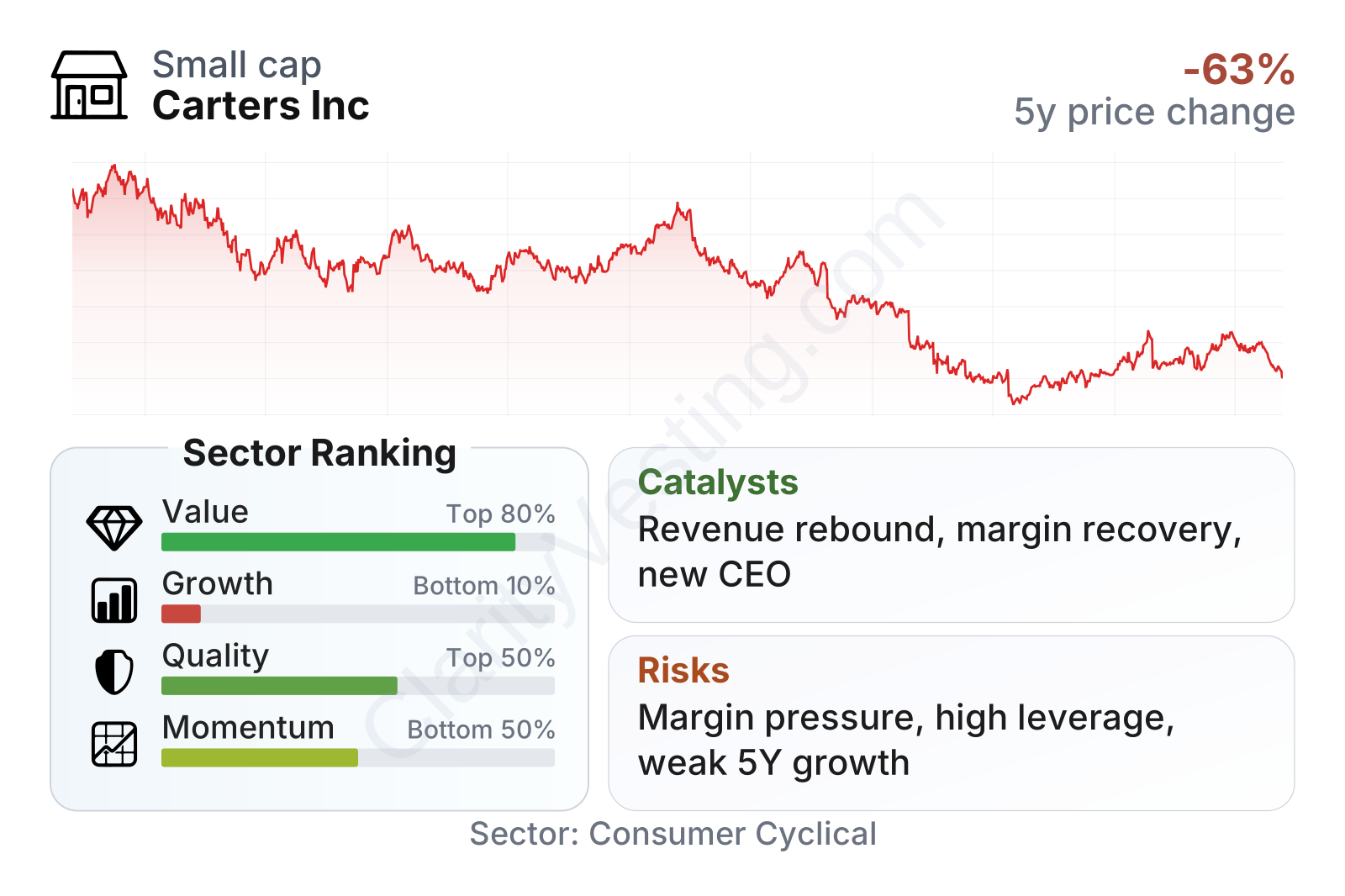
Carter’s is a mid-sized public company with a stock-market value around the low billions of dollars and a beta below 1, which suggests its shares have historically moved somewhat less violently than the broader market. On valuation, cash generation, and operating earnings relative to enterprise value, the company sits around or slightly better than the sector median. The weaker area is growth and business quality: recent margins, returns on capital, and debt burden are less favorable than many peers, even though short-term share-price momentum has improved from very depressed levels.
Growth
The children’s apparel market is not a high-growth industry, but it is a durable one. Demand is supported by recurring needs: babies and young children outgrow clothing quickly, and categories such as bodysuits, pajamas, and basics tend to be replenished regularly. That gives Carter’s a steadier demand base than many fashion retailers that depend heavily on changing trends.
Carter’s growth strategy is centered more on execution than disruption. Management has emphasized brand strength, pricing architecture, better inventory discipline, and a stronger digital and omnichannel approach. The company also continues to work through wholesale partnerships that give it broad national distribution, while using direct-to-consumer channels to protect brand presentation and customer relationships.
Recent sales trends show an important change: after several quarters of contraction, year-over-year revenue has moved back into positive territory, with the latest growth rate running around 8%. That rebound matters because the longer-term record is still weak. Over five years, revenue per share has been nearly flat, which means Carter’s still needs to prove that the recent improvement is the start of a more durable recovery rather than a short-term reset.
Cash generation remains a meaningful support for the business, but it has clearly cooled. Free cash flow is still positive and in the low hundreds of millions of dollars on a trailing basis, yet it has declined materially from the stronger levels seen in 2024. For a mature apparel company, this is a key point: the business does not need explosive growth, but it does need dependable cash flow to support operations, debt service, and capital returns.
A practical catalyst for Carter’s is any sustained improvement in margin after a period of cost pressure. If the company can combine modest top-line growth with cleaner inventories, fewer markdowns, and better expense control, earnings can recover faster than revenue. Another possible tailwind is channel mix: direct-to-consumer sales usually offer better economics than wholesale when executed well, even if they require more operating investment.
Recent company communications have also highlighted leadership transition and strategic review efforts. That can create an opportunity if new leadership sharpens execution, simplifies the brand portfolio, and restores consistency in merchandising and cost management. For a company in a stable but slow-moving category, better execution can matter more than aggressive expansion plans.
Risks
This article is for informational purposes only and does not constitute financial advice. Some content is AI-generated. See Disclaimer


