Stock Analysis · Credo Technology Group Holding Ltd (CRDO)
Overview
Credo Technology Group Holding Ltd designs high-speed connectivity products used to move data inside and between large computing systems. In simple terms, its chips, chiplets, cables, and software help servers, switches, and data centers send information faster while using less power. That makes the company closely tied to major infrastructure themes such as artificial intelligence, cloud computing, and the upgrade of data center networks to higher speeds.
According to the company’s latest annual filing for fiscal 2026, Credo organizes its business into two main product families: products and intellectual property licensing. In practice, the business is heavily driven by product sales, especially solutions used in high-speed Ethernet and active electrical cable connections for data centers.
The main revenue sources are approximately:
- Product revenue: about 98% — This includes integrated circuits, chiplets, active electrical cables, and related connectivity solutions used in data center and networking infrastructure.
- IP licensing revenue: about 2% — This comes from licensing Credo’s serializer/deserializer and related technology to other chipmakers and system companies.
Within product revenue, public disclosures indicate that data center connectivity is the dominant end market, while customer concentration remains high. The business model is built around selling components that help customers handle rising bandwidth needs without excessive power consumption, a useful value proposition as AI clusters and cloud networks scale up.
Another important point for long-term readers is how quickly the financial structure has changed. Over the last few years, Credo moved from losses and modest revenue to much larger sales, sharply higher gross profit, and strong operating income. Research and development spending has also risen substantially, showing that management is still investing heavily even as profitability has improved.
The financial flow shows a business that has scaled rapidly: revenue and gross profit expanded dramatically between fiscal 2025 and fiscal 2026, while operating expenses grew much more slowly than sales. That shift explains the recent jump in operating and net income.
Key Figures
| Metric | Value | Sector ⓘ |
|---|---|---|
| Date | Sep 12, 2026 | |
| Context | ||
| Sector | Technology | |
| Industry | Semiconductors | |
| Market Cap ⓘ | $30.13B | |
| Beta ⓘ | 3.23 | |
Value (Cheapness) | ||
| P/E Ratio ⓘ | 56.45 | 29.51 |
| FCF Yield ⓘ | 1.46% | 4.25% |
| EBIT / EV ⓘ | 1.16% | 2.85% |
| PEG ⓘ | N/A | |
Growth (Business expansion) | ||
| Revenue Growth ⓘ | 114.70% | 15.40% |
| RPS Growth (5Y CAGR) ⓘ | 76.30% | 8.56% |
| EPS Growth (5Y CAGR) ⓘ | 120.03% | -11.88% |
| Margin Growth (5Y Trend) ⓘ | N/A | 0.46% |
| FCF Growth (5Y CAGR) ⓘ | N/A | 9.80% |
Quality (Business durability) | ||
| ROIC (Latest) ⓘ | 31.59% | 9.44% |
| ROIC (5Y Median) ⓘ | -4.31% | 8.30% |
| Net Debt / EBIT (Latest) ⓘ | -2.40 | 0.54 |
| Net Debt / EBIT (5Y Median) ⓘ | N/A | 0.44 |
| Operating Margin (Latest) ⓘ | 35.61% | 9.58% |
| Operating Margin (5Y Median) ⓘ | -10.22% | 8.25% |
| Debt to Equity (Latest) ⓘ | 0.76% | 33.33% |
| Profit Margin (Latest) ⓘ | 33.83% | 7.14% |
| Free Cash Flow (Latest) ⓘ | $438.60M | |
Momentum (Price trend) | ||
| 3Y Return ⓘ | +941.21% | +45.48% |
| 12M Return (excl. last month) ⓘ | +113.88% | +23.48% |
| 6M Return ⓘ | +46.05% | +20.93% |
| Price vs. 200-Day MA ⓘ | -7.36% | +7.43% |
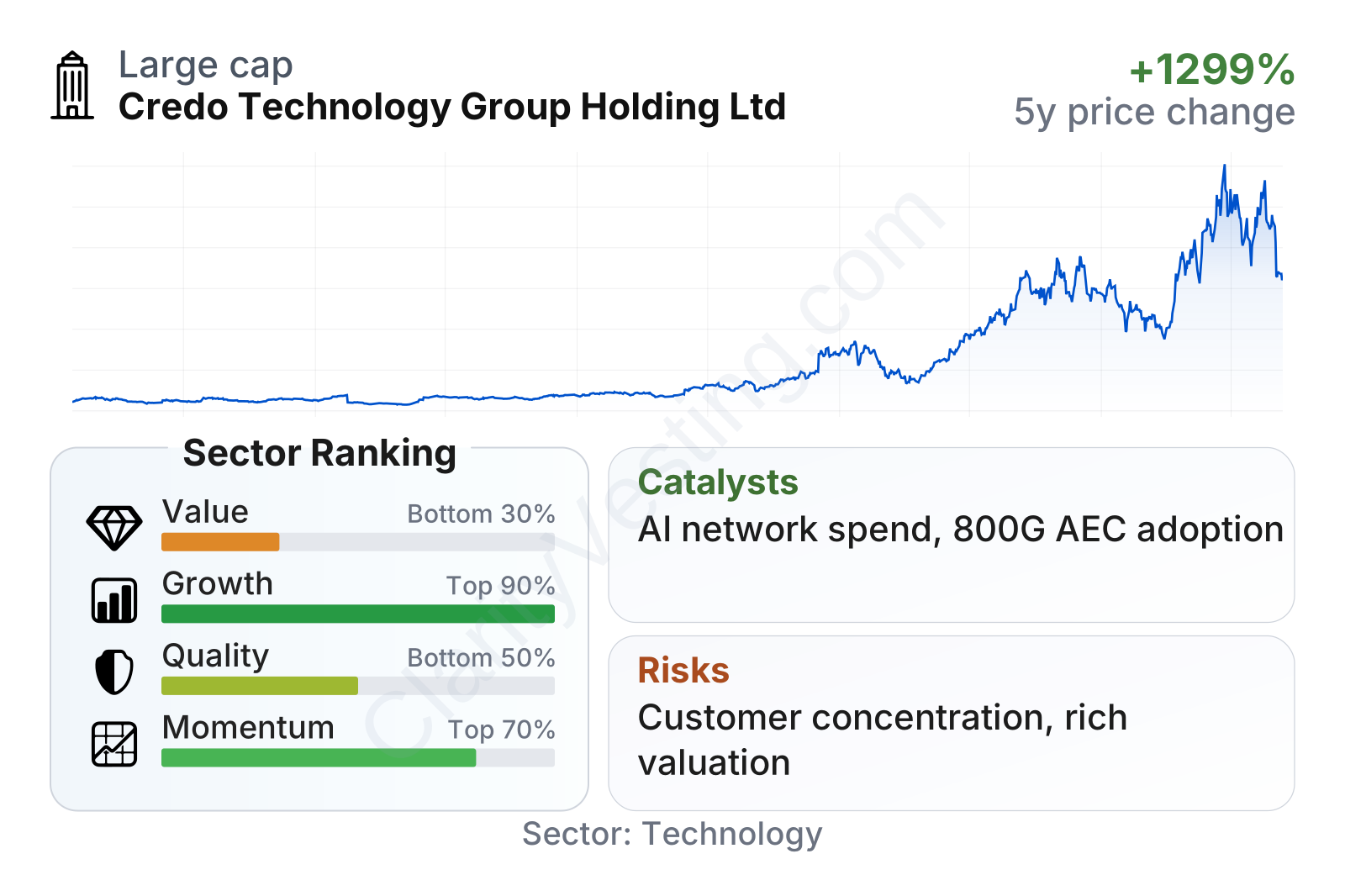
Credo is now a large semiconductor company by market value, but it still behaves like a fast-scaling growth business rather than a mature chip company. The table points to a mixed profile: growth ranks near the top of the sector, momentum is also strong over multi-year periods, while valuation looks demanding and quality is more nuanced. Profitability and returns on capital are currently very strong, but the longer historical record is less smooth because the company only recently crossed into sustained profitability. The balance sheet stands out positively, with extremely low leverage and net cash rather than heavy debt.
Growth
Credo operates in one of the strongest areas of the semiconductor market: high-speed connectivity for data centers. This is a growing segment because AI workloads require more networking bandwidth, more switching capacity, and more efficient ways to connect servers and accelerators. As computing systems become larger and denser, power efficiency matters more, and that directly matches Credo’s positioning.
The company’s strategy also appears coherent. Rather than trying to compete across the entire semiconductor landscape, Credo focuses on a narrower but important problem: moving data quickly with lower power and high signal integrity. That focus has allowed it to build a recognizable position in active electrical cables, retimers, optical DSP-related connectivity, and chiplet/IP solutions. These are not consumer gadgets with short-lived trends; they are infrastructure components tied to long investment cycles in cloud and AI networks.
Revenue growth has been exceptionally strong, although not perfectly linear. After a weaker period in 2023 and early 2024, growth reaccelerated sharply and then remained well above typical semiconductor sector levels through 2025 and into 2026. Even with some moderation from the peak, year-over-year expansion is still very high, which suggests demand has been driven by a real infrastructure buildout rather than a small one-time rebound.
Cash generation has improved just as clearly. Free cash flow was negative in earlier periods, briefly hovered around break-even, and then turned strongly positive by 2026. That matters because it shows the company is no longer just growing revenue on paper; it is increasingly converting that growth into cash.
A major catalyst is the continued migration to 400G, 800G, and eventually even faster network links inside AI and cloud data centers. Credo has repeatedly highlighted demand related to hyperscale customers and AI-oriented infrastructure. Its latest fiscal 2026 filing also showed a major jump in business scale, with annual revenue rising to more than $1.3 billion from roughly $437 million the year before. That kind of increase is unusually large even in a strong semiconductor cycle and suggests that the company is capturing share in a fast-expanding niche.
Recent company communications in 2026 also pointed to expanding deployments of active electrical cables and broader high-speed connectivity programs. If AI cluster spending remains elevated, Credo has a clear path to participate through both component content per system and wider customer adoption.
Risks
This article is for informational purposes only and does not constitute financial advice. Some content is AI-generated. See Disclaimer


