Stock Analysis · Chongqing Rural Commercial Bank Co Ltd (CRCBY)
Overview
Chongqing Rural Commercial Bank Co Ltd is a regional commercial bank based in Chongqing, China. It focuses on traditional banking activities: taking deposits, making loans, serving small businesses and rural customers, and offering payment, settlement, wealth management, and other financial services. Despite the “rural commercial” name, it is a large banking institution with a broad presence in Chongqing and a meaningful role in financing local households, agriculture, private enterprises, and infrastructure-related activity.
Like most banks, its revenue is mainly driven by the spread between what it earns on loans and investments and what it pays on deposits and other funding. Public filings typically group revenue into interest-based income and non-interest income rather than consumer-style product categories. Based on the bank’s reported structure, the main sources of revenue are approximately:
- Net interest income: about 75% to 90% of total operating income in most periods. This includes interest earned on corporate loans, retail loans, interbank assets, and investment securities, minus interest paid on deposits and wholesale funding.
- Fees and commissions: about 5% to 10%. This usually includes bank card services, settlement and clearing, agency services, wealth management-related services, and custody or intermediary fees.
- Investment and trading-related income: about 5% to 15%. This can include gains from financial investments, changes in fair value, and other market-related banking income.
- Other operating income: typically a low-single-share contribution. This may include foreign exchange-related items and miscellaneous banking services.
The business model is straightforward: gather deposits at scale, lend carefully, and earn steady income from the local economy. That makes the bank easier to understand than many diversified financial groups, but it also means results are closely tied to credit quality, loan demand, local economic conditions, and regulation in China’s banking system.
The profit flow over recent years shows a generally stable pattern: revenue and operating income have trended upward, and net income has also grown, although some line items appear volatile because bank reporting classifications can shift from one year to another. The broader message is that profitability has held up better than many readers might expect from a low-valued bank stock.
Key Figures
| Metric | Value | Sector ⓘ |
|---|---|---|
| Date | Oct 31, 2026 | |
| Context | ||
| Sector | Financial Services | |
| Industry | Banks - Regional | |
| Market Cap ⓘ | $8.86B | |
| Beta ⓘ | 0.12 | |
Value (Cheapness) | ||
| P/E Ratio ⓘ | 5.34 | 12.20 |
| P/B Ratio ⓘ | 0.00 | 1.26 |
| FCF Yield ⓘ | 216.12% | 9.87% |
| Dividend Yield ⓘ | 5.90% | 2.87% |
| EBIT / EV ⓘ | N/A | 8.17% |
| PEG ⓘ | N/A | |
Growth (Business expansion) | ||
| Revenue Growth ⓘ | 7.50% | 8.40% |
| RPS Growth (5Y CAGR) ⓘ | 156.98% | 12.31% |
| EPS Growth (5Y CAGR) ⓘ | -26.60% | -4.03% |
| BVPS Growth (5Y CAGR) ⓘ | 180.01% | 4.96% |
| Margin Growth (5Y Trend) ⓘ | 7.15% | -4.14% |
| FCF Growth (5Y CAGR) ⓘ | -19.49% | 4.70% |
| DPS Growth (5Y CAGR) ⓘ | 193.00% | 8.85% |
Quality (Business durability) | ||
| ROIC (Latest) ⓘ | N/A | 9.35% |
| ROE (Latest) ⓘ | 9.32% | 13.95% |
| ROA (Latest) ⓘ | 0.73% | 1.57% |
| ROIC (5Y Median) ⓘ | 3.81% | 7.78% |
| ROE (5Y Median) ⓘ | 9.47% | 12.12% |
| ROA (5Y Median) ⓘ | 0.78% | 1.28% |
| Net Debt / EBIT (Latest) ⓘ | N/A | 0.99 |
| Net Debt / EBIT (5Y Median) ⓘ | 5.00 | 0.73 |
| Net Debt / EBITDA (Latest) ⓘ | 31.74 | 0.79 |
| Operating Margin (Latest) ⓘ | N/A | 22.61% |
| Operating Margin (5Y Median) ⓘ | 46.30% | 24.52% |
| Debt to Equity (Latest) ⓘ | 373.42% | 58.76% |
| Profit Margin (Latest) ⓘ | 52.24% | 26.18% |
| Free Cash Flow (Latest) ⓘ | $19.14B | |
Momentum (Price trend) | ||
| 3Y Return ⓘ | +174.23% | +95.34% |
| 12M Return (excl. last month) ⓘ | +7.26% | +16.22% |
| 6M Return ⓘ | +2.25% | +7.41% |
| Price vs. 200-Day MA ⓘ | +9.88% | +5.48% |
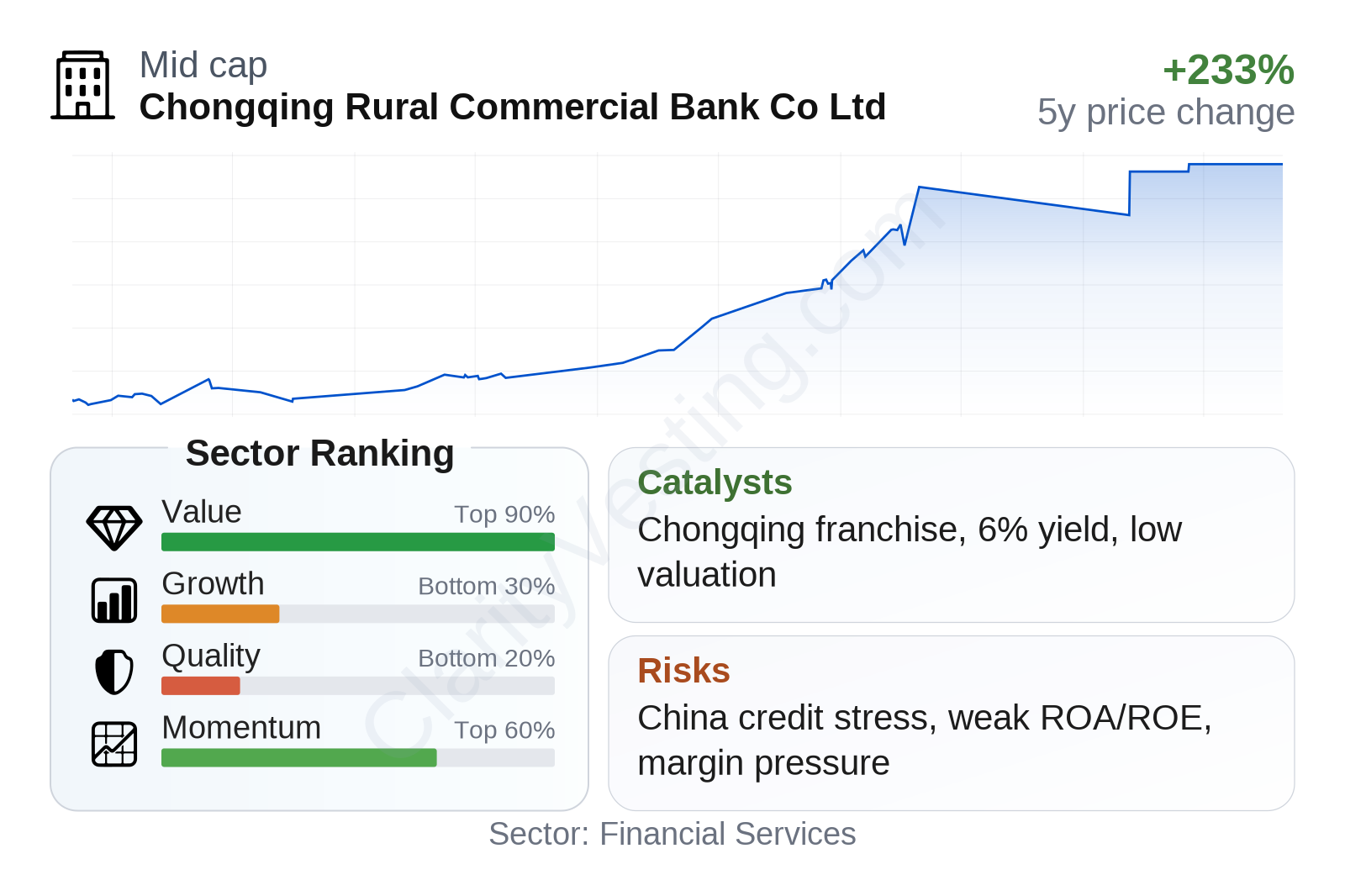
Several metrics stand out immediately. The bank screens as very cheap compared with the regional banking sector, with a price-to-earnings ratio near 5 versus a sector median closer to 13, and a dividend yield around 6%, roughly double the sector median. Momentum has also been positive over the longer period, with the stock well above its level from late 2021, although shorter-term performance has been calmer. On the other hand, quality metrics are weaker than many peers: return on equity is around 9% and return on assets around 0.7%, both below sector medians. In short, the market is assigning a very low valuation to a bank that remains profitable and income-generative, but not especially strong on efficiency or returns.
Growth
Banking in China is not a high-growth sector in the same way as software or semiconductors, but it remains essential. A bank such as Chongqing Rural Commercial Bank can still grow through loan expansion, deeper penetration of local retail and business customers, and better cross-selling of fee-based products. Its position in Chongqing matters here: the city is one of western China’s largest economic centers, and continued urbanization, manufacturing activity, logistics, and public investment can support long-term demand for banking services.
The bank’s strategy also makes sense for steady expansion rather than rapid transformation. It has a strong local franchise, a large deposit base, and a role in rural finance and small-business lending that can create sticky customer relationships. For a regional bank, this kind of embedded position is often more valuable than headline growth, because it can protect funding and support loan origination over time.
Earnings progression has been mixed rather than smooth. Annual earnings per share rose strongly from 2021 through 2024, then fell in 2025, which suggests that growth is sensitive to margin pressure, provisioning, or accounting movements rather than being consistently compounding every year. That makes it important to view this bank as a cyclical financial institution, not a linear earnings machine.
Book value per share has risen strongly over the multi-year period, which is important for banks because book value is a core anchor for measuring balance-sheet accumulation. Even allowing for what looks like an unusually large jump in the latest reading, the broader trend points to capital growth over time. That helps explain why the valuation looks so compressed relative to the balance sheet.
A practical catalyst is the combination of stable profitability, balance-sheet growth, and a still-low valuation. Another one is income distribution: the trailing dividend yield remains elevated versus many banking peers. If operating conditions in China’s regional banking system become less pressured, even modest improvement in sentiment could matter because the starting valuation is already unusually depressed. Recent market performance, with the stock holding above its long-term levels and above its 200-day average, suggests this re-rating process has at least partly started, even if the pace has been uneven.
Risks
This article is for informational purposes only and does not constitute financial advice. Some content is AI-generated. See Disclaimer