Stock Analysis · Capri Holdings Ltd (CPRI)
Overview
Capri Holdings is a global luxury fashion group that owns three well-known brands: Versace, Jimmy Choo, and Michael Kors. The company designs, markets, and sells handbags, footwear, apparel, accessories, and some licensed products. Its business reaches customers through company-operated stores, e-commerce, wholesale partners such as department stores and specialty retailers, and licensing arrangements.
For long-term analysis, the key point is that Capri is not a diversified consumer conglomerate. It is a focused luxury group whose results depend mainly on how strongly these three brands resonate with shoppers, how well stores perform, and whether management can protect pricing and brand desirability in a very competitive market.
Based on the company’s recent annual reporting, revenue is primarily split by brand, with Michael Kors remaining by far the largest contributor.
- Michael Kors: about 69% of revenue. This includes handbags, small leather goods, footwear, ready-to-wear, watches, and accessories sold through retail, wholesale, and digital channels.
- Versace: about 17% of revenue. This business is centered on high-end fashion, leather goods, footwear, accessories, and apparel.
- Jimmy Choo: about 14% of revenue. This brand focuses on luxury footwear, handbags, and accessories.
Geographically, Capri has meaningful exposure to the Americas, Europe, and Asia, with the Americas still representing the largest market. That gives the company global reach, but it also means performance can be affected by shifts in tourism, consumer confidence, foreign exchange, and demand trends in luxury spending across regions.
The recent financial flow shows a business that still generates a strong gross profit base, but one where operating expenses have absorbed a much larger share of revenue than they did several years ago. Revenue has also fallen materially from earlier peak levels, which explains why profitability has become much thinner.
Key Figures
| Metric | Value | Sector ⓘ |
|---|---|---|
| Date | Sep 12, 2026 | |
| Context | ||
| Sector | Consumer Cyclical | |
| Industry | Luxury Goods | |
| Market Cap ⓘ | $1.58B | |
| Beta ⓘ | 1.38 | |
Value (Cheapness) | ||
| P/E Ratio ⓘ | 16.54 | 17.10 |
| FCF Yield ⓘ | 5.26% | 8.53% |
| EBIT / EV ⓘ | 4.34% | 6.46% |
| PEG ⓘ | 0.16 | |
Growth (Business expansion) | ||
| Revenue Growth ⓘ | -3.50% | 5.75% |
| RPS Growth (5Y CAGR) ⓘ | -5.97% | 9.14% |
| EPS Growth (5Y CAGR) ⓘ | -49.32% | -18.21% |
| Margin Growth (5Y Trend) ⓘ | -14.92% | -0.23% |
| FCF Growth (5Y CAGR) ⓘ | -60.46% | 4.91% |
Quality (Business durability) | ||
| ROIC (Latest) ⓘ | 12.78% | 12.61% |
| ROIC (5Y Median) ⓘ | 6.94% | 10.72% |
| Net Debt / EBIT (Latest) ⓘ | 10.74 | 2.10 |
| Net Debt / EBIT (5Y Median) ⓘ | 12.01 | 2.32 |
| Operating Margin (Latest) ⓘ | 3.45% | 9.25% |
| Operating Margin (5Y Median) ⓘ | 3.08% | 9.64% |
| Debt to Equity (Latest) ⓘ | 1008.70% | 75.78% |
| Profit Margin (Latest) ⓘ | 4.44% | 5.33% |
| Free Cash Flow (Latest) ⓘ | $83.00M | |
Momentum (Price trend) | ||
| 3Y Return ⓘ | -73.60% | +14.53% |
| 12M Return (excl. last month) ⓘ | -20.74% | +3.08% |
| 6M Return ⓘ | -24.06% | +0.55% |
| Price vs. 200-Day MA ⓘ | -29.33% | -0.54% |
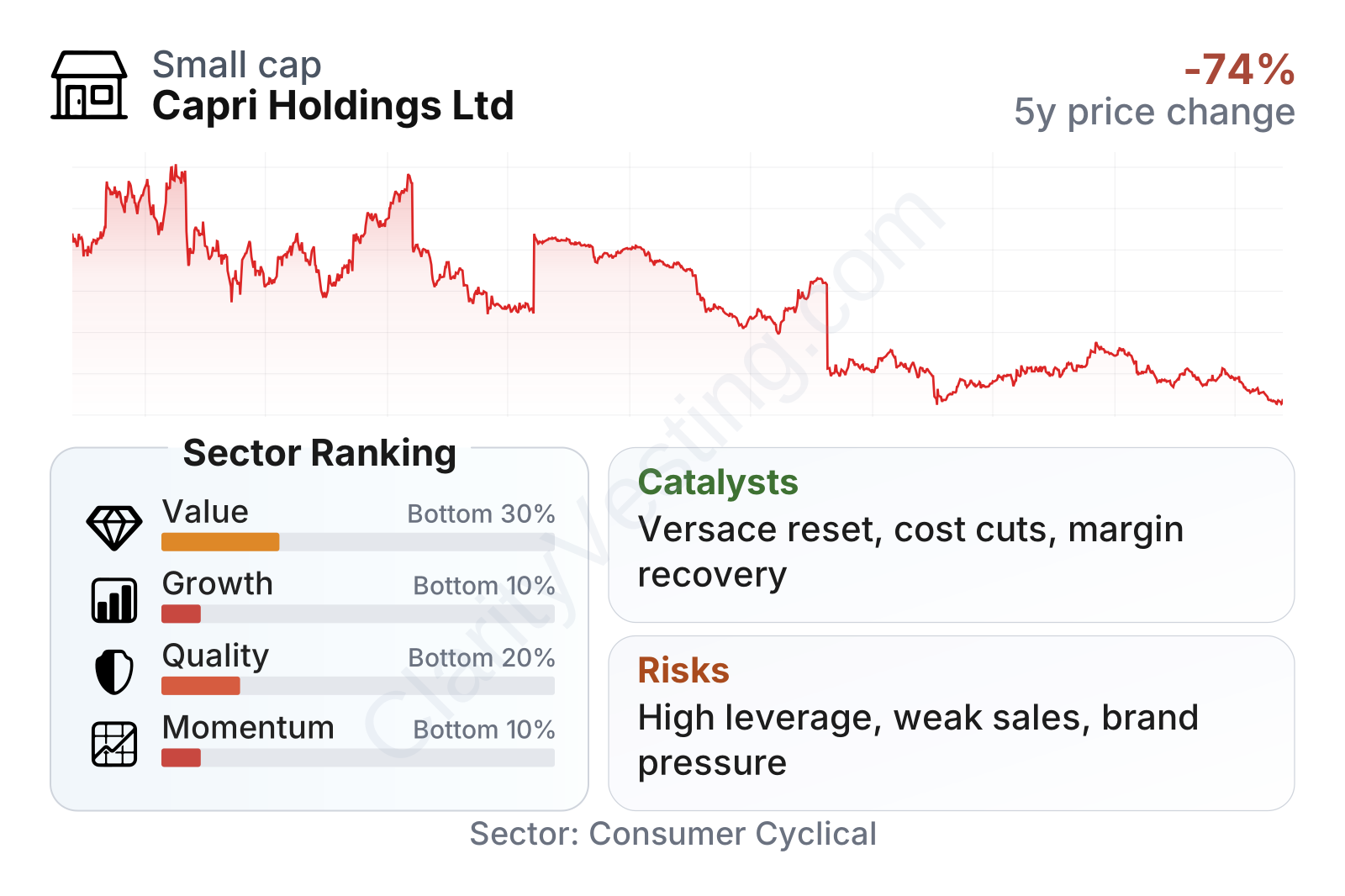
Capri currently sits in the lower end of its sector on value, growth, quality, and momentum measures. The most notable weak points are growth and balance-sheet pressure. Revenue and earnings trends have lagged far behind the sector median, while leverage remains unusually high. One brighter point is that recent return on invested capital is roughly in line with the sector, suggesting the brands still have earning power when operations stabilize. Even so, the overall profile remains that of a turnaround situation rather than a steadily compounding luxury business.
The stock chart reflects this reality clearly. After trading much higher in 2021 and early 2022, the shares have experienced a long and volatile decline, with only limited periods of stabilization. That pattern usually signals that the market is still waiting for stronger proof of durable improvement in sales, margins, and debt metrics.
Growth
Luxury goods remain an attractive sector over the long run because affluent consumers tend to keep spending on strong brands, and global demand can expand through tourism, digital sales, and growth in Asia and the Middle East. In that sense, Capri operates in a structurally appealing category. The challenge is that being in a good sector is not enough: luxury groups need brand heat, disciplined distribution, pricing power, and careful inventory management. Capri has struggled on several of those points in recent years.
Its strategy still makes sense in principle. Management has been working to elevate the brands, improve full-price selling, sharpen product assortments, and manage costs more tightly. If executed well, that approach could support better margins over time because luxury profitability depends heavily on selling more at full price and preserving exclusivity. Capri also continues to invest in direct relationships with customers through its own stores and digital channels, which is usually a more attractive model than relying too heavily on wholesale partners.
The revenue trend, however, shows why the market remains cautious. Capri has posted several periods of contraction, and the latest year-over-year figures are still negative. Compared with much of the broader consumer discretionary sector, this is a clear weak spot. For a luxury company, sustained revenue pressure is especially important because fixed costs such as stores, marketing, and corporate overhead can weigh heavily when sales are falling.
Cash generation has also become less reliable. Capri produced substantial free cash flow in earlier periods, then saw a sharp drop, a temporary rebound, and another decline. The latest trailing twelve-month figure is still positive, which matters, but it is far below the levels seen a few years ago. For a company in restructuring mode, positive cash flow is helpful, yet the low level means there is less room for error if sales remain soft or if investment needs rise.
A meaningful catalyst is the company’s ongoing effort to simplify operations and protect profitability after a difficult period for luxury demand, especially at the more accessible end of the market where Michael Kors competes. Another potential opportunity is brand recovery at Versace and Jimmy Choo if product refreshes, merchandising improvements, and retail execution gain traction. Because Capri owns globally recognized names, even moderate improvements in brand momentum can have an outsized effect on earnings when the cost base is already in place.
Recent company communications have also emphasized leadership changes and operational discipline. In a business driven by brand image and execution, management quality can quickly influence pricing, inventory, and store productivity. That does not guarantee a rebound, but it makes organizational improvement an important variable to watch.
Risks
This article is for informational purposes only and does not constitute financial advice. Some content is AI-generated. See Disclaimer


