Stock Analysis · Coupang LLC (CPNG)
Overview
Coupang is a South Korea-based commerce and technology company best known for its online retail platform and fast delivery network. The business combines a marketplace, direct retail, logistics infrastructure, food delivery, streaming, fintech-related services, and selected overseas operations. Its central idea is convenience: customers can order a wide range of products, often with very fast delivery, while merchants can use Coupang’s platform and fulfillment system to reach those customers.
The company reports revenue in two main segments. Product Commerce is by far the largest and includes core retail, marketplace services, Rocket delivery membership benefits tied to shopping activity, and the company’s developing luxury marketplace Farfetch. Developing Offerings is much smaller and includes Eats, Play, fintech and other newer initiatives. Based on recent annual reporting, the revenue mix is approximately:
- Product Commerce: about 95% to 97% of revenue. This is the core e-commerce operation, including first-party sales, third-party marketplace activity, and related shopping services.
- Developing Offerings: about 3% to 5% of revenue. This includes food delivery, streaming, fintech-related services, and other newer businesses that are still being scaled.
Geographically, most of Coupang’s business is still tied to South Korea, with a smaller contribution from Taiwan and other newer activities. That means the company is large in its home market, but it is not yet broadly diversified across many countries.
One important financial pattern is that revenue has expanded strongly over the past several years, while gross profit has grown even faster. That suggests the business model has become more efficient at scale, even though profitability remains uneven because Coupang continues to invest heavily in logistics, customer experience, and newer platforms.
The long-term direction is clear: sales have climbed from the high teens of billions of dollars in 2021 to the mid-$30 billions by 2025, and gross profit has widened materially. However, operating costs have also risen sharply, which explains why the company’s earnings still move around more than its revenue.
Key Figures
| Metric | Value | Sector ⓘ |
|---|---|---|
| Date | Sep 12, 2026 | |
| Context | ||
| Sector | Consumer Cyclical | |
| Industry | Internet Retail | |
| Market Cap ⓘ | $26.33B | |
| Beta ⓘ | 1.15 | |
Value (Cheapness) | ||
| P/E Ratio ⓘ | N/A | 17.10 |
| FCF Yield ⓘ | 0.41% | 8.53% |
| EBIT / EV ⓘ | -2.02% | 6.46% |
| PEG ⓘ | 1.19 | |
Growth (Business expansion) | ||
| Revenue Growth ⓘ | 3.90% | 5.75% |
| RPS Growth (5Y CAGR) ⓘ | 9.55% | 9.14% |
| EPS Growth (5Y CAGR) ⓘ | 56.62% | -18.21% |
| Margin Growth (5Y Trend) ⓘ | 10.11% | -0.23% |
| FCF Growth (5Y CAGR) ⓘ | N/A | 4.91% |
Quality (Business durability) | ||
| ROIC (Latest) ⓘ | -8.43% | 12.61% |
| ROIC (5Y Median) ⓘ | 2.86% | 10.72% |
| Net Debt / EBIT (Latest) ⓘ | -4.48 | 2.10 |
| Net Debt / EBIT (5Y Median) ⓘ | -3.51 | 2.32 |
| Operating Margin (Latest) ⓘ | -1.48% | 9.25% |
| Operating Margin (5Y Median) ⓘ | 1.98% | 9.64% |
| Debt to Equity (Latest) ⓘ | 188.58% | 75.78% |
| Profit Margin (Latest) ⓘ | -2.16% | 5.33% |
| Free Cash Flow (Latest) ⓘ | $107.54M | |
Momentum (Price trend) | ||
| 3Y Return ⓘ | -19.83% | +14.53% |
| 12M Return (excl. last month) ⓘ | -42.00% | +3.08% |
| 6M Return ⓘ | -18.45% | +0.55% |
| Price vs. 200-Day MA ⓘ | -20.65% | -0.54% |
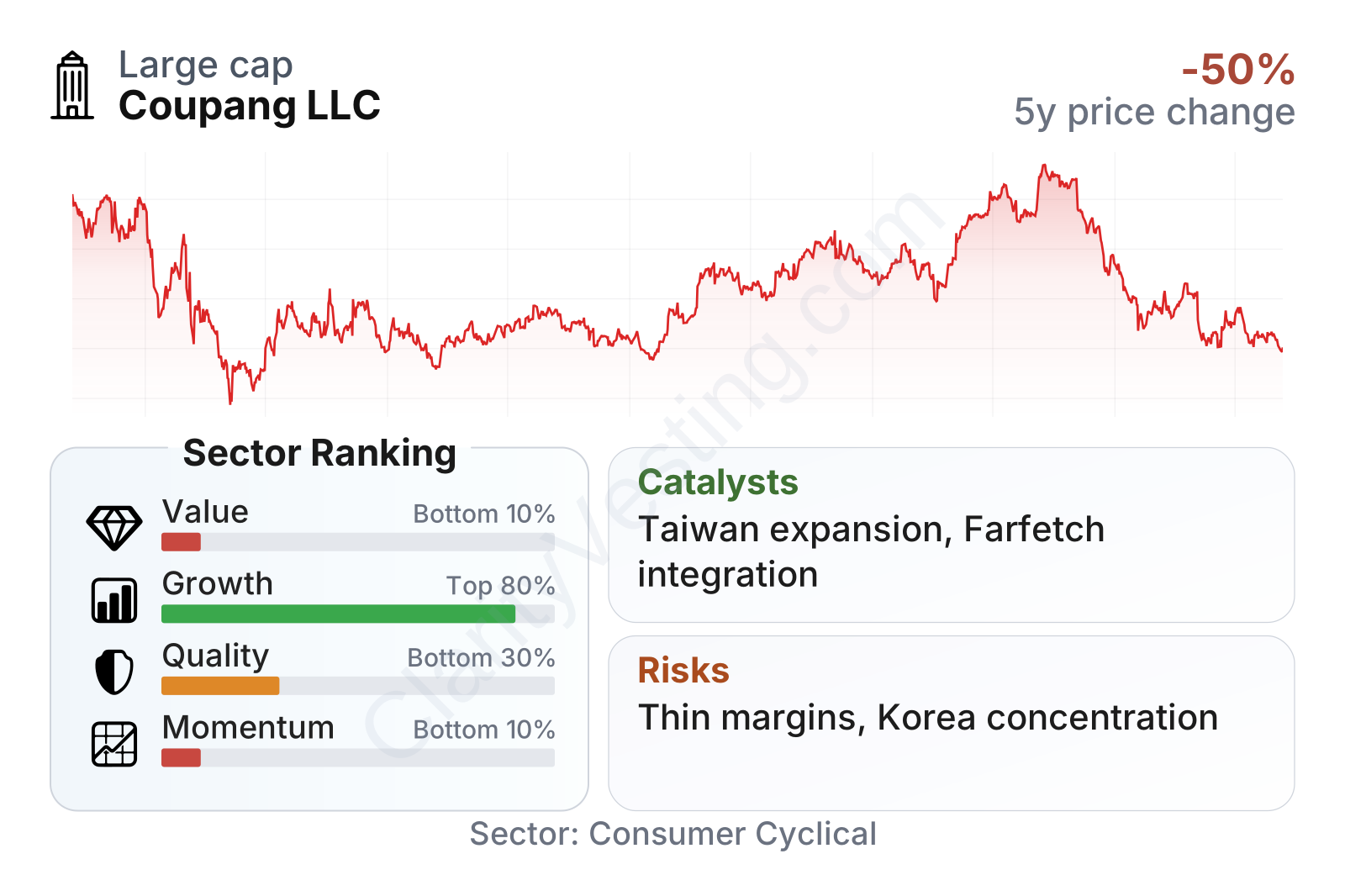
Coupang is now a large public company, but its profile is unusual. Growth metrics remain better than many peers over a multi-year period, especially on revenue per share, earnings improvement, and margin trend. By contrast, value, profitability quality, and recent share-price momentum rank weakly relative to the broader consumer cyclical sector. In simple terms, the market is still treating Coupang more like a business in transition than a mature retailer with stable returns.
The stock-price history also shows this tension clearly. After a steep drop following the post-IPO period, the shares recovered substantially through 2024 and much of 2025 before another sharp pullback in 2026. That kind of path usually reflects a company where the long-term opportunity is meaningful, but confidence in near-term margins and execution is still fragile.
Growth
Coupang operates in a sector that still has room to expand. Online commerce, digital payments, subscription ecosystems, retail advertising, and app-based delivery all continue to take share from more traditional offline channels. South Korea is already a highly developed e-commerce market, which means explosive early-stage growth is no longer the base case, but it also means customer behavior is deeply digital and favorable to convenience-led platforms.
Coupang’s strategy for future growth is coherent. The company has built an integrated network of fulfillment centers, last-mile delivery capabilities, membership benefits, and a broad product selection. That model can deepen spending from existing customers, attract merchants that want better logistics, and support adjacent services such as food delivery, streaming, and payments. It also creates a flywheel: more selection and faster delivery can attract more users, which can bring more sellers, which can improve economics over time.
Revenue growth has slowed from the very high rates seen earlier in the company’s public life, but the business has still been growing at a healthy pace over a multi-year period. More recently, year-over-year growth has decelerated into the single-digit range, which is a notable change from the 20%+ phases seen in 2023 and 2024. For a business of Coupang’s size, this is not surprising, but it does mean future upside depends more on mix improvement and margin expansion, not only on adding gross sales.
Cash generation is another important part of the growth case. Coupang moved from deeply negative free cash flow in earlier years to strongly positive levels by 2023 and 2024, although the trailing figure has come down sharply more recently. That pullback does not erase the progress, but it shows that capital intensity and operating volatility still matter. For long-term analysis, this is a key point: the company has demonstrated that its model can generate cash, but not yet with the consistency usually associated with a fully mature platform.
Several catalysts stand out. Taiwan remains a closely watched expansion market because it offers Coupang a chance to apply its logistics-heavy playbook outside Korea. The Farfetch acquisition also gives the company exposure to global luxury e-commerce, which is a different customer segment from its core retail base. In addition, if membership adoption, merchant services, and advertising continue to expand, Coupang could raise profit per customer even if headline revenue growth moderates.
Recent company updates have also highlighted continued investment in newer offerings and international initiatives. Those moves indicate a significant opportunity if management can turn convenience and logistics strength into a broader commerce ecosystem rather than just a large online store.
Risks
This article is for informational purposes only and does not constitute financial advice. Some content is AI-generated. See Disclaimer


