Stock Analysis · Corpay Inc (CPAY)
Overview
Corpay Inc is a business payments company focused on helping organizations control and automate spending. Its products are used to manage vehicle-related expenses, employee travel spending, accounts payable, cross-border payments, and lodging costs. In simple terms, Corpay sits between businesses and the many payments they need to make, then earns fees and related revenue for handling those flows more efficiently. The company was formerly known as FleetCor and over time expanded well beyond fuel cards into broader corporate payments.
Its business is organized around several major revenue streams. Based on recent company reporting, the mix is roughly as follows:
- Vehicle Payments: about 44% of revenue. This includes fuel cards, toll payments, parking, and other vehicle-related expense management for commercial fleets and businesses.
- Corporate Payments: about 31% of revenue. This segment includes accounts payable automation, virtual cards, and cross-border payment solutions used by companies to pay suppliers and move funds internationally.
- Lodging Payments: about 18% of revenue. This mainly covers hotel booking and payment solutions for crews, field workers, and business travel programs.
- Other: about 7% of revenue. This includes smaller payment-related activities and remaining legacy offerings.
What stands out is that Corpay combines recurring, operationally important services with payment processing economics. Customers often use these tools inside day-to-day workflows, which can make the services sticky once adopted. Over the last several years, revenue has moved higher while operating income has remained very strong, showing that the business scales well even as it broadens its product set.
The long-term pattern points to a business with high gross profitability and unusually strong operating income for a company classified in software and infrastructure. Revenue has risen steadily from the low-$2 billion range a few years ago to above $4 billion, while operating income has also climbed. A notable pressure point is interest expense, which has become much larger as the company has used debt in its expansion.
Key Figures
| Metric | Value | Sector ⓘ |
|---|---|---|
| Date | Sep 12, 2026 | |
| Context | ||
| Sector | Technology | |
| Industry | Software - Infrastructure | |
| Market Cap ⓘ | $26.80B | |
| Beta ⓘ | 0.87 | |
Value (Cheapness) | ||
| P/E Ratio ⓘ | 24.88 | 29.51 |
| FCF Yield ⓘ | 6.11% | 4.25% |
| EBIT / EV ⓘ | 6.42% | 2.85% |
| PEG ⓘ | 0.78 | |
Growth (Business expansion) | ||
| Revenue Growth ⓘ | 21.50% | 15.40% |
| RPS Growth (5Y CAGR) ⓘ | 17.26% | 8.56% |
| EPS Growth (5Y CAGR) ⓘ | -7.13% | -11.88% |
| Margin Growth (5Y Trend) ⓘ | -0.18% | 0.46% |
| FCF Growth (5Y CAGR) ⓘ | 4.59% | 9.80% |
Quality (Business durability) | ||
| ROIC (Latest) ⓘ | 11.31% | 9.44% |
| ROIC (5Y Median) ⓘ | N/A | 8.30% |
| Net Debt / EBIT (Latest) ⓘ | 0.72 | 0.54 |
| Net Debt / EBIT (5Y Median) ⓘ | 3.64 | 0.44 |
| Operating Margin (Latest) ⓘ | 44.72% | 9.58% |
| Operating Margin (5Y Median) ⓘ | 43.14% | 8.25% |
| Debt to Equity (Latest) ⓘ | 299.94% | 33.33% |
| Profit Margin (Latest) ⓘ | 22.72% | 7.14% |
| Free Cash Flow (Latest) ⓘ | $1.64B | |
Momentum (Price trend) | ||
| 3Y Return ⓘ | +50.04% | +45.48% |
| 12M Return (excl. last month) ⓘ | +32.42% | +23.48% |
| 6M Return ⓘ | +26.95% | +20.93% |
| Price vs. 200-Day MA ⓘ | +20.24% | +7.43% |
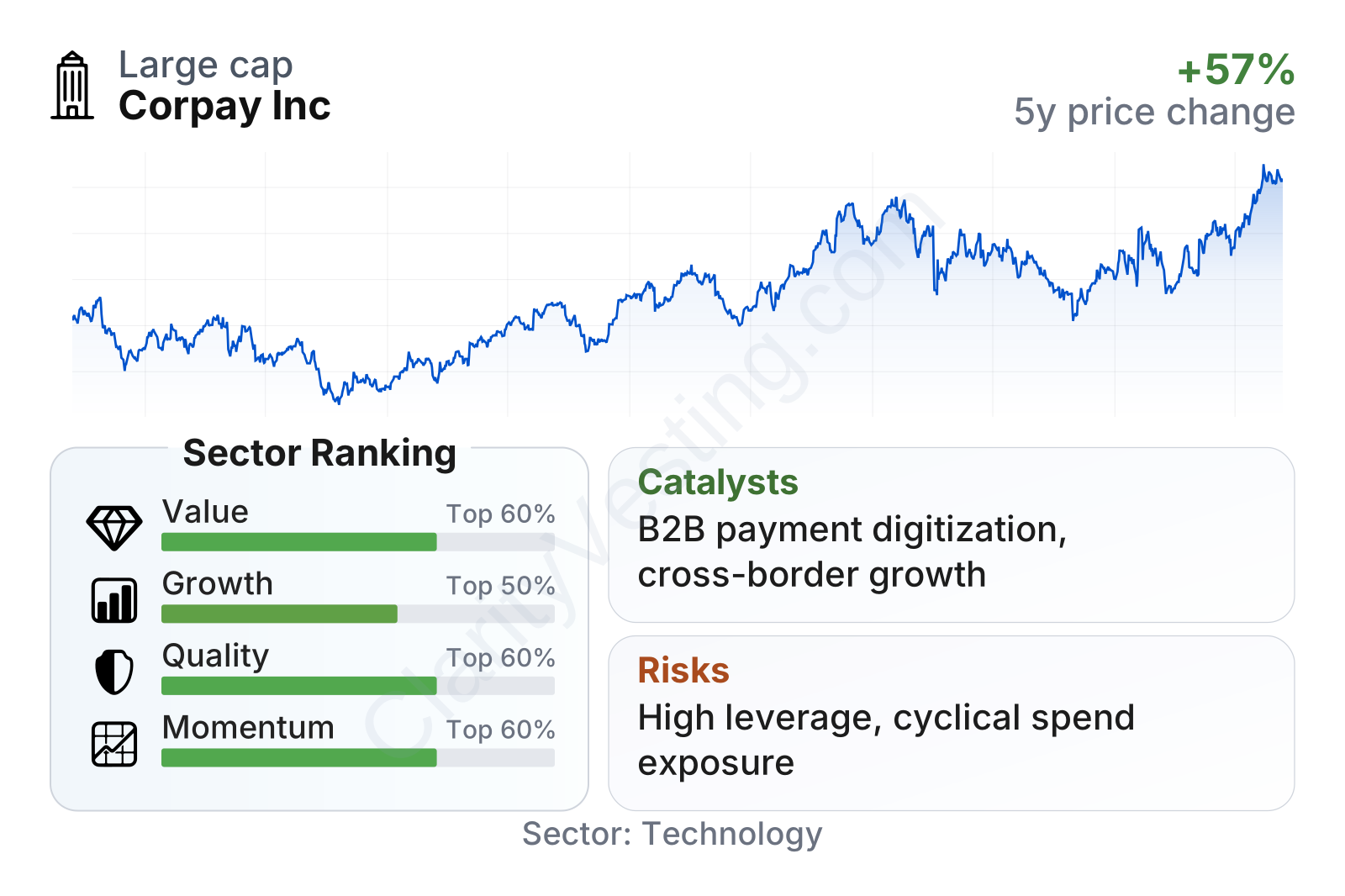
Corpay is a large company with a market value in the mid-$20 billions and a stock that has shown lower volatility than the broader market. The overall profile is mixed in a constructive way: valuation metrics look less demanding than many technology peers, profitability is clearly above sector norms, and growth is solid but not uniform across every measure. The weaker spots are balance-sheet leverage and a slower free-cash-flow growth trend over five years than some peers. Share performance over three years has been strong, although the shorter-term pace has been more uneven.
Growth
Corpay operates in a favorable part of the market: the long shift from manual, paper-based, and fragmented business payments toward digital, automated, and data-rich platforms. That trend is still far from complete, especially in accounts payable, cross-border business payments, and specialized travel and lodging payments. These are areas where companies continue to look for cost control, visibility, fraud reduction, and workflow automation.
The company’s strategy also makes sense for future expansion because it is not relying on only one narrow product. Vehicle payments remain important, but Corpay has been building more exposure to corporate payments and cross-border activity, which can deepen customer relationships and broaden the number of transactions it touches. This diversification matters because it reduces dependence on a single spending category and opens more room for cross-selling.
Recent growth has reaccelerated after a slower period. Year-over-year revenue growth moved from low single digits in parts of 2024 to above 20% in the most recent readings, which is stronger than the sector median. That does not necessarily mean growth will stay at that pace, but it does suggest the business has regained momentum through a combination of demand, pricing, acquisitions, and broader adoption of its payment products.
Free cash flow remains substantial at well above $1 billion on a trailing basis, even though it has come down from earlier highs. For a long-term business analysis, this is important: Corpay is not just producing accounting profits, it is generating real cash that can support acquisitions, debt reduction, technology investment, and share repurchases.
One of the strongest catalysts is the continued migration of business payments from legacy methods to digital systems. Another is cross-border complexity: companies operating internationally increasingly need tools that simplify currency handling, compliance, and payment execution. Corpay has also continued to position itself as a broader corporate spend platform rather than just a fleet card provider, which could support a higher-quality revenue mix over time if execution remains disciplined.
Recent company communications have continued to emphasize product expansion, international reach, and larger enterprise relationships. Those themes point to a meaningful opportunity if Corpay can keep integrating its offerings and win a greater share of payment flows that are still handled manually or through multiple vendors.
Risks
This article is for informational purposes only and does not constitute financial advice. Some content is AI-generated. See Disclaimer


