Stock Analysis · Columbia Sportswear Company (COLM)
Overview
Columbia Sportswear Company is an outdoor and active lifestyle apparel company that sells jackets, footwear, fleece, sportswear, accessories, and equipment. Its products are designed for activities such as hiking, trail running, fishing, skiing, and everyday outdoor use. The company operates through a portfolio of brands led by Columbia, with additional brands including SOREL, Mountain Hardwear, and prAna. It sells through wholesale partners, its own stores, e-commerce websites, and international distributors.
Revenue is concentrated in a few major areas. Based on the latest annual reporting, the business mix is dominated by the Columbia brand and by apparel rather than footwear or accessories.
- Columbia brand: about 82% of revenue. This is the core business and includes outerwear, fleece, sportswear, footwear, and accessories sold under the Columbia name.
- SOREL: about 10% of revenue. This brand is centered on boots, casual footwear, and cold-weather products.
- Mountain Hardwear: about 4% of revenue. It focuses on more technical outdoor gear and apparel.
- prAna: about 4% of revenue. This brand is oriented toward activewear, climbing, yoga, and outdoor-inspired lifestyle clothing.
By product category, apparel is the largest contributor, followed by footwear, then accessories and equipment. The company also has meaningful geographic diversification, with the United States as its largest market and international markets contributing a substantial share through both direct operations and distribution partners.
Columbia’s business model is relatively straightforward: design products, build brand demand through marketing and retail presence, and distribute through a mix of wholesale and direct-to-consumer channels. That mix matters because direct sales usually offer higher gross margins, while wholesale can provide broader reach and scale.
The longer-term financial picture shows a company whose sales have stayed in a fairly narrow range in recent years, while profitability has come under pressure as selling and operating costs rose faster than revenue. Gross profit has remained solid, but more of it has been absorbed by overhead and brand-building expenses than earlier in the cycle.
Key Figures
| Metric | Value | Sector ⓘ |
|---|---|---|
| Date | Sep 12, 2026 | |
| Context | ||
| Sector | Consumer Cyclical | |
| Industry | Apparel Manufacturing | |
| Market Cap ⓘ | $2.91B | |
| Beta ⓘ | 0.93 | |
Value (Cheapness) | ||
| P/E Ratio ⓘ | 14.86 | 17.10 |
| FCF Yield ⓘ | 11.03% | 8.53% |
| EBIT / EV ⓘ | 10.09% | 6.46% |
| PEG ⓘ | 2.19 | |
Growth (Business expansion) | ||
| Revenue Growth ⓘ | 1.50% | 5.75% |
| RPS Growth (5Y CAGR) ⓘ | 7.14% | 9.14% |
| EPS Growth (5Y CAGR) ⓘ | -58.98% | -18.21% |
| Margin Growth (5Y Trend) ⓘ | -7.68% | -0.23% |
| FCF Growth (5Y CAGR) ⓘ | -9.26% | 4.91% |
Quality (Business durability) | ||
| ROIC (Latest) ⓘ | 12.58% | 12.61% |
| ROIC (5Y Median) ⓘ | 12.34% | 10.72% |
| Net Debt / EBIT (Latest) ⓘ | -0.26 | 2.10 |
| Net Debt / EBIT (5Y Median) ⓘ | -0.12 | 2.32 |
| Operating Margin (Latest) ⓘ | 8.07% | 9.25% |
| Operating Margin (5Y Median) ⓘ | 8.90% | 9.64% |
| Debt to Equity (Latest) ⓘ | 28.80% | 75.78% |
| Profit Margin (Latest) ⓘ | 6.05% | 5.33% |
| Free Cash Flow (Latest) ⓘ | $321.30M | |
Momentum (Price trend) | ||
| 3Y Return ⓘ | -16.24% | +14.53% |
| 12M Return (excl. last month) ⓘ | +13.75% | +3.08% |
| 6M Return ⓘ | +4.62% | +0.55% |
| Price vs. 200-Day MA ⓘ | -2.99% | -0.54% |
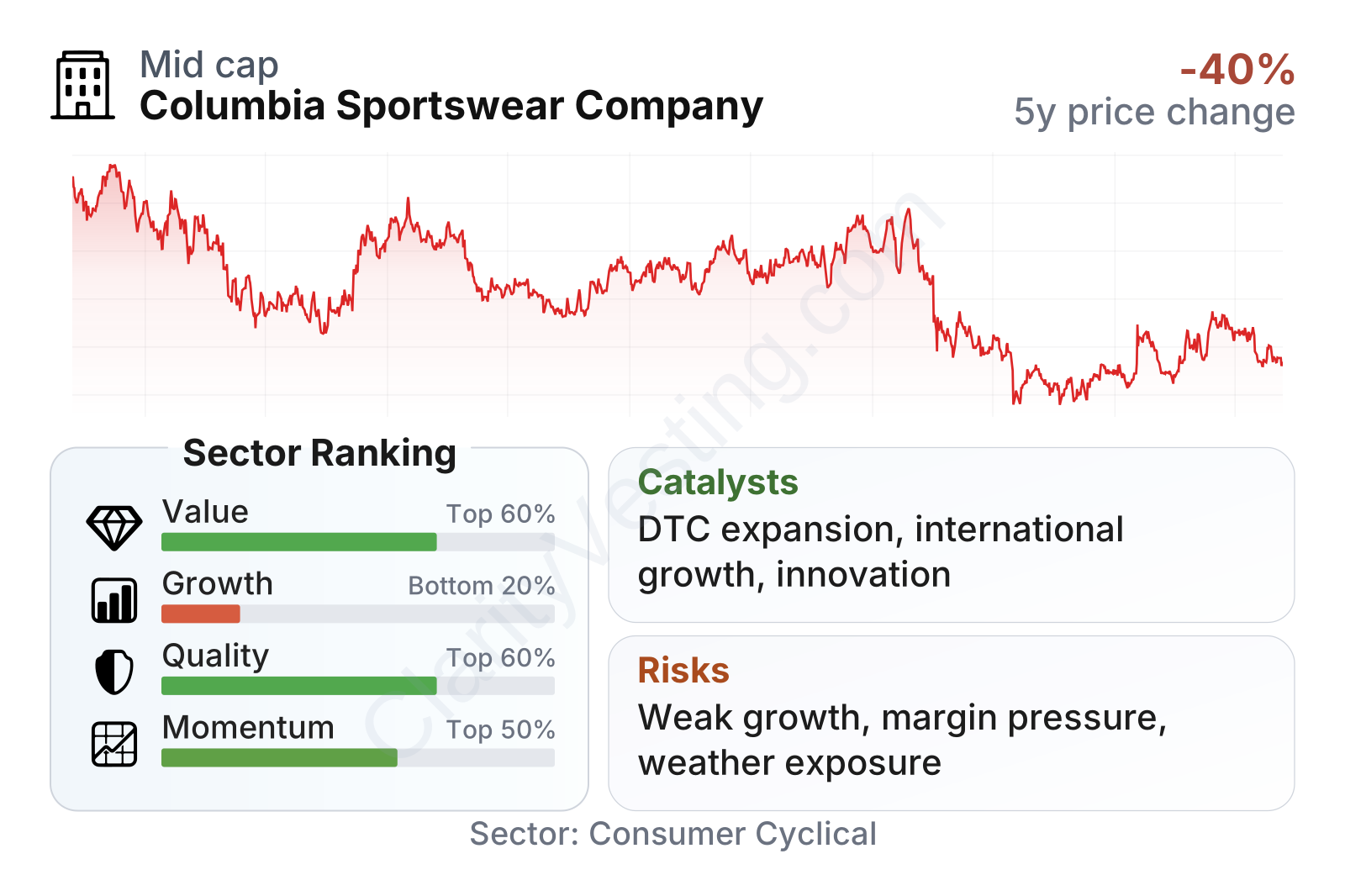
Columbia is a mid-sized public company with a share price that has been much less volatile than many consumer discretionary names, reflected in a beta slightly below 1. The overall profile is mixed. On valuation and balance-sheet strength, it compares reasonably well with much of the sector. On growth, it sits near the weaker end of the peer group. Quality remains respectable, supported by positive returns on invested capital, above-sector profit margin, and a net cash position rather than heavy leverage.
That combination gives the company an unusual shape: financially conservative and still profitable, but currently lacking the growth and margin momentum that usually earns a premium multiple in apparel.
Growth
The outdoor and performance apparel market remains attractive over the long run because it benefits from several durable trends: casualization of dress, growing participation in outdoor activities, demand for technical fabrics, and the blending of sportswear with everyday clothing. These are supportive industry conditions, but they do not automatically create growth for every brand. In Columbia’s case, the sector backdrop is favorable, while company-specific execution has been more uneven.
Recent revenue trends show that the business has moved from strong post-pandemic expansion into a much slower phase. Growth was very strong in 2021 and 2022, then softened materially, turned negative through parts of 2024, and has only recently returned to low positive territory. The latest year-over-year pace is around 1% to 2%, which is well below the sector median.
Management’s strategy still makes logical sense for future expansion. The company continues to invest in product innovation, international markets, and direct-to-consumer capabilities. Columbia’s own websites and stores are important because they give the company more control over pricing, customer data, and presentation of its brands. Internationally, the company still has room to deepen penetration, especially where outdoor participation and premium sportswear adoption are increasing faster than in mature U.S. channels.
Another potential catalyst is the company’s innovation pipeline. Columbia has long marketed its products around proprietary technologies in insulation, waterproofing, cooling, and sun protection. In apparel, technical differentiation does not create the same lock-in as software, but it can still support pricing, retailer interest, and repeat purchases when the products perform well and the branding stays relevant.
Cash generation remains meaningful even after the recent slowdown. Free cash flow has been volatile, which is common in apparel because inventory swings can strongly affect cash movement from one year to the next. Even so, trailing free cash flow remains solid in absolute terms and provides flexibility for dividends, buybacks, and investment without relying on debt.
A recent opportunity worth watching is the company’s effort to stabilize inventory, sharpen brand focus, and improve operational discipline after a period of weaker profitability. For a business with established brands and broad distribution, even modest sales acceleration can have an outsized effect if expense growth is brought back under control.
Risks
This article is for informational purposes only and does not constitute financial advice. Some content is AI-generated. See Disclaimer