Stock Analysis · Cohu Inc (COHU)
Stock Analysis · Cohu Inc (COHU)

Overview

Cohu is a semiconductor equipment company. In simple terms, it sells the machines, software, contactors, and services that chipmakers and outsourced semiconductor assembly and test companies use to test chips before they are shipped. That work matters because modern semiconductors must be checked for speed, power use, reliability, and performance under different temperatures before they go into cars, phones, industrial systems, data centers, and other electronics.

The business is centered on test handling and interface equipment. Test handlers move chips through the testing process, while interface products such as contactors connect the chip to the tester. Cohu also provides diagnostics, inspection, spare parts, kits, and service support. This creates a mix of equipment sales, which are usually more cyclical, and recurring revenue tied to an installed base already running in customer factories.

Based on recent company disclosures, Cohu’s revenue is mainly organized around semiconductor test and inspection solutions rather than consumer-facing products. A practical way to think about revenue sources is:

  • Test handlers and automated test equipment support: roughly the largest portion, likely around half of revenue or more in most periods.
  • Interface products, including contactors and related consumables: a major second contributor, often around one-third of revenue.
  • Services, spares, kits, and other recurring support: a smaller but important stream, often in the mid-teens as a share of revenue.

Geographically, Cohu is exposed to global chip manufacturing, with a meaningful share of sales tied to Asia, where much of semiconductor packaging and testing takes place. That gives the company access to the core of the supply chain, but it also makes results sensitive to industry investment cycles and customer concentration.

The broader financial picture shows a business that was much larger and more profitable earlier in the cycle, then went through a sharp downturn as semiconductor customers cut spending. Revenue fell steeply from the 2021 peak through 2024, and profitability turned negative, although the latest period shows signs of recovery in sales.

Cohu’s revenue base has contracted sharply from the 2021 high, and profits have fallen much faster than sales. The notable point is that research and development remained relatively substantial through the downturn, suggesting management is trying to preserve product competitiveness even while margins are under pressure.

Key Figures

MetricValueSector
DateJul 18, 2026
Context
SectorTechnology
IndustrySemiconductor Equipment & Materials
Market Cap $2.41B
Beta 1.55
Value
(Cheapness)
P/E Ratio N/A31.76
FCF Yield 1.66%4.18%
EBIT / EV -1.85%2.56%
PEG 1.15
Growth
(Business expansion)
Revenue Growth 29.30%13.50%
RPS Growth (5Y CAGR) -14.70%8.57%
EPS Growth (5Y CAGR) -80.26%-21.87%
Margin Growth (5Y Trend) -28.21%0.41%
FCF Growth (5Y CAGR) -40.51%9.76%
Quality
(Business durability)
ROIC (Latest) -3.41%8.54%
ROIC (5Y Median) 2.90%8.12%
Net Debt / EBIT (Latest) N/A0.38
Net Debt / EBIT (5Y Median) -1.110.38
Operating Margin (Latest) -8.72%9.58%
Operating Margin (5Y Median) 7.42%8.25%
Debt to Equity (Latest) 42.55%33.52%
Profit Margin (Latest) -11.54%6.96%
Free Cash Flow (Latest) $40.17M
Momentum
(Price trend)
3Y Return +23.56%+30.91%
12M Return (excl. last month) +259.42%+28.90%
6M Return +75.67%+5.38%
Price vs. 200-Day MA +45.33%+7.61%
Better than sector median
Slightly worse than sector median
More than 20% worse than sector median

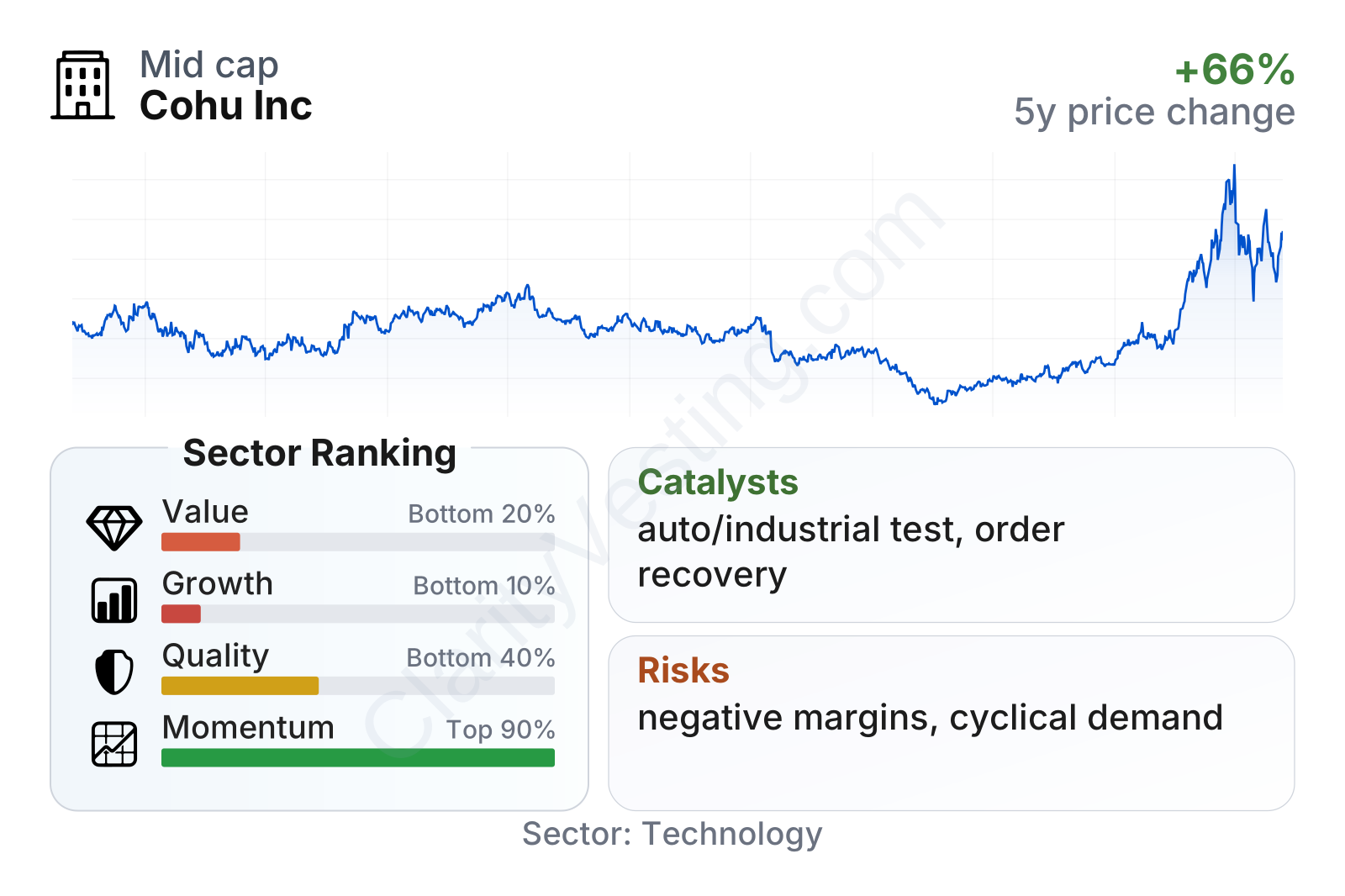
Cohu currently sits in a mixed position. Market momentum has been very strong, with the shares rebounding sharply over the last year and outperforming much of the technology sector. By contrast, value, quality, and especially long-term growth metrics remain weak relative to peers. The company is still small compared with many semiconductor equipment names, with a market capitalization around $3.3 billion, and the stock’s beta above 1.6 points to above-average volatility.

The most important takeaway is the contrast between short-term improvement and longer-term scars from the downturn. Recent revenue growth has turned positive again, but profitability, returns on capital, and cash flow trends still lag the sector. That makes the current picture more about recovery than about a fully restored earnings engine.

Growth

Cohu operates in a sector with attractive long-term demand drivers. Semiconductor content keeps rising in vehicles, industrial automation, communications hardware, artificial intelligence infrastructure, and connected devices. More chips in more products usually means more testing requirements, especially as devices become more complex and quality standards become stricter. In that sense, the company is in a structurally growing area of the technology industry, even if the path is highly cyclical.

Cohu’s strategy also makes industrial sense. Management has emphasized a broader portfolio in handlers, interface products, software, inspection, and aftermarket support. That helps the company participate across more steps of the test process instead of depending on a single tool category. It also supports recurring revenue through spare parts, consumables, and services, which can soften the impact of weak equipment orders during down cycles.

The recent revenue trend is encouraging. After several quarters of deep declines, year-over-year growth turned positive and moved into a strong double-digit range. That does not erase the earlier contraction, but it does suggest the business may be moving out of the trough as customer spending gradually normalizes.

Cash generation tells a similar story. Free cash flow dropped from healthy levels to negative territory during the downturn, then recovered back into positive territory in the latest trailing period. A return to positive cash flow matters because it shows the company is not relying only on accounting improvement; the underlying business is again producing cash, even if still well below prior peak levels.

One of the clearest catalysts is the increasing complexity of semiconductor testing, especially in automotive and high-performance applications. Chips used in cars, advanced driver-assistance systems, power management, and industrial markets need extremely high reliability. That can support demand for better test handling and interface solutions, which is where Cohu has established positions.

Another potential growth lever is the industry’s gradual move toward more advanced packaging and more demanding test requirements. As chipmakers look for higher throughput, better thermal control, and lower cost per test, specialist suppliers can gain share if they offer measurable productivity improvements. Cohu’s continued spending on engineering during a weak market suggests it is trying to be ready for that next upcycle rather than simply cutting back.

Recent company updates in 2026 have also pointed to design wins, customer engagements, and recovery in parts of the test market. None of that guarantees a straight-line rebound, but it does strengthen the case that the business is now tied to a healthier demand environment than it faced in 2024.

Risks

The biggest risk is cyclicality. Cohu sells into one of the most uneven parts of the semiconductor chain. Customers can reduce equipment orders quickly when utilization falls, inventories rise, or confidence weakens. That can hit revenue hard because fixed costs remain significant. The company’s recent history shows exactly that pattern: sales fell sharply, margins turned negative, and earnings deteriorated faster than revenue.

Balance-sheet risk is worth watching. For several years, debt relative to equity was very low and comfortably below the sector median. More recently, that ratio jumped to above the sector median, which suggests less financial flexibility than the company had during the earlier phase of the cycle. It is not an extreme leverage profile by industrial standards, but the direction has become less favorable.

Margins are another clear pressure point. Cohu used to generate profit margins well above the sector median, but that advantage reversed sharply. The company is still posting negative net margins while the sector median remains positive. That means the current recovery in revenue has not yet translated into a full recovery in earnings power.

Competition is significant. In semiconductor test equipment, Cohu faces larger and well-capitalized rivals as well as specialized niche suppliers. Competitors include companies involved in automated test systems, handlers, interface solutions, and inspection tools, such as Teradyne in broader test equipment, Advantest in test systems, and smaller interface or handler specialists across Asia and the U.S. Cohu is not the dominant overall leader in semiconductor test equipment, but it does hold meaningful positions in test handlers and interface products. Its advantage is specialization and a broad installed base rather than sheer scale.

That creates both strengths and limits. The company’s competitive advantages include long customer relationships, engineering know-how in thermal and handling applications, and recurring revenue from consumables and service tied to existing tools in the field. However, it lacks the scale and financial resources of the largest test equipment players, which can matter in research spending, pricing pressure, and global reach.

There are also customer and geographic risks. Semiconductor equipment suppliers often depend on a relatively small number of customers for a large share of revenue, and many of those customers are located in Asia. Any delay in customer capital spending, export restrictions, supply-chain disruption, or regional weakness can have an outsized effect on results.

On governance and reputation, there is no widely noted public scandal that stands out as a major red flag. The more relevant near-term risk is operational execution: if the market recovery is slower than expected, or if new product introductions do not convert into higher utilization and orders, the rebound thesis becomes harder to support.

Valuation

Valuation is tricky here because standard earnings-based measures are currently distorted. Since earnings are negative on a trailing basis, the usual price-to-earnings ratio is not meaningful at the moment. That is why the market is effectively valuing Cohu more on expected recovery, cycle normalization, and strategic positioning than on current profits.

The longer history shows that Cohu often traded below the sector’s typical earnings multiple when profits were healthy and the market was less enthusiastic. The present situation is different: with negative trailing earnings, the stock cannot be called conventionally cheap using P/E alone. Other measures in the latest metrics also suggest the valuation is not obviously low relative to fundamentals, especially with free cash flow yield and operating returns still weaker than sector norms.

At the same time, the share price rebound indicates that the market is assigning value to improving conditions. That is understandable. Revenue growth has turned positive again, cash flow has recovered from negative territory, and semiconductor test remains a strategically important niche. In other words, the current price appears to reflect a recovery setup rather than a bargain based on current profitability.

The key valuation question is therefore less about whether the stock is inexpensive on trailing numbers and more about how much of a future margin rebound is already reflected. With momentum strong and quality metrics still weak, the valuation context looks more demanding than it did near the cycle lows, even though the business itself is showing better operational direction.

Conclusion

Cohu is a specialized semiconductor equipment company with real industrial relevance, a meaningful installed base, and exposure to long-term themes such as rising chip complexity, automotive electronics, and higher testing requirements. The business appears to be emerging from a difficult downturn, with revenue growth turning positive again and free cash flow recovering. Those are important signs that conditions are improving.

Still, the company is not yet back to a strong financial profile. Margins remain negative, returns on capital are weak, and leverage has moved higher than it was during the healthier years. Cohu’s position in test handlers and interface products gives it credible competitive footing, but it does not have the scale or dominance of the largest semiconductor test suppliers.

The overall picture is therefore one of a recovering cyclical company in an attractive industry niche rather than a business already firing on all cylinders. The operating backdrop looks better than the recent past, but the stock’s sharp rebound suggests the market has already recognized much of that improvement. For a long-term perspective, the most convincing part of the case is the sector exposure and the company’s specialized role in chip testing; the biggest challenge is proving that the recovery can become durable enough to restore margins and stronger returns.

Sources:

  • SEC EDGAR — Cohu, Inc. Form 10-Q for the quarter ended March 29, 2026
  • SEC EDGAR — Cohu, Inc. Form 10-K for the fiscal year ended December 27, 2025
  • Cohu Investor Relations — quarterly earnings releases and shareholder materials published in 2026
  • Cohu Investor Relations — company presentations describing products, end markets, and strategy
  • Wikipedia — Cohu basic company background and history

This article is for informational purposes only and does not constitute financial advice. Some content is AI-generated. See Disclaimer


Sign up for exclusive research and insights.

Unsubscribe anytime.
