Stock Analysis · Coherent Inc (COHR)
Overview
Coherent Inc designs and manufactures the components and systems that help move, shape, and detect light, electricity, and data. In simple terms, it sells the building blocks used in fiber-optic communications, industrial lasers, semiconductor manufacturing, defense applications, consumer electronics, and medical equipment. The current company was formed through the combination of II-VI and the former Coherent, which created a broader platform across materials, lasers, optics, and communications hardware.
Its revenue base is spread across several end markets rather than a single product line, which matters because demand can be weak in one area and strong in another. In recent company reporting, the business has been organized around a few large categories tied to end markets and product families.
- Networking / communications components and modules: roughly 35% to 45% of revenue. This includes optical transceivers, pluggable modules, pump lasers, silicon photonics-related products, and other parts used in data centers, telecom networks, and AI-related optical links.
- Industrial lasers and manufacturing solutions: roughly 20% to 30%. This covers laser tools and related systems used for cutting, welding, marking, materials processing, and precision manufacturing.
- Semiconductor-related products: roughly 15% to 25%. This includes materials, optics, laser components, and other products used in chip equipment and advanced electronics manufacturing.
- Electronics, instrumentation, and consumer-related applications: roughly 10% to 20%. This area includes optics, compound semiconductors, and specialty components used in display, sensing, and device applications.
- Aerospace, defense, and life sciences: generally a smaller but strategic share. These businesses tend to be lower in revenue contribution than communications or industrial markets, but they can offer higher technical barriers and longer product cycles.
What stands out is that Coherent is not just a laser company. It sits at the intersection of several long-term themes: rising internet traffic, AI infrastructure, advanced chip production, automation, and precision manufacturing. That broader footprint gives it more ways to participate in technology spending than a narrower specialist.
The business mix also shows a notable improvement in recent years: revenue expanded materially from 2022 to 2025, while gross profit rose as the company scaled. Operating expenses became much heavier after the large merger, but more recent results indicate better conversion from revenue into operating income and net income. Interest expense has also fallen sharply, which suggests balance sheet pressure has started to ease.
Key Figures
| Metric | Value | Sector ⓘ |
|---|---|---|
| Date | Sep 12, 2026 | |
| Context | ||
| Sector | Technology | |
| Industry | Scientific & Technical Instruments | |
| Market Cap ⓘ | $57.41B | |
| Beta ⓘ | 2.10 | |
Value (Cheapness) | ||
| P/E Ratio ⓘ | 70.99 | 29.51 |
| FCF Yield ⓘ | -1.80% | 4.25% |
| EBIT / EV ⓘ | 1.76% | 2.85% |
| PEG ⓘ | 0.92 | |
Growth (Business expansion) | ||
| Revenue Growth ⓘ | 33.70% | 15.40% |
| RPS Growth (5Y CAGR) ⓘ | 6.36% | 8.56% |
| EPS Growth (5Y CAGR) ⓘ | 8.21% | -11.88% |
| Margin Growth (5Y Trend) ⓘ | 2.43% | 0.46% |
| FCF Growth (5Y CAGR) ⓘ | -18.08% | 9.80% |
Quality (Business durability) | ||
| ROIC (Latest) ⓘ | 7.88% | 9.44% |
| ROIC (5Y Median) ⓘ | 1.89% | 8.30% |
| Net Debt / EBIT (Latest) ⓘ | 2.29 | 0.54 |
| Net Debt / EBIT (5Y Median) ⓘ | 5.41 | 0.44 |
| Operating Margin (Latest) ⓘ | 14.58% | 9.58% |
| Operating Margin (5Y Median) ⓘ | 9.50% | 8.25% |
| Debt to Equity (Latest) ⓘ | 32.45% | 33.33% |
| Profit Margin (Latest) ⓘ | 11.31% | 7.14% |
| Free Cash Flow (Latest) ⓘ | -$1.03B | |
Momentum (Price trend) | ||
| 3Y Return ⓘ | +832.14% | +45.48% |
| 12M Return (excl. last month) ⓘ | +205.11% | +23.48% |
| 6M Return ⓘ | +26.57% | +20.93% |
| Price vs. 200-Day MA ⓘ | +9.19% | +7.43% |
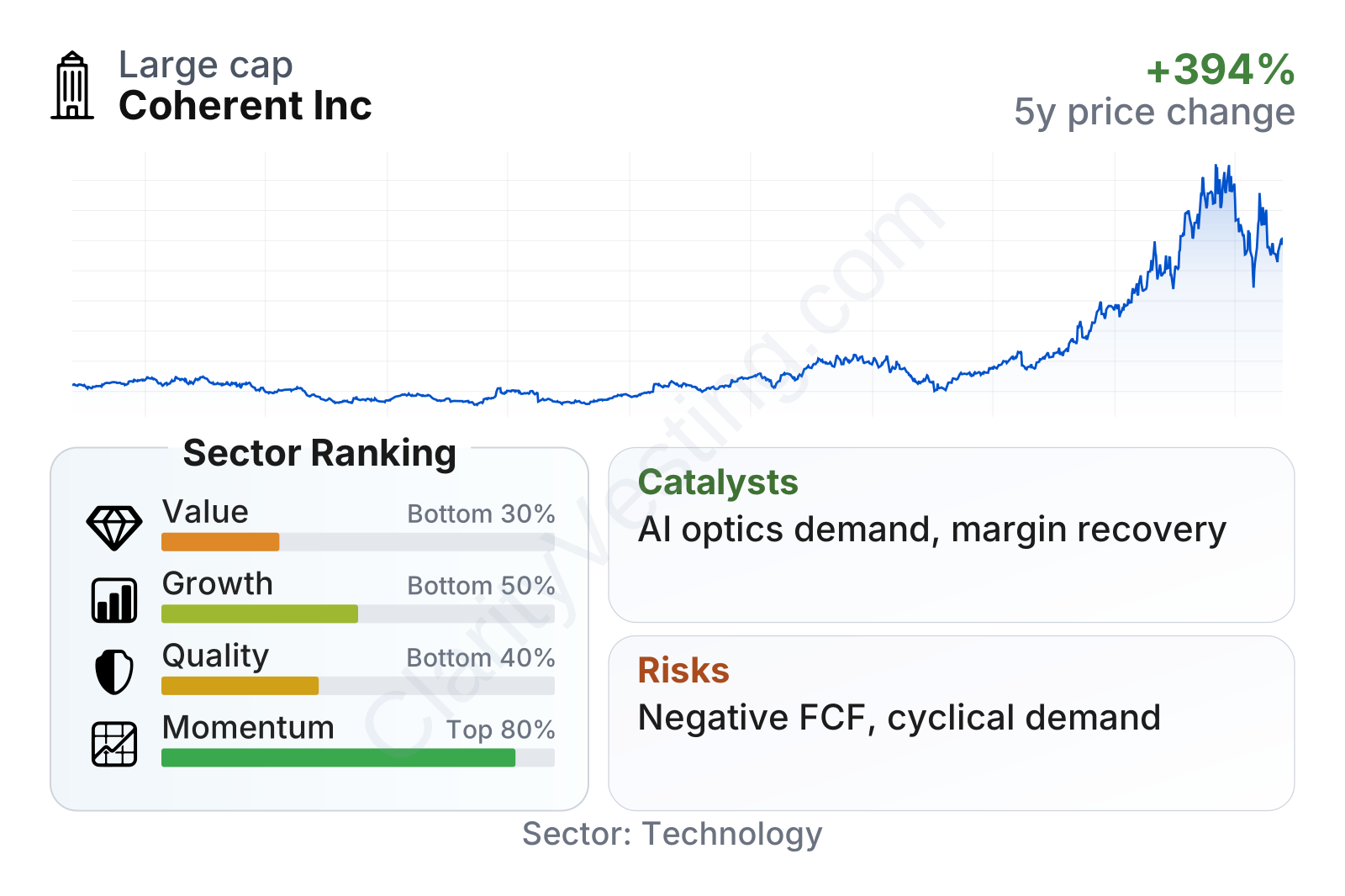
Coherent is now a large technology hardware company, and the stock has been extremely volatile. The share price has climbed dramatically over the last three years, far outpacing the broader sector, which shows that the market has become much more optimistic about its earnings potential. At the same time, the stock’s beta above 2 suggests larger swings than the average technology name.
The summary metrics point to a mixed profile. Growth in the latest period is strong, especially on a year-over-year revenue basis, and profit margin has recovered to a level above the sector median. However, value metrics remain weak, free cash flow is currently negative, and debt-adjusted quality measures still lag peers. In short, the market is rewarding acceleration in the business, but it is doing so before all balance sheet and cash generation questions are fully resolved.
Growth
Coherent operates in markets that should remain structurally important for years: optical networking, AI data center infrastructure, semiconductor manufacturing, and advanced industrial automation. These are not niche trends. They are tied to the growth of cloud computing, higher-speed data transmission, more complex chips, and increasing use of precision tools in factories.
A particularly important growth driver is optical connectivity for AI and high-performance computing. As computing clusters become larger and more power-hungry, moving data efficiently between servers becomes critical. Coherent’s portfolio in transceivers, lasers, indium phosphide, silicon carbide, and other photonics-related technologies gives it exposure to this demand. This is one of the clearest reasons the market has re-rated the company.
Its strategy also makes industrial sense. By combining materials, components, and systems under one roof, Coherent can serve customers across more of the value chain. That can help in design wins, pricing, and supply reliability, especially in technically demanding areas where customers want proven manufacturing scale.
Recent revenue momentum has improved meaningfully. After a weaker stretch in late 2023 and early 2024, the company returned to sustained positive growth and the latest year-over-year increase is well above the sector median. That pattern suggests recovery has moved beyond simple stabilization and into a stronger demand phase, especially in communications-related products.
Cash generation is less clean than revenue growth. Free cash flow had been positive for several years before swinging sharply negative in the latest trailing period. For a long-term view, this matters because durable growth is far more valuable when it turns into recurring cash rather than only accounting profit. The key question is whether the recent decline reflects temporary working-capital needs and investment for expansion, or a more persistent issue.
Recent company updates have highlighted strong interest tied to AI-related optical products and higher-speed networking. If those deployments continue at scale, they could support both revenue growth and better factory utilization, which would help margins. Lower interest expense in the latest period is another positive sign because it means more operating improvement can reach the bottom line.
Risks
This article is for informational purposes only and does not constitute financial advice. Some content is AI-generated. See Disclaimer