Stock Analysis · PC Connection Inc (CNXN)
Overview
PC Connection, Inc. is an information technology solutions provider that helps businesses, government agencies, schools, and individual consumers buy and manage technology. In simple terms, the company acts as a large reseller and adviser: it sources computers, software, cloud tools, networking gear, security products, and related services from major vendors, then sells them to customers together with configuration, deployment, and support.
The business is organized around customer groups rather than a single product category. Based on the company’s recent filings, revenue is mainly generated through three operating segments.
- Business Solutions: approximately 48% of revenue in 2025. This segment serves small- and medium-sized businesses and includes hardware, software, peripherals, and technology services.
- Enterprise Solutions: approximately 36% of revenue in 2025. This unit focuses on larger corporations and offers more complex infrastructure, data center, cloud, security, and managed technology solutions.
- Public Sector Solutions: approximately 16% of revenue in 2025. This segment serves government and educational customers, where purchasing can be steadier but often depends on contracts and budget cycles.
Across these segments, most sales still come from products rather than services. That matters because product resale tends to produce high revenue but relatively thin profit margins. The business model relies on scale, vendor relationships, customer service, and efficient operations more than on proprietary technology.
Over the last several years, total revenue has moved in a fairly narrow range around the high-$2 billion to low-$3 billion level. Gross profit has stayed more resilient than sales, suggesting the company has been able to preserve pricing discipline and mix quality even when demand softened. Operating income and net income have also remained positive throughout that period, which is notable for a distributor-style business.
The overall picture is of a mid-sized technology distributor and solutions provider with a broad catalog, diversified customer base, and a business model built on repeat corporate and public-sector demand rather than fast-changing consumer hype.
Key Figures
| Metric | Value | Sector ⓘ |
|---|---|---|
| Date | Sep 12, 2026 | |
| Context | ||
| Sector | Technology | |
| Industry | Electronics & Computer Distribution | |
| Market Cap ⓘ | $2.08B | |
| Beta ⓘ | 0.86 | |
Value (Cheapness) | ||
| P/E Ratio ⓘ | 21.85 | 29.51 |
| FCF Yield ⓘ | 1.63% | 4.25% |
| EBIT / EV ⓘ | 7.37% | 2.85% |
| PEG ⓘ | 1.82 | |
Growth (Business expansion) | ||
| Revenue Growth ⓘ | 12.40% | 15.40% |
| RPS Growth (5Y CAGR) ⓘ | 0.53% | 8.56% |
| EPS Growth (5Y CAGR) ⓘ | -12.97% | -11.88% |
| Margin Growth (5Y Trend) ⓘ | 0.62% | 0.46% |
| FCF Growth (5Y CAGR) ⓘ | 5.17% | 9.80% |
Quality (Business durability) | ||
| ROIC (Latest) ⓘ | 10.32% | 9.44% |
| ROIC (5Y Median) ⓘ | 9.67% | 8.30% |
| Net Debt / EBIT (Latest) ⓘ | -0.90 | 0.54 |
| Net Debt / EBIT (5Y Median) ⓘ | -1.33 | 0.44 |
| Operating Margin (Latest) ⓘ | 4.33% | 9.58% |
| Operating Margin (5Y Median) ⓘ | 3.70% | 8.25% |
| Debt to Equity (Latest) ⓘ | 0.79% | 33.33% |
| Profit Margin (Latest) ⓘ | 3.21% | 7.14% |
| Free Cash Flow (Latest) ⓘ | $34.05M | |
Momentum (Price trend) | ||
| 3Y Return ⓘ | +64.69% | +45.48% |
| 12M Return (excl. last month) ⓘ | +29.32% | +23.48% |
| 6M Return ⓘ | +42.76% | +20.93% |
| Price vs. 200-Day MA ⓘ | +28.42% | +7.43% |
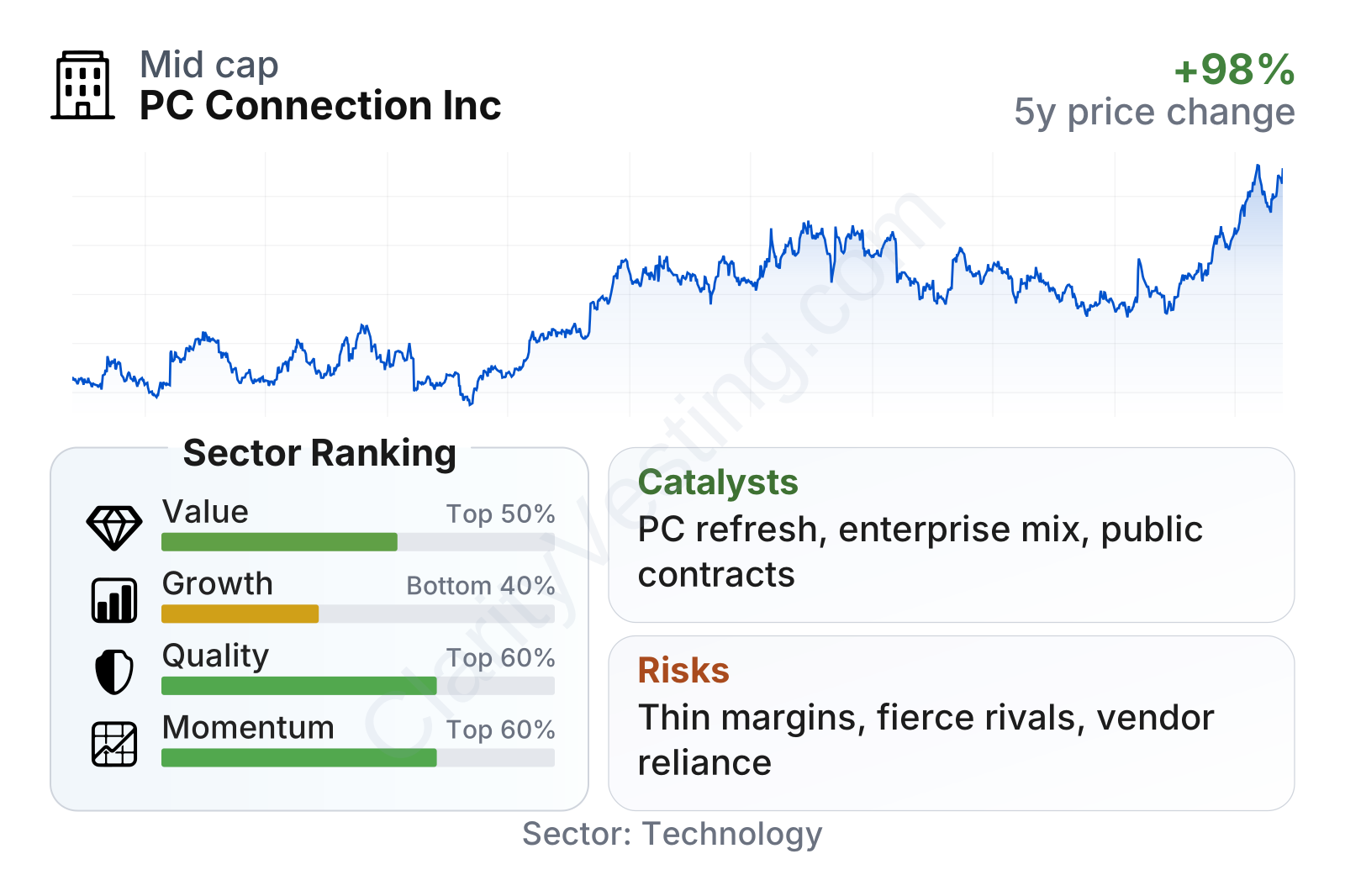
PC Connection stands out more for balance-sheet strength and operating discipline than for rapid expansion. Its valuation metrics place it around the middle of the technology sector overall, with an earnings multiple below the sector median. Quality indicators are decent, helped by returns on invested capital above the median and an exceptionally low debt load. Growth metrics are weaker, reflecting modest long-term sales expansion and uneven earnings progression. Momentum has been stronger recently, with the share price outperforming the broader technology median over multi-year and six-month periods.
The company’s market value places it in the smaller end of publicly traded technology names, while its beta below 1 suggests the stock has historically been somewhat less volatile than the overall market.
Growth
PC Connection operates in a sector with durable long-term demand. Organizations continue to spend on PCs, servers, networking, cybersecurity, cloud migration, device lifecycle services, and hybrid-work infrastructure. Even though hardware resale is not a high-growth niche by itself, enterprise technology purchasing remains essential, and many customers prefer a vendor-neutral partner that can combine products from multiple suppliers with services and support.
The company’s strategy is sensible for that environment. Instead of trying to compete as a software innovator, it focuses on solving purchasing and deployment problems for customers. That includes endpoint devices, data center products, software licensing, cloud offerings, and related services. This approach can benefit from recurring replacement cycles, especially in PCs and enterprise infrastructure, and from growing complexity in cybersecurity and hybrid IT environments.
Recent revenue growth has been uneven, which is typical after the post-pandemic hardware surge and subsequent digestion period across the technology channel. The pattern shows a strong upswing in 2021 and early 2022, a broad contraction through much of 2023 and early 2024, and then a return to positive growth, ending with a noticeably stronger year-over-year increase in the latest period. That rebound suggests customer demand has improved, although the company’s longer-term growth profile still trails the sector median.
Cash generation has also been volatile but generally positive. Free cash flow moved from a low base to very strong levels in 2024, then normalized, and later recovered again. For a reseller, this can be influenced heavily by working capital, especially inventory and receivables. Even so, the ability to remain cash generative through changing demand conditions is an important sign of resilience.
A practical catalyst is the ongoing refresh cycle in commercial devices and infrastructure. Businesses and institutions periodically replace laptops, desktops, servers, and networking equipment, and those cycles can accelerate when operating systems change, security requirements rise, or AI-capable hardware becomes more relevant. Public-sector and education contracts can also create incremental opportunities when budget releases and procurement timing line up favorably.
Another potential tailwind is mix improvement. If the company continues shifting toward higher-value enterprise solutions, software, cloud, and services, profit growth could outpace pure revenue growth. That would likely matter more than simply adding low-margin volume.
Risks
This article is for informational purposes only and does not constitute financial advice. Some content is AI-generated. See Disclaimer


