Stock Analysis · Concentrix Corporation (CNXC)
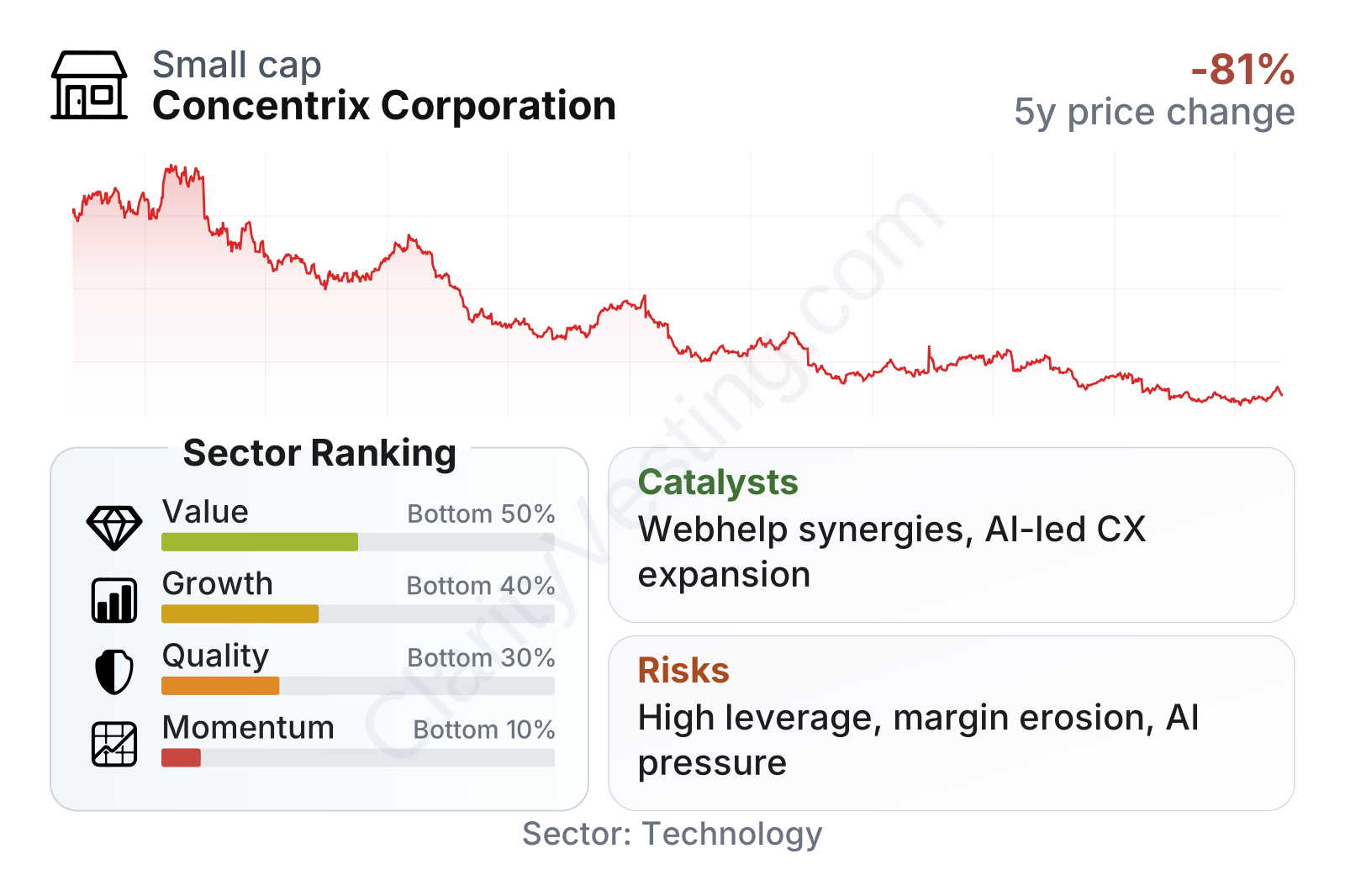
Overview
Concentrix Corporation is a global business services company that helps other organizations manage customer interactions, sales support, technical support, digital operations, and parts of their technology and transformation work. In simple terms, many large brands use Concentrix to handle customer care across phone, chat, email, social media, and increasingly AI-enabled channels. The company also provides consulting, analytics, automation, trust and safety services, and digital product support.
Its business is mainly built around long-term service contracts with enterprise clients in industries such as technology, communications, media, retail, travel, banking, healthcare, and public sector work. A major feature of the model is scale: Concentrix operates across many countries, languages, and channels, which matters because large clients often want one partner that can serve them globally.
Revenue is not usually broken out in public filings by a simple product menu with exact percentages for each service line, but the broad mix can be summarized approximately as follows based on company disclosures about its integrated service model:
- Customer experience operations and support services: the clear majority of revenue, likely around 70% to 80%. This includes customer care, technical support, sales support, content moderation, and back-office process work.
- Digital transformation, analytics, consulting, and automation: likely around 15% to 25%. This includes process redesign, analytics, AI-enabled workflow tools, and broader experience improvement projects.
- Other specialized services: likely less than 10%, including adjacent offerings tied to trust, safety, and industry-specific outsourced operations.
The bigger picture is that Concentrix sells a bundled service rather than one standalone software product. That makes revenue more recurring than a project-only consulting firm, but it also means margins are generally lower than those of pure software companies.
The business expanded significantly with the acquisition of Webhelp, which increased Concentrix’s scale and geographic reach. That deal made the company larger and more diversified, but it also raised the importance of integration, debt management, and restoring profitability after acquisition-related pressure.
Over the last several years, revenue rose sharply, but the path from sales to profit became less favorable. Gross profit increased with scale, yet higher operating costs and interest expense absorbed much of that benefit, and the latest annual period shows a clear break from earlier profitability.
Key Figures
| Metric | Value | Sector ⓘ |
|---|---|---|
| Date | Sep 12, 2026 | |
| Context | ||
| Sector | Technology | |
| Industry | Information Technology Services | |
| Market Cap ⓘ | $1.65B | |
| Beta ⓘ | 0.46 | |
Value (Cheapness) | ||
| P/E Ratio ⓘ | N/A | 29.51 |
| FCF Yield ⓘ | 31.17% | 4.25% |
| EBIT / EV ⓘ | -15.90% | 2.85% |
| PEG ⓘ | 0.34 | |
Growth (Business expansion) | ||
| Revenue Growth ⓘ | 1.90% | 15.40% |
| RPS Growth (5Y CAGR) ⓘ | 9.71% | 8.56% |
| EPS Growth (5Y CAGR) ⓘ | -20.65% | -11.88% |
| Margin Growth (5Y Trend) ⓘ | -19.44% | 0.46% |
| FCF Growth (5Y CAGR) ⓘ | 11.90% | 9.80% |
Quality (Business durability) | ||
| ROIC (Latest) ⓘ | -9.44% | 9.44% |
| ROIC (5Y Median) ⓘ | 7.26% | 8.30% |
| Net Debt / EBIT (Latest) ⓘ | N/A | 0.54 |
| Net Debt / EBIT (5Y Median) ⓘ | 5.89 | 0.44 |
| Operating Margin (Latest) ⓘ | -9.51% | 9.58% |
| Operating Margin (5Y Median) ⓘ | 9.30% | 8.25% |
| Debt to Equity (Latest) ⓘ | 169.73% | 33.33% |
| Profit Margin (Latest) ⓘ | -13.15% | 7.14% |
| Free Cash Flow (Latest) ⓘ | $513.53M | |
Momentum (Price trend) | ||
| 3Y Return ⓘ | -57.86% | +45.48% |
| 12M Return (excl. last month) ⓘ | -44.61% | +23.48% |
| 6M Return ⓘ | -8.25% | +20.93% |
| Price vs. 200-Day MA ⓘ | -5.14% | +7.43% |
Concentrix currently sits in an unusual position: the market value is relatively modest for a company with nearly $10 billion in annual revenue, and the stock has been very weak over the last several years. On the positive side, cash generation remains meaningful, and the free cash flow yield stands far above the sector median. On the weaker side, profitability, return on capital, and share price momentum rank poorly versus the broader technology services group. The low beta suggests the stock has not moved as sharply as many technology names overall, but the company-specific trend has still been clearly negative.
Growth
Concentrix operates in a sector with long-term relevance. Companies continue to outsource customer support and business processes, and they increasingly want those services delivered through digital channels, automation, and AI tools. That creates a logical growth path for providers that can combine labor scale with workflow technology. In that sense, the sector itself is not disappearing; it is evolving from traditional call-center work into broader customer experience and business transformation services.
Concentrix’s strategy broadly fits that shift. Management has emphasized end-to-end customer experience services, AI-enabled solutions, analytics, and cross-selling a larger service bundle to global clients. The Webhelp acquisition also expanded its footprint in Europe, digital sales capabilities, and multilingual service capacity. If integration goes well, that combination can strengthen the company’s relevance with multinational customers that prefer fewer strategic vendors.
The growth profile, however, is mixed. Year-over-year revenue growth surged around the acquisition period and then slowed sharply, with the latest pace much lower than the sector median. That suggests recent expansion has depended more on acquisitions than on fast underlying organic growth. Over a five-year view, revenue per share has still grown at a respectable pace, so the company has not been stagnant. The question is whether that scale can now be translated into stronger margins and more durable earnings growth.
Cash flow is one of the more constructive features. Free cash flow has remained solid even as accounting profitability weakened, and the latest trailing twelve-month level is close to the better points of the last few years. For a services business facing integration costs and margin pressure, that matters because cash can be used to reduce debt, support restructuring, and stabilize the balance sheet. A strong catalyst from here would be evidence that the larger combined platform can produce cost synergies and improved operating efficiency without hurting client retention.
Recent company updates have also highlighted AI-related offerings and enterprise demand for automation, trust and safety, and more complex customer engagement services. For Concentrix, the opportunity is not likely to come from becoming a pure AI software vendor; it is more likely to come from using AI to improve productivity, deepen client relationships, and defend pricing in a business that has historically been labor intensive.
Risks
This article is for informational purposes only and does not constitute financial advice. Some content is AI-generated. See Disclaimer


