Stock Analysis · Constellation Software Inc (CNSWF)
Overview
Constellation Software Inc. is a Canadian software company that specializes in buying, operating, and improving vertical market software businesses. These are software companies built for very specific industries such as public transit, utilities, health care, education, local government, hospitality, and many other niche markets. Rather than relying on one flagship product, Constellation owns a very large portfolio of software businesses, each serving customers that often depend on the software for daily operations.
Its model is unusual in the technology sector. Instead of prioritizing one large platform, Constellation grows by acquiring smaller software companies, keeping local management in place, and focusing on steady cash generation. This gives the group broad diversification across end markets and geographies, while reducing dependence on any single product cycle.
The company’s revenue mainly comes from software-related recurring and operational activities. Based on company reporting structure and business mix, the main sources are approximately:
- Maintenance and recurring software fees: roughly 35% to 45% of revenue. This generally includes support contracts, subscriptions, upgrades, and ongoing customer payments tied to mission-critical software.
- Professional services: roughly 20% to 30%. This includes implementation, customization, consulting, training, and project work.
- Software licenses and subscriptions sold upfront or over term agreements: roughly 15% to 25%.
- Transaction processing and other revenues: roughly 10% to 20%, depending on the mix of acquired businesses and end-market activity.
What matters most for long-term analysis is that a large share of revenue is tied to recurring customer relationships. Many clients use these systems for core workflows and may be reluctant to switch because replacement can be costly, disruptive, and risky.
The operating profile also shows a business that has scaled meaningfully over time. Revenue has more than doubled since 2021, gross profit has expanded strongly, and operating income recovered sharply after a weak 2023. At the same time, interest expense has risen, showing that acquisitions and balance sheet usage remain an important part of the model.
Key Figures
| Metric | Value | Sector ⓘ |
|---|---|---|
| Date | Sep 12, 2026 | |
| Context | ||
| Sector | Technology | |
| Industry | Software - Application | |
| Market Cap ⓘ | $43.25B | |
| Beta ⓘ | 0.70 | |
Value (Cheapness) | ||
| P/E Ratio ⓘ | 44.96 | 29.51 |
| FCF Yield ⓘ | 6.15% | 4.25% |
| EBIT / EV ⓘ | 3.69% | 2.85% |
| PEG ⓘ | 0.49 | |
Growth (Business expansion) | ||
| Revenue Growth ⓘ | 17.30% | 15.40% |
| RPS Growth (5Y CAGR) ⓘ | 22.83% | 8.56% |
| EPS Growth (5Y CAGR) ⓘ | -11.41% | -11.88% |
| Margin Growth (5Y Trend) ⓘ | 1.93% | 0.46% |
| FCF Growth (5Y CAGR) ⓘ | 19.23% | 9.80% |
Quality (Business durability) | ||
| ROIC (Latest) ⓘ | 13.71% | 9.44% |
| ROIC (5Y Median) ⓘ | 10.44% | 8.30% |
| Net Debt / EBIT (Latest) ⓘ | 1.76 | 0.54 |
| Net Debt / EBIT (5Y Median) ⓘ | 2.02 | 0.44 |
| Operating Margin (Latest) ⓘ | 13.28% | 9.58% |
| Operating Margin (5Y Median) ⓘ | 10.29% | 8.25% |
| Debt to Equity (Latest) ⓘ | 141.06% | 33.33% |
| Profit Margin (Latest) ⓘ | 7.60% | 7.14% |
| Free Cash Flow (Latest) ⓘ | $2.66B | |
Momentum (Price trend) | ||
| 3Y Return ⓘ | -0.46% | +45.48% |
| 12M Return (excl. last month) ⓘ | -35.61% | +23.48% |
| 6M Return ⓘ | +5.79% | +20.93% |
| Price vs. 200-Day MA ⓘ | +0.31% | +7.43% |
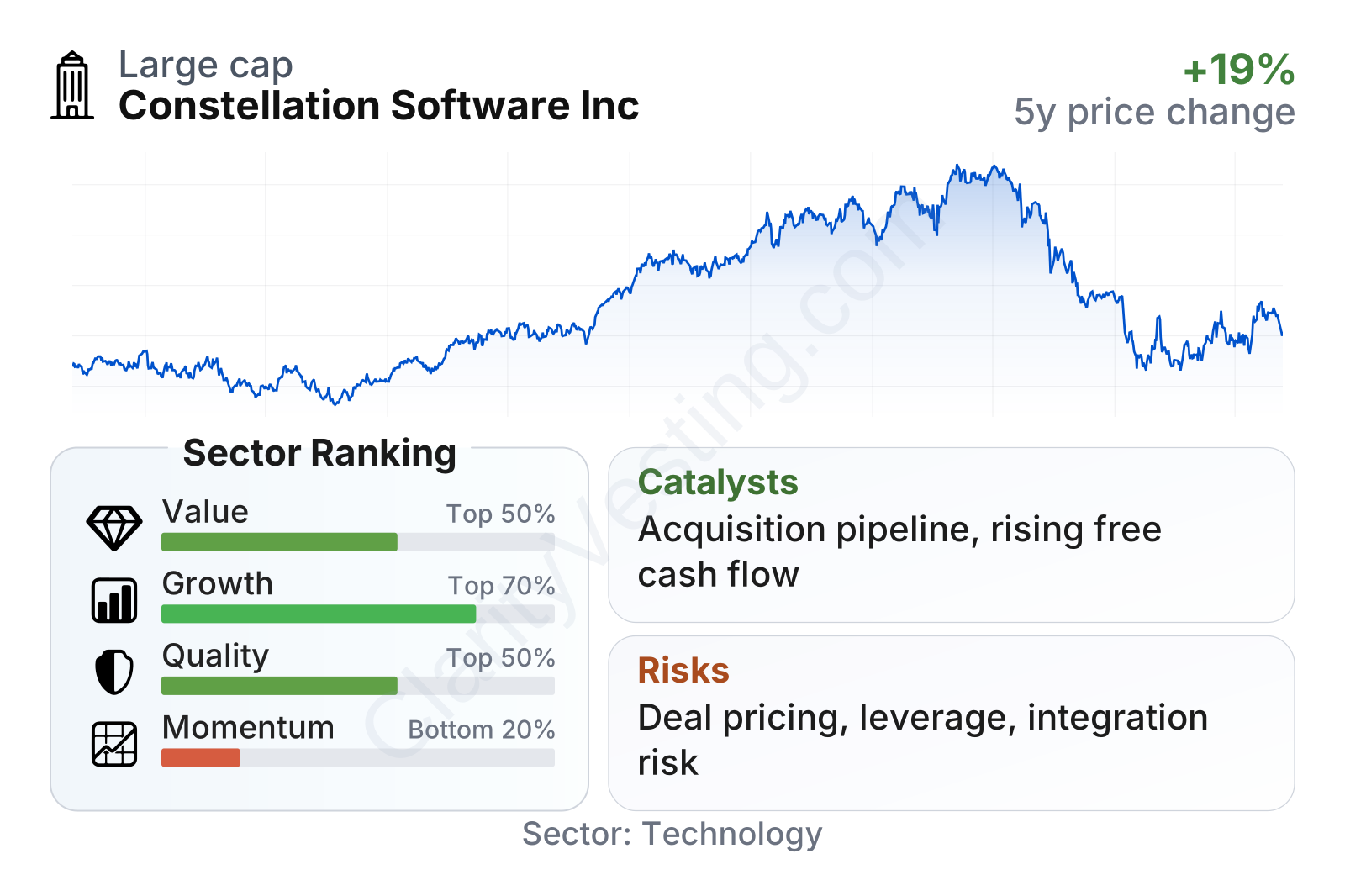
Constellation is now a large software company by market value, but it still behaves like a decentralized acquirer rather than a typical platform software name. The latest profile looks mixed in a constructive way: valuation is above the sector median on earnings, quality is solid, growth remains better than many peers, and share price momentum has been weaker than the broader software group over the last year. Free cash flow generation stands out, and profitability metrics are generally ahead of the sector median, while leverage is clearly higher than what is typical in software.
Growth
Constellation operates in a favorable part of the software market. Vertical market software tends to benefit from durable demand because customers need specialized systems to run essential processes, comply with regulation, manage billing, schedule services, or handle operational data. These are not usually optional tools. That creates a more resilient base than many software categories exposed to shifting consumer trends.
The company’s growth strategy has been consistent for years: acquire niche software businesses, preserve entrepreneurial management, improve operations, and reinvest the cash flow into new deals. This approach makes strategic sense because the market for small and midsize vertical software companies remains highly fragmented. In practical terms, Constellation does not need one breakthrough product to grow; it needs continued discipline in identifying, pricing, and integrating acquisitions.
Revenue growth has remained healthy, although the pace has moderated from the unusually strong levels seen earlier in the cycle. Even with that slowdown, year-over-year growth has still been running in the mid-teens recently, which is slightly better than the sector median. That is a respectable outcome for a company of this size, especially one built around many mature, niche businesses rather than a single high-growth application.
Cash generation is another important growth enabler. Free cash flow has climbed materially over the last several years and is now in the multibillion-dollar range on a trailing basis. That matters because Constellation’s expansion depends heavily on having capital available for acquisitions. Strong free cash flow helps fund deals internally and reduces reliance on issuing new shares.
A meaningful catalyst is the company’s repeatable acquisition engine. Many software firms struggle after acquisitions because integration becomes centralized and disruptive. Constellation’s decentralized structure is designed to avoid that problem. Another catalyst is the broad digital modernization still underway in local industries and public-sector functions, where many legacy software providers continue to be relevant. Recent company communications have also continued to emphasize active capital deployment and operating discipline, which supports the case that the acquisition pipeline remains central to future expansion.
Risks
This article is for informational purposes only and does not constitute financial advice. Some content is AI-generated. See Disclaimer


