Stock Analysis · Chipotle Mexican Grill Inc (CMG)
Overview
Chipotle Mexican Grill is a restaurant company focused on fast-casual Mexican-inspired food. Its menu is built around burritos, bowls, tacos, quesadillas, salads, and related sides and beverages. The concept is simple: a limited menu, quick service, heavy use of digital ordering, and a strong emphasis on food preparation in each restaurant. As of its latest company reporting in 2026, Chipotle operates primarily in the United States, with a smaller international presence.
The business is much more concentrated than many large restaurant groups. Chipotle does not rely on a portfolio of different brands; almost all of its economic engine comes from one brand and one operating model. That makes execution easier to understand, but it also means company performance depends heavily on keeping the brand strong, traffic healthy, and restaurant-level margins resilient.
Its revenue sources are relatively straightforward:
- Company-operated restaurant sales: about 98% to 99%. This is the core of the business and includes in-store orders, digital pickup, delivery, and catering-related restaurant transactions.
- Delivery and digital-related sales: a meaningful subset of restaurant sales. Chipotle does not report this as a separate top-line segment in the same way as total revenue, but digital ordering has been an important growth driver and includes app, web, and marketplace orders.
- Franchise and other revenue: about 1% to 2%. This is small and includes limited royalty or licensing-related activity and other miscellaneous revenue items rather than a large franchised estate.
One important feature of Chipotle’s model is that nearly all sales come directly from restaurants the company runs itself. That gives management more control over food quality, labor standards, pricing, and digital operations than a heavily franchised chain would typically have.
The long-term financial picture has also shown a notable improvement in scale. Over the last several years, revenue has climbed from roughly $7.5 billion to nearly $12.0 billion, while operating income and net income expanded faster than sales. That suggests the company has not only opened more restaurants, but has also become more efficient as the brand grew.
The flow of revenue into profit shows a business that has widened earnings over time. Sales have risen strongly since 2021, and operating income has grown faster than overhead, pointing to improving efficiency even as food, labor, and occupancy costs remain important.
Key Figures
| Metric | Value | Sector ⓘ |
|---|---|---|
| Date | Sep 12, 2026 | |
| Context | ||
| Sector | Consumer Cyclical | |
| Industry | Restaurants | |
| Market Cap ⓘ | $45.81B | |
| Beta ⓘ | 0.94 | |
Value (Cheapness) | ||
| P/E Ratio ⓘ | 33.52 | 17.10 |
| FCF Yield ⓘ | 3.43% | 8.53% |
| EBIT / EV ⓘ | 3.76% | 6.46% |
| PEG ⓘ | 1.60 | |
Growth (Business expansion) | ||
| Revenue Growth ⓘ | 9.30% | 5.75% |
| RPS Growth (5Y CAGR) ⓘ | 13.81% | 9.14% |
| EPS Growth (5Y CAGR) ⓘ | -3.94% | -18.21% |
| Margin Growth (5Y Trend) ⓘ | 5.68% | -0.23% |
| FCF Growth (5Y CAGR) ⓘ | 14.59% | 4.91% |
Quality (Business durability) | ||
| ROIC (Latest) ⓘ | 54.00% | 12.61% |
| ROIC (5Y Median) ⓘ | 45.10% | 10.72% |
| Net Debt / EBIT (Latest) ⓘ | 2.74 | 2.10 |
| Net Debt / EBIT (5Y Median) ⓘ | 2.76 | 2.32 |
| Operating Margin (Latest) ⓘ | 15.26% | 9.25% |
| Operating Margin (5Y Median) ⓘ | 16.54% | 9.64% |
| Debt to Equity (Latest) ⓘ | 246.35% | 75.78% |
| Profit Margin (Latest) ⓘ | 11.43% | 5.33% |
| Free Cash Flow (Latest) ⓘ | $1.57B | |
Momentum (Price trend) | ||
| 3Y Return ⓘ | -6.36% | +14.53% |
| 12M Return (excl. last month) ⓘ | -23.79% | +3.08% |
| 6M Return ⓘ | +11.18% | +0.55% |
| Price vs. 200-Day MA ⓘ | +3.55% | -0.54% |
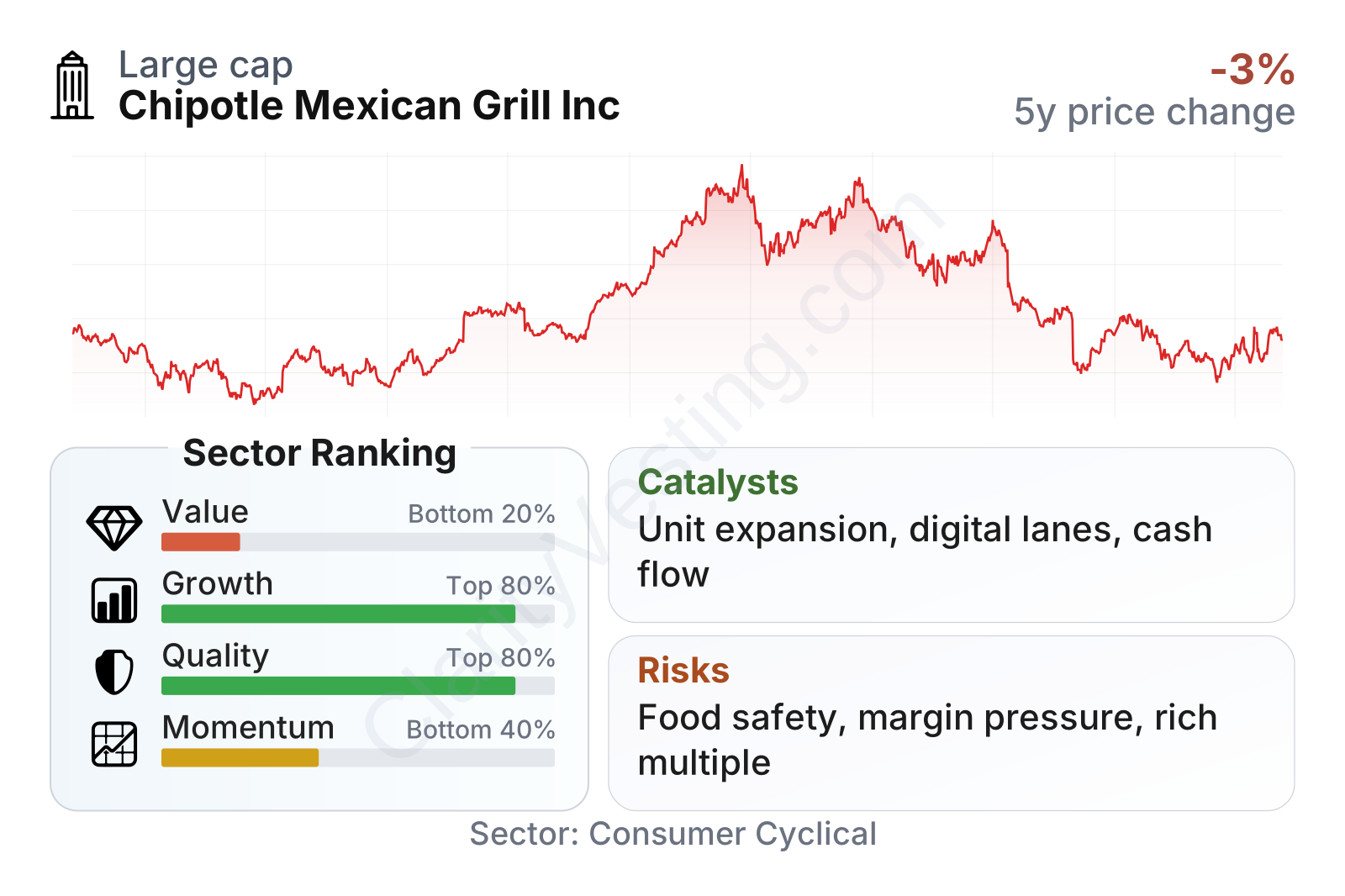
Chipotle is a large restaurant company with a market value in the tens of billions of dollars and a share-price volatility close to the broader market. The overall profile is unusual in a positive way on business quality and growth: profitability, returns on invested capital, and cash generation stand well above many restaurant peers. Revenue growth has also remained better than the sector median. The weaker areas are valuation and recent stock performance, as the shares still trade at richer multiples than much of the sector even after a noticeable pullback.
Growth
Chipotle operates in a part of the restaurant market that still has room to grow. Fast-casual dining sits between traditional fast food and more expensive casual dining, and it benefits from consumer demand for speed, convenience, customization, and perceived food quality. These habits fit well with Chipotle’s assembly-line format and digital ordering system.
The company’s strategy for future expansion is easy to follow. It continues to open new restaurants, with a strong focus on locations that include digital pickup lanes. These formats can improve convenience and throughput while supporting order volumes beyond the in-store line. Because the brand remains underpenetrated relative to its national ambitions, unit expansion is still a major growth lever rather than just a small add-on.
Same-store sales also remain important. Chipotle has historically grown through a mix of traffic, menu pricing, and higher digital engagement. A simplified menu can be a strength here because it keeps kitchen execution manageable while still allowing customization. Management has also put effort into throughput, operational consistency, and loyalty features, all of which can support repeat visits over time.
Revenue growth has cooled from the very strong post-pandemic period, but it remains positive and still above the sector median. The recent pattern suggests Chipotle is no longer in an exceptional rebound phase, yet it is still expanding faster than many restaurant peers.
Another encouraging point is cash generation. Free cash flow has risen materially over the last several years, showing that growth has translated into real cash rather than only accounting profit. That gives the company flexibility to invest in new restaurants, technology, supply chain support, and shareholder returns without depending heavily on outside financing.
Free cash flow has climbed from a little over $800 million to around $1.5 billion over four years, which is a strong sign of maturing scale. Even with growth investments continuing, the business has been producing substantial cash.
Recent company updates in 2026 have continued to point to restaurant expansion, operational initiatives, and digital convenience as key drivers. The biggest near-term opportunity is not a dramatic new product cycle, but the steady compounding effect of more units, higher restaurant productivity, and a brand that remains relevant with younger consumers.
Risks
This article is for informational purposes only and does not constitute financial advice. Some content is AI-generated. See Disclaimer


