Stock Analysis · CLARIVATE PLC (CLVT)
Stock Analysis · CLARIVATE PLC (CLVT)

Overview

Clarivate is an information services company that sells data, software, analytics, and workflow tools used mainly by researchers, universities, libraries, pharmaceutical companies, medical device makers, patent professionals, lawyers, and intellectual property teams. In simple terms, it helps customers find scientific information, manage research, evaluate innovation, track patents and trademarks, and make decisions based on specialized databases that are hard to replicate.

The business is built around recurring subscriptions and long-term customer relationships. Its products are usually embedded into professional workflows, which can make them sticky even when customers reduce spending elsewhere. Clarivate’s best-known assets include Web of Science in academic research and a broader set of intellectual property and life sciences solutions.

Based on the company’s segment reporting in recent filings, revenue is mainly split across three areas, with approximate weights as follows:

  • Academic & Government: roughly 40% to 45% of revenue. This includes research intelligence, bibliographic databases, library resources, and analytics tools used by universities, research institutions, and governments.
  • Intellectual Property: roughly 30% to 35% of revenue. This segment provides patent, trademark, and IP lifecycle tools, data, and services for corporations, law firms, and innovation teams.
  • Life Sciences & Healthcare: roughly 20% to 25% of revenue. This covers data and analytics used in drug development, regulatory work, commercial strategy, and healthcare decision support.

That mix matters because the academic and IP activities tend to be relatively recurring, while life sciences can give Clarivate exposure to a healthcare data market with long-term structural demand. At the same time, the company is still working through a multi-year cleanup after a period marked by acquisitions, integration complexity, and weak earnings quality.

The long-term pattern shows a business with high gross profit but a large gap between gross profit and net income. Revenue has gradually declined from its 2022 peak, while interest expense has remained heavy. Operating profitability improved materially in 2025, but the company still has work to do to turn strong cash generation into consistently solid accounting earnings.

Key Figures

MetricValueSector
DateJul 18, 2026
Context
SectorTechnology
IndustryInformation Technology Services
Market Cap $1.53B
Beta 1.39
Value
(Cheapness)
P/E Ratio N/A31.76
FCF Yield 39.08%4.18%
EBIT / EV 3.06%2.56%
PEG 0.17
Growth
(Business expansion)
Revenue Growth -1.40%13.50%
RPS Growth (5Y CAGR) 5.63%8.57%
EPS Growth (5Y CAGR) -35.85%-21.87%
Margin Growth (5Y Trend) N/A0.41%
FCF Growth (5Y CAGR) 4.49%9.76%
Quality
(Business durability)
ROIC (Latest) 1.45%8.54%
ROIC (5Y Median) -0.03%8.12%
Net Debt / EBIT (Latest) 23.750.38
Net Debt / EBIT (5Y Median) N/A0.38
Operating Margin (Latest) 7.06%9.58%
Operating Margin (5Y Median) -0.30%8.25%
Debt to Equity (Latest) 90.51%33.52%
Profit Margin (Latest) -5.61%6.96%
Free Cash Flow (Latest) $597.10M
Momentum
(Price trend)
3Y Return -75.86%+30.91%
12M Return (excl. last month) -51.42%+28.90%
6M Return -25.78%+5.38%
Price vs. 200-Day MA -15.74%+7.61%
Better than sector median
Slightly worse than sector median
More than 20% worse than sector median

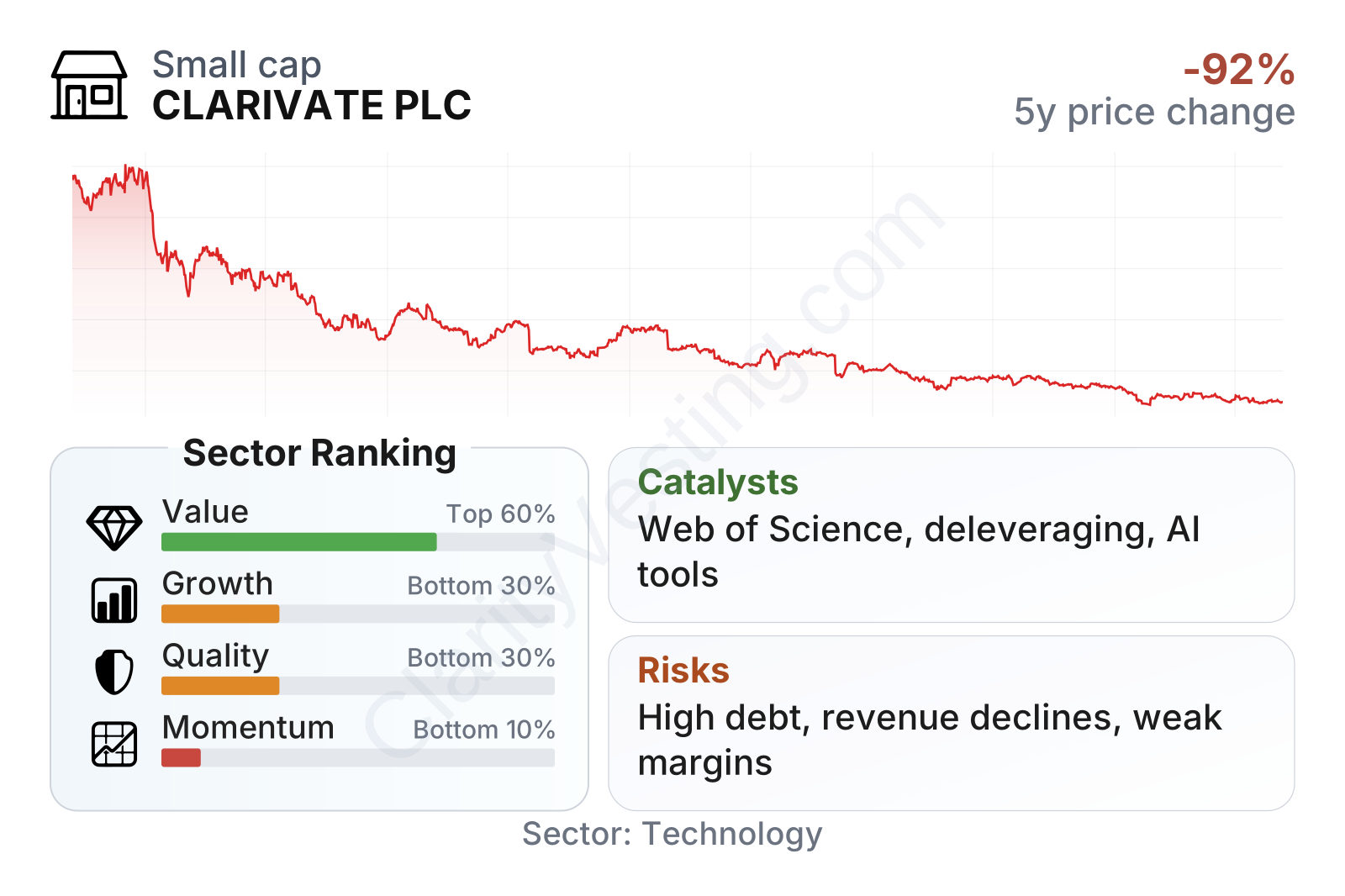
Clarivate’s profile is unusual. On one side, it screens as inexpensive on cash flow-based measures, with free cash flow yield far above the sector median and enterprise-value-based earnings measures also somewhat better than the typical technology services peer. On the other side, growth, quality, and market momentum rank poorly. Revenue has been slightly negative year over year, returns on invested capital are weak, leverage is elevated, and the stock has underperformed the sector by a very wide margin over one, three, and recent six-month periods. In short, the market is recognizing cash generation, but still discounting the business because of balance-sheet pressure, uneven profitability, and limited topline momentum.

Growth

Clarivate operates in sectors that are attractive over the long run. Research analytics, scientific information, patent intelligence, and healthcare data all benefit from durable trends: rising research output, more complex intellectual property environments, larger volumes of scientific literature, and increasing pressure on healthcare and drug-development efficiency. These are not fad-driven markets. They are tied to institutions and professional users that rely on trusted content and workflow integration.

The main issue is not whether the end markets are relevant, but whether Clarivate can convert that relevance into steady organic growth. Recent performance suggests that growth has been difficult to sustain. After strong acquisition-related expansion earlier in the cycle, revenue growth turned flat to negative and has remained below the broader sector.

The recent trend points to a company that has moved past the sharp swings of prior years but has not yet re-established a durable growth engine. Revenue declines have generally been modest rather than catastrophic, which suggests customer retention is still meaningful, but that alone is not enough to support a stronger market view unless the company starts adding cleaner organic expansion.

Management’s current strategy is centered more on simplification and execution than on aggressive expansion. That includes portfolio focus, cost discipline, deleveraging, and stronger product alignment around core information assets. For a company in Clarivate’s position, that strategy is logical. A cleaner operating model could eventually matter more than near-term sales acceleration, especially because many of its products sit in mission-critical workflows where incremental pricing, cross-selling, and retention improvements can have a meaningful effect.

Cash generation is one of the strongest parts of the case. Free cash flow has remained substantial and recently rebounded sharply, reaching a level that is large relative to the company’s current market value. That does not erase the company’s problems, but it does show the underlying business still produces significant cash despite weak net income.

A meaningful catalyst would be proof that simplification is translating into more stable organic revenue, better margins, and debt reduction. Another potential opportunity is deeper use of AI-enabled search, analytics, and workflow tools across scientific and patent databases. Clarivate owns content-rich assets where better discovery and automation features could improve product value without requiring a complete reinvention of the business. Recent company communications have also emphasized operational improvement and focus on core franchises, which is important because those franchises remain relevant even if recent execution has been inconsistent.

Risks

The biggest risk is leverage. Clarivate’s debt load remains high relative to its earnings base, and that limits flexibility. Interest expense has stayed substantial for years, which means a meaningful share of operating improvement can be absorbed before it reaches shareholders. A business with recurring revenue can support some debt, but Clarivate currently looks stretched compared with most peers.

The balance sheet trend has deteriorated over time. Debt to equity has risen from roughly the 50% area several years ago to around 90% recently, while the sector median is much lower. That does not automatically create a near-term crisis, but it does raise the importance of refinancing conditions, execution discipline, and consistent cash conversion.

Profitability is the second major concern. Clarivate has posted repeated net losses, partly tied to amortization, impairments, restructuring, and financing burden. Even though some of those items are non-cash or non-recurring, they still matter because they reflect the economic cost of prior acquisitions and the challenge of turning scale into durable returns.

The recent direction is better than the worst periods, but profit margin is still negative while the sector median remains clearly positive. This gap helps explain why the market is skeptical. Investors are not just looking for losses to narrow; they are looking for evidence that Clarivate can earn sustainably attractive returns from its assets.

Competition is real, although Clarivate does have some defensible positions. In academic research and citation data, it competes with Elsevier, Digital Science, and other scholarly information providers. In intellectual property, it faces rivals such as Questel, LexisNexis IP, and specialized patent analytics vendors. In life sciences and healthcare information, competition includes large data and analytics firms with broader healthcare reach. Clarivate is not the undisputed leader across all of these categories, but it does control recognized brands, proprietary content, and embedded workflows that give it switching-cost advantages in several niches.

That said, those advantages are narrower than the moat implied by the company’s legacy reputation. Customers have become more price-sensitive, open-source tools have improved in some research tasks, and AI-based interfaces could reshape how users access and compare information. If Clarivate does not improve product experience fast enough, data assets that once felt hard to challenge could become easier to route around.

Another risk to watch is execution credibility. Over the last few years, the company has had to deal with weak stock performance, restructuring efforts, and the aftermath of acquisitions that did not clearly translate into stronger shareholder outcomes. There is no need for a scandal to create risk here; persistent underdelivery on revenue and earnings goals would be enough to keep pressure on the valuation.

Valuation

Clarivate is difficult to value with simple headline ratios because reported earnings remain negative, which makes the standard price-to-earnings measure largely unusable. That is why cash flow and enterprise-value-based measures are more informative in this case.

The absence of a meaningful P/E line for most of the period reflects the company’s lack of consistent positive earnings, while the broader sector has traded around much healthier earnings multiples. This is a reminder that Clarivate is not being priced like a typical stable software or data business, even though some of its operations have subscription-like characteristics.

On a cash-flow basis, the stock looks optically cheap. The market capitalization is modest relative to the company’s recent free cash flow, and the free cash flow yield stands far above sector norms. That usually signals either a strong bargain or a market belief that current cash generation is not fully secure. In Clarivate’s case, the discount appears tied to leverage, weak growth, low returns on capital, and the risk that future improvements take longer than expected.

So the current valuation looks low compared with the company’s underlying cash production, but not obviously low compared with the full set of business risks. The market is assigning limited value to a recovery beyond stabilization. If Clarivate can show that cash flow remains durable while revenue turns stable and debt declines, the valuation framework could look conservative. If not, the low multiple is easier to justify.

Conclusion

Clarivate remains a relevant provider of specialized data, research intelligence, and workflow software in markets that should stay important for many years. Its products serve real institutional needs, its content assets are difficult to recreate quickly, and its cash generation is stronger than the income statement first suggests. Those are meaningful positives.

Still, the company is in a repair phase rather than a position of strength. Revenue has been stagnant to slightly negative, profitability remains weak by sector standards, leverage is high, and the stock’s multi-year collapse shows how little patience the market has left for execution missteps. The central question is not whether Clarivate owns valuable assets; it is whether management can turn those assets into a cleaner, less leveraged, and more consistently growing business.

At the current valuation, the market is clearly emphasizing the company’s problems more than its franchise value. That makes Clarivate look less like a straightforward high-quality compounder and more like a restructuring and stabilization case built on strong information assets. The upside in perception depends heavily on execution, while the downside is tied mainly to debt and the risk that slow erosion continues longer than expected.

Sources:

  • Clarivate Plc — Annual Report on Form 10-K for fiscal year 2025
  • Clarivate Plc — Quarterly Report on Form 10-Q for quarter ended March 31, 2026
  • SEC EDGAR — Clarivate Plc filings and exhibits
  • Clarivate Investor Relations — earnings releases and investor presentation materials published in 2026
  • Clarivate Investor Relations — company-hosted earnings call materials published in 2026
  • Wikipedia — Clarivate basic company background and history

This article is for informational purposes only and does not constitute financial advice. Some content is AI-generated. See Disclaimer


Sign up for exclusive research and insights.

Unsubscribe anytime.
