Stock Analysis · Cellebrite DI (CLBT)
Overview
Cellebrite DI is a digital investigations software company focused on helping public-sector and enterprise customers collect, review, analyze, and manage digital evidence. In simple terms, its tools are used to extract and organize information from phones, computers, cloud accounts, and other digital sources so investigators can work faster and with more structure. The company is best known for serving law enforcement, but it also sells to intelligence agencies, defense organizations, private-sector investigative teams, and corporate functions such as internal investigations and e-discovery.
The business model is increasingly centered on software and recurring subscriptions rather than one-time hardware sales. That matters because recurring software revenue is usually more predictable and often carries higher margins. Cellebrite has also been expanding from device access and extraction into a broader end-to-end workflow, including evidence management, analytics, and cloud-based offerings.
Based on company disclosures, revenue is primarily generated from software subscriptions and related services, with a smaller contribution from hardware and professional services. Exact splits can vary by year, but the broad mix is heavily tilted toward software.
- Recurring software and subscriptions: approximately 75% to 80% of revenue. This includes digital intelligence platforms, analytics, investigative workflow tools, and cloud or term-based software arrangements.
- Services: approximately 10% to 15% of revenue. This typically includes training, support, maintenance, and professional services tied to deployments and customer usage.
- Hardware and other products: approximately 10% to 15% of revenue. This mainly includes device access and extraction equipment sold alongside software.
The financial profile has improved meaningfully over time. Revenue has risen from about $246 million in 2021 to roughly $476 million in 2025, while gross profit has remained strong. Profitability has been uneven because reported earnings were affected by unusual items in some periods, but the underlying operating model now looks more software-driven and cash-generative than it did a few years ago.
The revenue mix shows a company with high gross margins and growing scale. One notable point is that reported net income was distorted in some years by non-core items, while revenue, gross profit, and free cash flow followed a steadier upward path. Research and development spending has also remained substantial, which supports product expansion but keeps pressure on short-term margins.
Key Figures
| Metric | Value | Sector ⓘ |
|---|---|---|
| Date | Sep 12, 2026 | |
| Context | ||
| Sector | Technology | |
| Industry | Software - Infrastructure | |
| Market Cap ⓘ | $2.85B | |
| Beta ⓘ | 1.15 | |
Value (Cheapness) | ||
| P/E Ratio ⓘ | 49.24 | 29.51 |
| FCF Yield ⓘ | 4.90% | 4.25% |
| EBIT / EV ⓘ | 3.71% | 2.85% |
| PEG ⓘ | N/A | |
Growth (Business expansion) | ||
| Revenue Growth ⓘ | 15.80% | 15.40% |
| RPS Growth (5Y CAGR) ⓘ | 5.71% | 8.56% |
| EPS Growth (5Y CAGR) ⓘ | -12.39% | -11.88% |
| Margin Growth (5Y Trend) ⓘ | -14.31% | 0.46% |
| FCF Growth (5Y CAGR) ⓘ | 53.65% | 9.80% |
Quality (Business durability) | ||
| ROIC (Latest) ⓘ | 14.60% | 9.44% |
| ROIC (5Y Median) ⓘ | -44.83% | 8.30% |
| Net Debt / EBIT (Latest) ⓘ | -1.30 | 0.54 |
| Net Debt / EBIT (5Y Median) ⓘ | -1.12 | 0.44 |
| Operating Margin (Latest) ⓘ | 17.71% | 9.58% |
| Operating Margin (5Y Median) ⓘ | 19.17% | 8.25% |
| Debt to Equity (Latest) ⓘ | 4.32% | 33.33% |
| Profit Margin (Latest) ⓘ | 11.43% | 7.14% |
| Free Cash Flow (Latest) ⓘ | $139.59M | |
Momentum (Price trend) | ||
| 3Y Return ⓘ | +51.14% | +45.48% |
| 12M Return (excl. last month) ⓘ | +9.63% | +23.48% |
| 6M Return ⓘ | -22.71% | +20.93% |
| Price vs. 200-Day MA ⓘ | -22.93% | +7.43% |
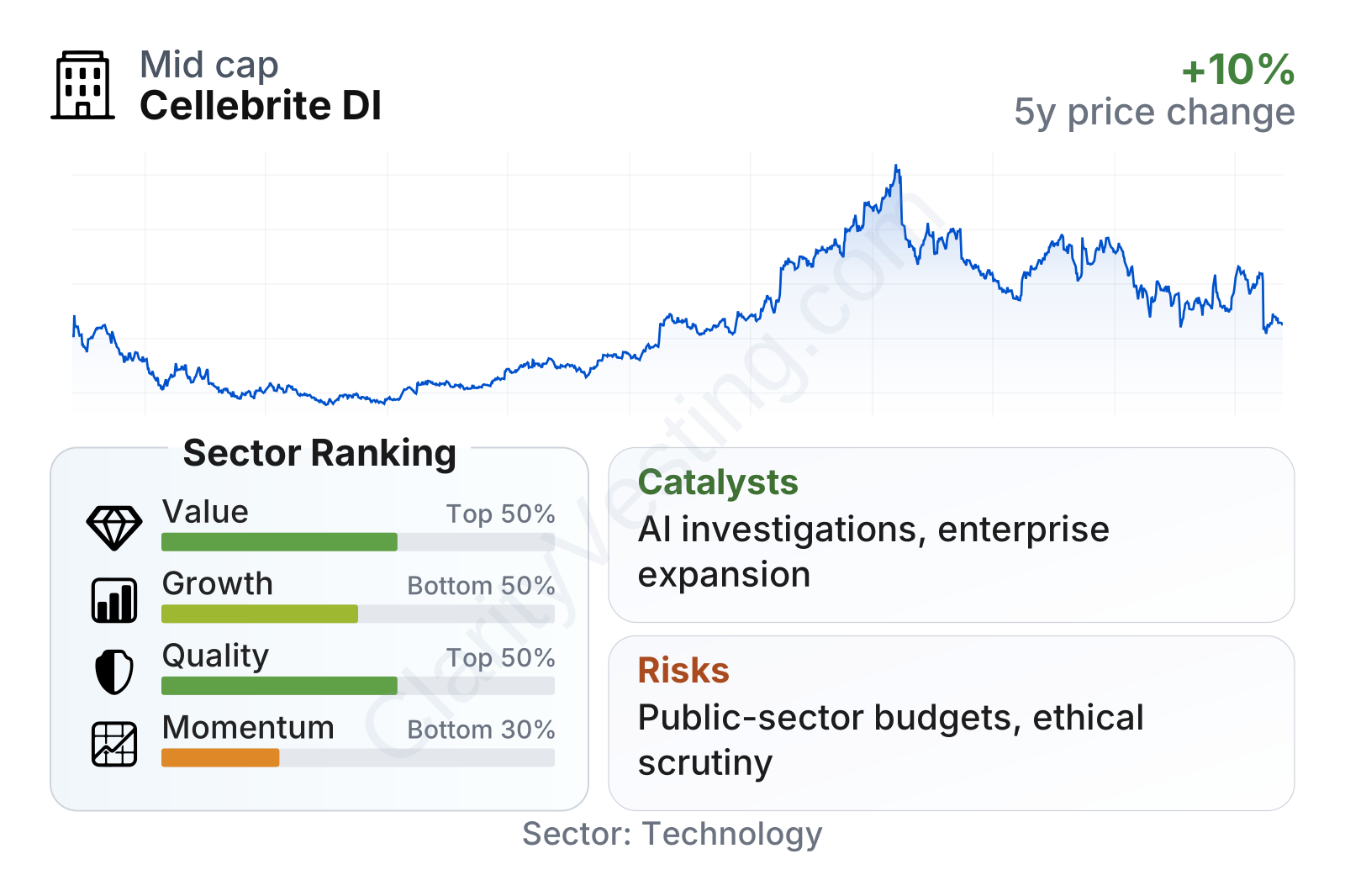
Cellebrite currently sits in the upper half of its sector on value and quality measures, but growth and share-price momentum are weaker relative to many software peers. The company stands out for strong returns on invested capital, above-median operating profitability, solid free cash flow generation, and a very light balance-sheet burden. At the same time, recent revenue growth is only around the sector median, the longer-term revenue-per-share trend is less impressive, and the stock has been under pressure in recent months despite the company’s improved cash profile.
The stock’s path has been volatile since listing, with a deep decline in 2022, a strong rebound through 2024 and early 2025, and then a visible pullback into 2026. That pattern suggests the market has already recognized much of the company’s operational improvement, but sentiment has become less enthusiastic as valuation and execution expectations rose.
Growth
Cellebrite operates in a sector with durable long-term demand. Digital evidence keeps growing as more communication, payments, files, and daily activity move onto smartphones, apps, cloud platforms, vehicles, and connected devices. That creates a structural need for tools that can gather and interpret information at scale. Public safety agencies, prosecutors, intelligence organizations, and corporate investigative teams all face rising data volumes and increasing complexity, which supports long-run demand for specialized digital investigation software.
The company’s strategy also appears coherent. It is moving from a narrower forensic extraction identity toward a broader platform approach. That expansion matters because a customer that starts with one use case can potentially adopt additional modules for review, analytics, evidence management, and collaboration. This can improve retention, raise revenue per customer, and deepen customer dependence on the platform.
Revenue growth has remained positive for a long stretch and was especially strong through 2023, 2024, and early 2025, often running in the high-teens to high-20s range. More recently, growth has moderated to the mid-teens, which still indicates expansion but suggests the business is no longer in its fastest phase. In other words, Cellebrite remains a grower, but it now has to prove it can sustain strong expansion as the revenue base gets larger.
Cash generation is one of the more encouraging aspects of the company’s trajectory. Free cash flow has increased sharply over the past several years, rising from a modest level in 2022 to well above $150 million on a trailing basis by early 2026. That is a strong signal that the business is not just growing revenue, but increasingly turning that growth into cash that can support acquisitions, product development, and balance-sheet flexibility.
Recent company updates have also highlighted product broadening and greater use of artificial intelligence in investigative workflows. That can be a meaningful catalyst because AI tools can help customers sift through larger volumes of digital evidence faster, making the platform more valuable without requiring equivalent growth in headcount. Another relevant opportunity is international expansion and broader enterprise adoption beyond traditional law enforcement customers.
A further growth angle comes from regulation and operational pressure. Many agencies and organizations are under pressure to reduce evidence backlogs, improve chain-of-custody processes, and handle more encrypted or cloud-based data sources. A platform that can save time and improve case throughput may benefit from these pressures even when customer budgets are tight.
Risks
This article is for informational purposes only and does not constitute financial advice. Some content is AI-generated. See Disclaimer


