Stock Analysis · Cipher Mining Inc (CIFR)
Overview
Cipher Mining Inc is a U.S.-based Bitcoin mining company. In simple terms, it runs large computing facilities that help secure the Bitcoin network and, in return, earn Bitcoin as compensation. The business is built around access to power, specialized mining machines, and data center infrastructure. Cipher has focused on developing industrial-scale sites in the United States, which matters because electricity cost and reliability are two of the biggest drivers of profitability in Bitcoin mining.
The company’s revenue is heavily concentrated in one activity: Bitcoin mining. Based on its recent filings, the business has generated nearly all of its revenue from the production of Bitcoin, with a smaller contribution from related services and energy-related activities when applicable. The mix can shift by quarter depending on curtailment programs, power market conditions, and whether the company sells Bitcoin it has mined, but the core model remains straightforward.
- Bitcoin mining revenue: approximately 85% to 95% of total revenue in recent periods. This is the main engine of the business and comes from earning Bitcoin through operating mining machines.
- Ancillary and power-related revenue: approximately 5% to 15%. This can include demand response, curtailment-related power credits, and other site-level operating income tied to managing energy usage.
Cipher’s operating profile shows a company that has been scaling quickly. Revenue expanded sharply from 2022 to 2025, but costs and capital spending also rose substantially as the company built out capacity. That combination is common in this industry: growth often arrives before stable profitability.
The business has clearly increased its revenue base over the last several years, but the path from sales to earnings remains weak. Gross profit improved as operations expanded, yet operating expenses and other charges have kept net income deeply negative, especially during periods of aggressive buildout.
Key Figures
| Metric | Value | Sector ⓘ |
|---|---|---|
| Date | Sep 12, 2026 | |
| Context | ||
| Sector | Technology | |
| Industry | Information Technology Services | |
| Market Cap ⓘ | $6.62B | |
| Beta ⓘ | 3.17 | |
Value (Cheapness) | ||
| P/E Ratio ⓘ | N/A | 29.51 |
| FCF Yield ⓘ | -22.61% | 4.25% |
| EBIT / EV ⓘ | N/A | 2.85% |
| PEG ⓘ | N/A | |
Growth (Business expansion) | ||
| Revenue Growth ⓘ | -43.00% | 15.40% |
| RPS Growth (5Y CAGR) ⓘ | 263.23% | 8.56% |
| EPS Growth (5Y CAGR) ⓘ | -22.35% | -11.88% |
| Margin Growth (5Y Trend) ⓘ | N/A | 0.46% |
| FCF Growth (5Y CAGR) ⓘ | N/A | 9.80% |
Quality (Business durability) | ||
| ROIC (Latest) ⓘ | N/A | 9.44% |
| ROIC (5Y Median) ⓘ | -6.76% | 8.30% |
| Net Debt / EBIT (Latest) ⓘ | N/A | 0.54 |
| Net Debt / EBIT (5Y Median) ⓘ | N/A | 0.44 |
| Operating Margin (Latest) ⓘ | N/A | 9.58% |
| Operating Margin (5Y Median) ⓘ | -190.24% | 8.25% |
| Debt to Equity (Latest) ⓘ | 993.99% | 33.33% |
| Profit Margin (Latest) ⓘ | N/A | 7.14% |
| Free Cash Flow (Latest) ⓘ | -$1.50B | |
Momentum (Price trend) | ||
| 3Y Return ⓘ | +501.79% | +45.48% |
| 12M Return (excl. last month) ⓘ | +278.60% | +23.48% |
| 6M Return ⓘ | +22.90% | +20.93% |
| Price vs. 200-Day MA ⓘ | -8.57% | +7.43% |
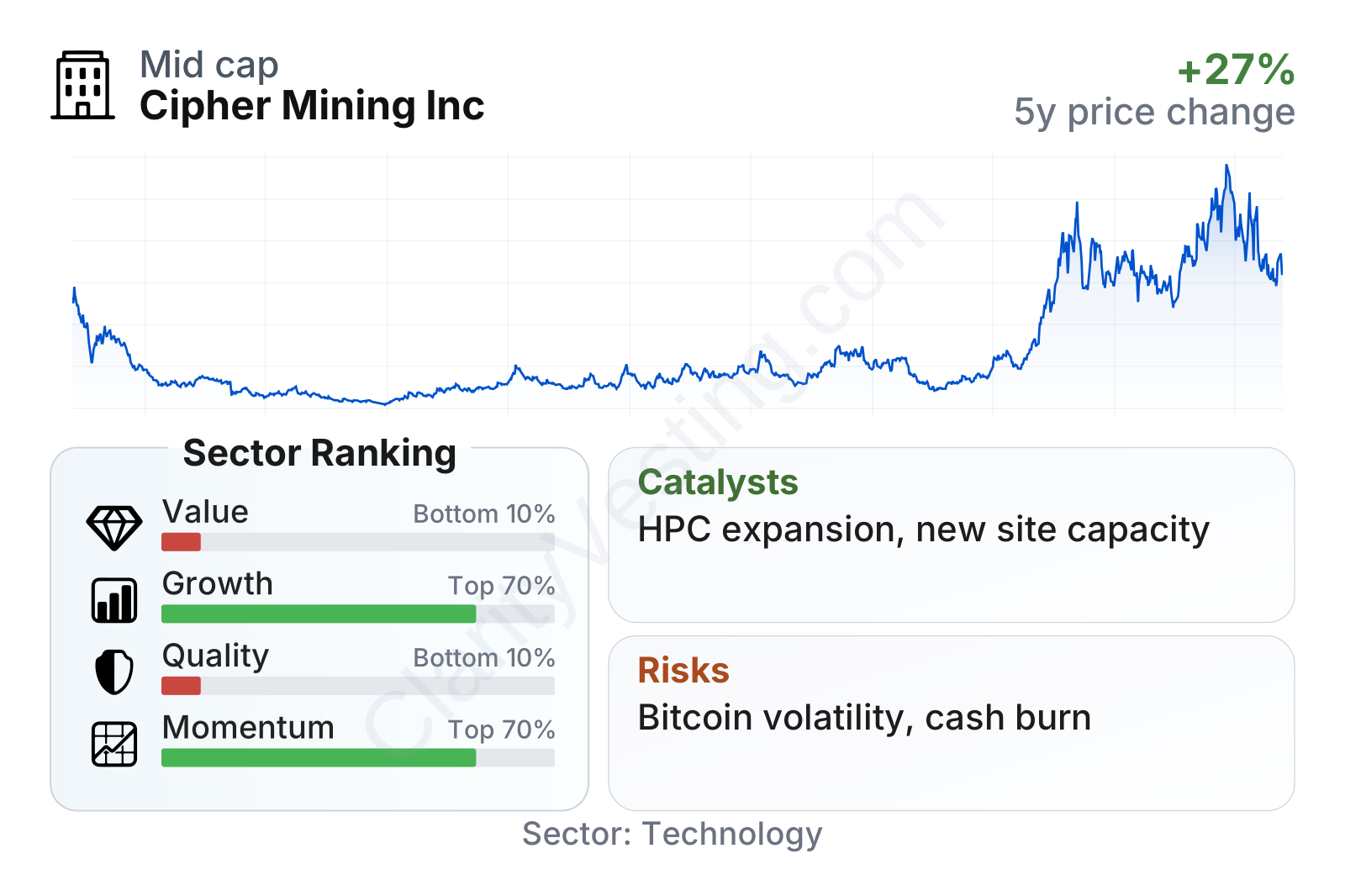
Cipher is now a large public company by market value, but its profile is unusual compared with the broader technology sector. Growth and market momentum look stronger than many peers over multi-year periods, while value and quality metrics rank near the bottom of the sector. That split reflects a business with meaningful expansion potential, but also low current profitability and very heavy cash demands. The stock has also been highly volatile, with a beta above 3, which means price swings have been far larger than the overall market.
Growth
Bitcoin mining is part of a growing digital asset infrastructure market, but it is not a smooth growth industry. Long-term expansion depends on Bitcoin adoption, mining economics, access to low-cost electricity, and the ability to keep upgrading machines as the network becomes more competitive. Cipher’s strategy makes sense within that context: it is building large-scale U.S. capacity in locations where power access can support industrial mining over time.
A key positive is that Cipher has shown an ability to grow its operating footprint over several years. The longer-term revenue trend has been strong even though the latest year-over-year comparison turned negative, which is a reminder that quarterly results can swing sharply with Bitcoin prices, network difficulty, weather, and fleet upgrades.
The revenue pattern is volatile rather than linear. There were periods of very strong expansion, including exceptional spikes, followed by contractions. For a long-term view, the more important point is that the company has built a much larger revenue base than it had just a few years ago, even if short-term comparisons remain noisy.
Another major growth catalyst is high-performance computing, or HPC. Cipher has recently emphasized that some of its power capacity and infrastructure could be used for AI and data center workloads, not only Bitcoin mining. That matters because HPC contracts can potentially provide more predictable and diversified revenue than mining alone. During 2025 and 2026, the company released updates tied to site development, financing, and infrastructure expansion that support this broader data center angle. If execution is successful, the market may increasingly view Cipher as more than a pure Bitcoin miner.
Still, growth currently comes with a large cash cost.
Free cash flow has remained deeply negative and has worsened as the company invested in new facilities and equipment. That does not automatically invalidate the expansion plan, but it does mean the business is still in a build phase rather than a harvest phase. For long-term analysis, the main question is whether today’s spending creates durable low-cost capacity that can earn strong returns later.
Risks
This article is for informational purposes only and does not constitute financial advice. Some content is AI-generated. See Disclaimer


