Stock Analysis · Ciena Corp (CIEN)
Overview
Ciena is a communications equipment and network software company that helps telecom carriers, cloud providers, governments, and large enterprises move massive amounts of data across fiber networks. In simple terms, its products sit behind the internet’s heavy traffic: video streaming, cloud computing, mobile backhaul, and the links connecting data centers and long-distance networks.
The business is centered on high-capacity optical networking, which is the technology used to send data through fiber at very high speeds. Ciena also sells software that helps customers automate and manage their networks, plus related services such as installation, maintenance, consulting, and support. This mix matters because hardware usually drives scale, while software and services can help deepen customer relationships and improve visibility on future revenue.
Based on recent company reporting, Ciena’s revenue is mainly split into the following sources:
- Networking platforms: approximately 75% to 80% of revenue. This is the core hardware business, including optical transport systems, routing and switching platforms, and broadband access-related equipment.
- Platform software and services: approximately 20% to 25% of revenue combined. This includes network control and automation software, analytics, support, maintenance, professional services, and deployment work.
Within its customer base, large telecom service providers remain the biggest buyers, but cloud and web-scale customers have become increasingly important as artificial intelligence workloads and data center interconnection demand more bandwidth. That gives Ciena exposure to both traditional carrier spending and newer infrastructure buildouts tied to cloud and AI traffic.
The company’s cost structure also shows a business that invests heavily in research and development. Over the last several years, revenue has risen from roughly the low-$3 billion range to nearly $4.8 billion, while research spending has also climbed materially. That suggests management is prioritizing product leadership in a market where technical performance can strongly influence customer wins.
The broader financial flow points to a company with meaningful scale, solid gross profit generation, and a large commitment to product development. Revenue has expanded over time, but net income has been much more uneven, which is important for understanding both the opportunity and the volatility in the business model.
Key Figures
| Metric | Value | Sector ⓘ |
|---|---|---|
| Date | Sep 12, 2026 | |
| Context | ||
| Sector | Technology | |
| Industry | Communication Equipment | |
| Market Cap ⓘ | $47.44B | |
| Beta ⓘ | 1.31 | |
Value (Cheapness) | ||
| P/E Ratio ⓘ | 75.69 | 29.51 |
| FCF Yield ⓘ | 1.52% | 4.25% |
| EBIT / EV ⓘ | 0.95% | 2.85% |
| PEG ⓘ | 0.58 | |
Growth (Business expansion) | ||
| Revenue Growth ⓘ | 37.00% | 15.40% |
| RPS Growth (5Y CAGR) ⓘ | 9.19% | 8.56% |
| EPS Growth (5Y CAGR) ⓘ | 50.08% | -11.88% |
| Margin Growth (5Y Trend) ⓘ | -8.45% | 0.46% |
| FCF Growth (5Y CAGR) ⓘ | 9.54% | 9.80% |
Quality (Business durability) | ||
| ROIC (Latest) ⓘ | 14.37% | 9.44% |
| ROIC (5Y Median) ⓘ | 5.28% | 8.30% |
| Net Debt / EBIT (Latest) ⓘ | 0.98 | 0.54 |
| Net Debt / EBIT (5Y Median) ⓘ | 1.55 | 0.44 |
| Operating Margin (Latest) ⓘ | 9.82% | 9.58% |
| Operating Margin (5Y Median) ⓘ | 6.48% | 8.25% |
| Debt to Equity (Latest) ⓘ | 7.76% | 33.33% |
| Profit Margin (Latest) ⓘ | 10.87% | 7.14% |
| Free Cash Flow (Latest) ⓘ | $718.99M | |
Momentum (Price trend) | ||
| 3Y Return ⓘ | +616.12% | +45.48% |
| 12M Return (excl. last month) ⓘ | +348.18% | +23.48% |
| 6M Return ⓘ | +3.77% | +20.93% |
| Price vs. 200-Day MA ⓘ | -8.10% | +7.43% |
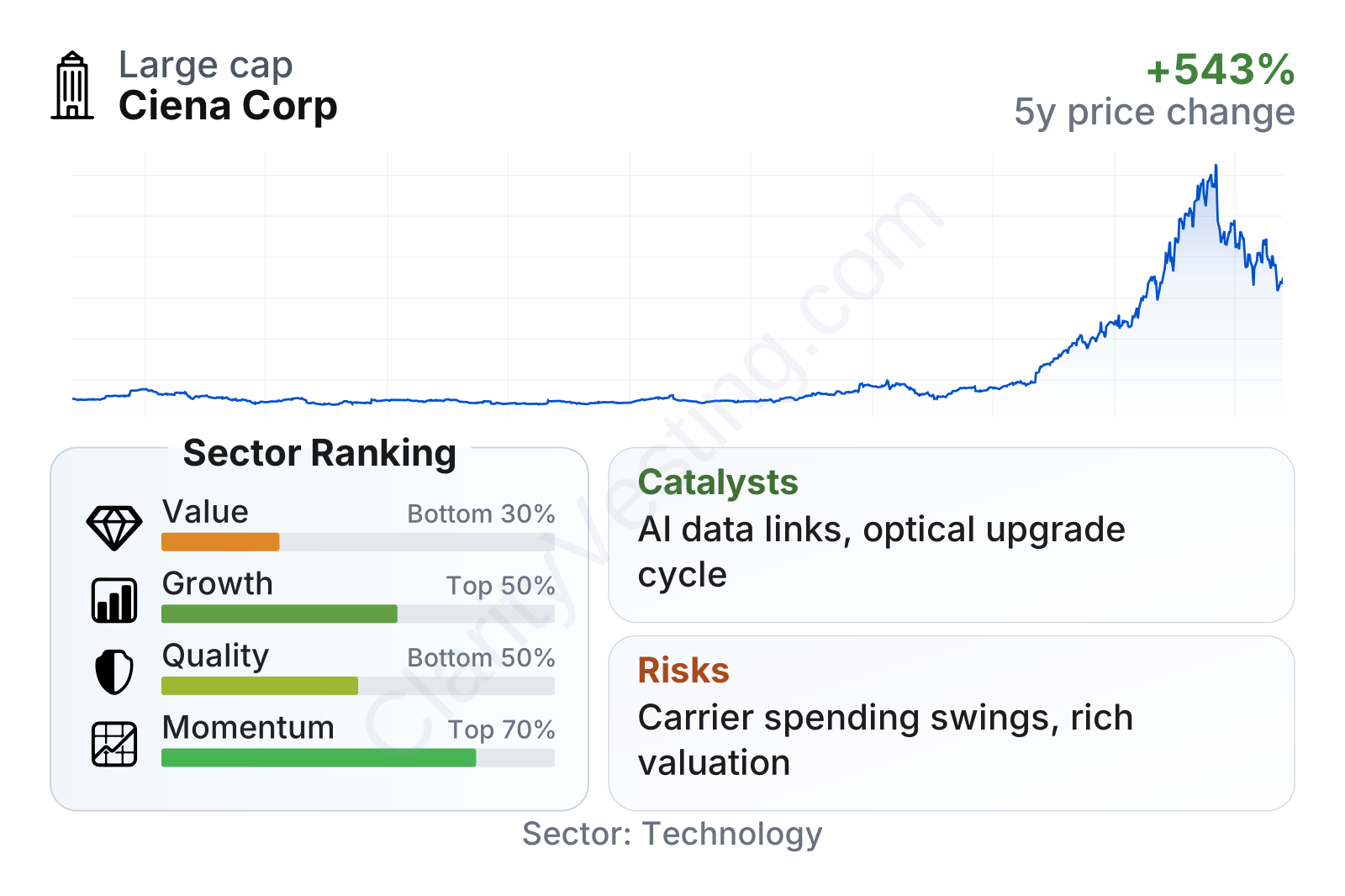
Ciena currently sits in the large-cap range and shows above-average share price volatility, with a beta around 1.3. The stock’s long-term price performance has been exceptionally strong, but the metrics table also shows a mixed fundamental picture: growth ranks relatively well versus the sector, while value looks weak because the earnings multiple and cash flow yield are less favorable than many peers. Quality is mixed rather than poor overall, with strong recent returns on capital and low balance-sheet leverage, but a less consistent historical margin profile.
Growth
Ciena operates in a sector with durable long-term demand drivers. Global data traffic continues to rise as cloud computing, video, 5G, and artificial intelligence applications require more capacity. Fiber remains the backbone of that system, and optical transport upgrades are not optional forever: networks eventually need more speed, better efficiency, and improved automation. That places Ciena in a market with structural growth, even if customer spending can be cyclical from year to year.
The company’s strategy also makes industrial sense. Ciena is not only selling boxes; it is combining transport hardware, routing, software control, and services. That can make deployments more integrated and harder to replace once installed. It also positions the company to capture more spending per customer as networks become more programmable and more closely linked with cloud infrastructure.
Recent revenue momentum has clearly improved. After a weak period in 2024, year-over-year growth turned positive again and accelerated into 2026, reaching roughly the high-30% range most recently, well ahead of the sector median. That kind of rebound usually signals either a healthier demand environment, market share gains, easier comparisons, or a combination of all three. It does not remove cyclicality, but it does show that the business is participating in a stronger spending cycle.
Cash generation has also recovered meaningfully. Free cash flow moved from negative territory in 2023 to a much stronger positive level more recently, reaching roughly $700 million to $750 million on a trailing basis. For long-term analysis, that matters because cash flow is often a better test of business strength than revenue alone. A company can grow sales without creating much value if margins are weak or working capital is unstable. Ciena’s recent recovery in cash generation is therefore a constructive signal, even though its history shows this figure can swing sharply.
One of the clearest catalysts is the buildout of data center interconnect and metro capacity tied to AI infrastructure. Training and running AI models creates very large data flows between data centers, which increases the need for high-capacity optical links. Ciena has repeatedly emphasized this demand area in company communications, and it fits the company’s core strengths. Another support factor is ongoing product evolution toward higher-speed coherent optics and more automated network management, which can help customers lower cost per transported bit while expanding throughput.
Recent company updates have also pointed to strong order activity and improving customer spending patterns in parts of the business that had previously been soft. That does not guarantee a straight-line expansion, but it reinforces the view that Ciena is positioned in an area where infrastructure demand can remain healthy for several years.
Risks
This article is for informational purposes only and does not constitute financial advice. Some content is AI-generated. See Disclaimer


