Stock Analysis · Chime Financial Inc (CHYM)
Overview
Chime Financial Inc is a digital consumer finance company best known for mobile-first checking and savings accounts, debit cards, early access to paychecks, credit-building tools, and short-term liquidity features. Rather than operating like a traditional bank with a large branch network, Chime distributes its services through an app and partners with regulated banks to provide core banking services. Its positioning is centered on everyday consumers, especially people looking for lower fees, simpler money management, and faster access to wages.
Its business model is different from many traditional financial institutions because a large share of revenue comes from customer spending activity instead of charging monthly account fees. Based on the company’s public filings around its IPO and annual reporting, the revenue mix is dominated by payment-related income, with a smaller contribution from interchange on credit products, subscription-style or service-related products, and other arrangements tied to deposits and platform activity.
- Debit card interchange and payment processing: approximately 75% to 85% of revenue. This is the fee earned when members use Chime-linked cards for purchases.
- Credit-related interchange and transaction revenue: approximately 10% to 20%. This includes activity tied to products such as Credit Builder and other card-based usage.
- Other revenue: approximately 5% to 10%. This can include fees from optional services, interest-related arrangements, and miscellaneous platform revenue.
That concentration matters. Chime is not mainly monetizing through traditional lending spreads or branch-based services. It is monetizing engagement: more active members, more direct deposit relationships, and more card transactions. This creates a relatively asset-light model, but it also makes the company highly dependent on customer activity and payments economics.
The longer-term financial direction has been encouraging in one important way: revenue has climbed quickly over the past several years, while losses narrowed materially through 2024 before a much weaker reported result in 2025. Gross profit has remained strong relative to revenue, showing that the core platform can scale, but operating expenses expanded sharply in 2025 and overwhelmed that progress.
Revenue has expanded strongly since 2022, and gross profit has grown with it, which suggests the core platform economics are attractive. The weak point is operating discipline: after a sharp improvement through 2024, expenses jumped in 2025, especially in research and development and administrative costs, pushing reported losses much higher again.
Key Figures
| Metric | Value | Sector ⓘ |
|---|---|---|
| Date | Aug 22, 2026 | |
| Context | ||
| Sector | Technology | |
| Industry | Software - Application | |
| Market Cap ⓘ | $12.10B | |
| Beta ⓘ | N/A | |
Value (Cheapness) | ||
| P/E Ratio ⓘ | 6.16 | 30.63 |
| FCF Yield ⓘ | 2.64% | 4.23% |
| EBIT / EV ⓘ | -0.32% | 2.79% |
| PEG ⓘ | N/A | |
Growth (Business expansion) | ||
| Revenue Growth ⓘ | 26.80% | 15.90% |
| RPS Growth (5Y CAGR) ⓘ | 26.72% | 8.68% |
| EPS Growth (5Y CAGR) ⓘ | N/A | -12.38% |
| Margin Growth (5Y Trend) ⓘ | N/A | 0.39% |
| FCF Growth (5Y CAGR) ⓘ | N/A | 9.76% |
Quality (Business durability) | ||
| ROIC (Latest) ⓘ | -0.78% | 9.19% |
| ROIC (5Y Median) ⓘ | N/A | 8.21% |
| Net Debt / EBIT (Latest) ⓘ | N/A | 0.46 |
| Net Debt / EBIT (5Y Median) ⓘ | N/A | 0.42 |
| Operating Margin (Latest) ⓘ | -1.54% | 9.23% |
| Operating Margin (5Y Median) ⓘ | -32.29% | 8.19% |
| Debt to Equity (Latest) ⓘ | 9.32% | 32.74% |
| Profit Margin (Latest) ⓘ | -0.74% | 7.01% |
| Free Cash Flow (Latest) ⓘ | $318.91M | |
Momentum (Price trend) | ||
| 3Y Return ⓘ | N/A | +46.51% |
| 12M Return (excl. last month) ⓘ | -34.81% | +18.95% |
| 6M Return ⓘ | +58.97% | +18.99% |
| Price vs. 200-Day MA ⓘ | +48.37% | +9.57% |
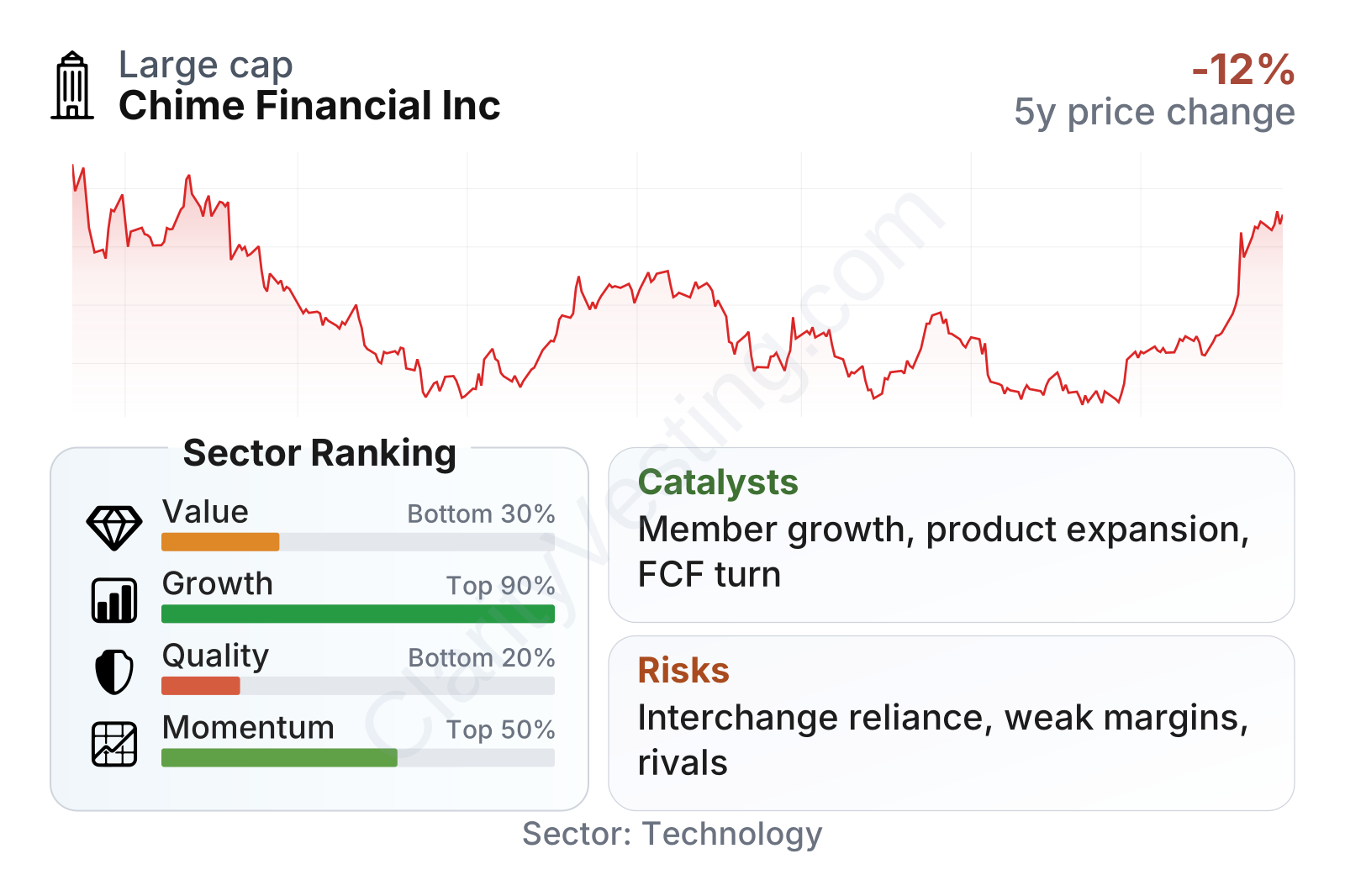
Chime is now a large public fintech by market value, but its profile is mixed. Growth ranks near the top of its sector, with revenue expansion around the high-20% range year over year and a five-year revenue-per-share growth rate far above the software median. Balance-sheet leverage looks conservative, with debt to equity near 8% versus roughly 33% for the sector median. The weak areas are profitability and returns on capital: operating margin and profit margin remain below sector norms, and return on invested capital is deeply negative. Valuation metrics look optically low on earnings, but that needs caution because earnings quality is still uneven and recent profitability has been fragile.
Growth
Chime operates in a part of finance that still has room to expand. Digital banking, embedded payments, and app-based money management continue to take share from branch-heavy banking models, especially among younger and lower-to-middle income consumers. This broader shift supports Chime’s long-term opportunity because its product design is built around mobile access, direct deposit, card usage, and financial convenience rather than legacy infrastructure.
The company’s strategy also makes sense for future growth. Chime’s core engine is to attract members with simple banking features, deepen engagement with direct deposit, and then expand usage through adjacent tools such as credit building, overdraft alternatives, and short-term liquidity products. That creates a loop where more engagement can drive more transactions, and more transactions can drive more revenue without requiring a large loan book.
Recent growth has remained strong. Year-over-year revenue growth has stayed around the mid-to-high 20% range in recent quarters, comfortably ahead of the sector median. That is a meaningful signal that Chime is still gaining scale rather than merely defending an existing user base.
Another positive point is cash generation. Trailing free cash flow turned clearly positive and improved quickly into 2026, which is important for a company still working through profitability questions. Positive free cash flow does not remove all concerns, but it does suggest the business is not purely dependent on external funding to keep operating and investing.
As a catalyst, Chime’s public-market transition itself has increased visibility and may broaden access to capital and commercial partnerships. The company has also continued to emphasize product expansion beyond basic checking accounts, which could increase revenue per active member over time. If management can show that newer products deepen engagement without materially raising losses, that would strengthen the long-term growth case.
Risks
This article is for informational purposes only and does not constitute financial advice. Some content is AI-generated. See Disclaimer