Stock Analysis · Chorus Ltd (CHRYY)
Overview
Chorus Ltd is a New Zealand telecommunications infrastructure company best known for owning and operating fixed-line broadband networks. Its core role is not selling mobile plans or entertainment bundles directly to households. Instead, it builds, maintains, and upgrades the fiber and copper access network that retail service providers use to reach homes and businesses. That makes Chorus closer to a utility-style network owner than a traditional consumer telecom brand.
The business is centered on wholesale connectivity. Revenue mainly comes from charging retail telecom providers for access to its network, especially fiber connections delivered under New Zealand’s ultra-fast broadband framework. Copper-based services still contribute, but they have been declining as customers migrate to fiber. Public company materials indicate the mix is dominated by fiber access and related wholesale services, with legacy copper and other network services making up the balance.
The broad revenue mix can be described as follows:
- Fiber broadband access services: approximately 70% to 80% of revenue. This includes regulated and contracted wholesale fiber connections for residential and business customers.
- Copper-based broadband and voice access: approximately 10% to 20% of revenue. This is the older network base and continues to shrink as fiber adoption rises.
- Other network and infrastructure services: approximately 5% to 15% of revenue. This includes field services, backhaul-related activities, and other wholesale network offerings.
That mix matters because fiber generally has better long-term economics than copper: lower strategic obsolescence, stronger demand, and a clearer role in a data-hungry economy. The company’s recent financial flow also points to a business with relatively stable revenue around the low-billion-dollar range, solid operating income generation, and earnings that are heavily influenced by financing costs.
The operating profile looks stronger than the final bottom line. Revenue has been fairly steady with a gradual upward bias, while operating income improved in the latest period. A large share of profit is still absorbed by interest expense, which helps explain why a business with healthy operating margins can still report thin net income.
Key Figures
| Metric | Value | Sector ⓘ |
|---|---|---|
| Date | Sep 12, 2026 | |
| Context | ||
| Sector | Communication Services | |
| Industry | Telecom Services | |
| Market Cap ⓘ | $2.25B | |
| Beta ⓘ | 0.40 | |
Value (Cheapness) | ||
| P/E Ratio ⓘ | 103.56 | 18.61 |
| FCF Yield ⓘ | 16.57% | 13.68% |
| EBIT / EV ⓘ | N/A | 4.54% |
| PEG ⓘ | 2.64 | |
Growth (Business expansion) | ||
| Revenue Growth ⓘ | 1.80% | 5.40% |
| RPS Growth (5Y CAGR) ⓘ | 4.55% | 4.62% |
| EPS Growth (5Y CAGR) ⓘ | -17.45% | -18.01% |
| Margin Growth (5Y Trend) ⓘ | 2.19% | 1.10% |
| FCF Growth (5Y CAGR) ⓘ | 42.14% | 5.88% |
Quality (Business durability) | ||
| ROIC (Latest) ⓘ | N/A | 8.38% |
| ROIC (5Y Median) ⓘ | 4.20% | 8.32% |
| Net Debt / EBIT (Latest) ⓘ | 9.13 | 1.99 |
| Net Debt / EBIT (5Y Median) ⓘ | 16.09 | 2.94 |
| Operating Margin (Latest) ⓘ | 25.44% | 14.89% |
| Operating Margin (5Y Median) ⓘ | 24.53% | 12.96% |
| Debt to Equity (Latest) ⓘ | 486.12% | 59.59% |
| Profit Margin (Latest) ⓘ | 3.60% | 8.77% |
| Free Cash Flow (Latest) ⓘ | $372.34M | |
Momentum (Price trend) | ||
| 3Y Return ⓘ | +38.74% | +46.64% |
| 12M Return (excl. last month) ⓘ | +9.29% | +2.16% |
| 6M Return ⓘ | -0.27% | +5.05% |
| Price vs. 200-Day MA ⓘ | -2.24% | +2.88% |
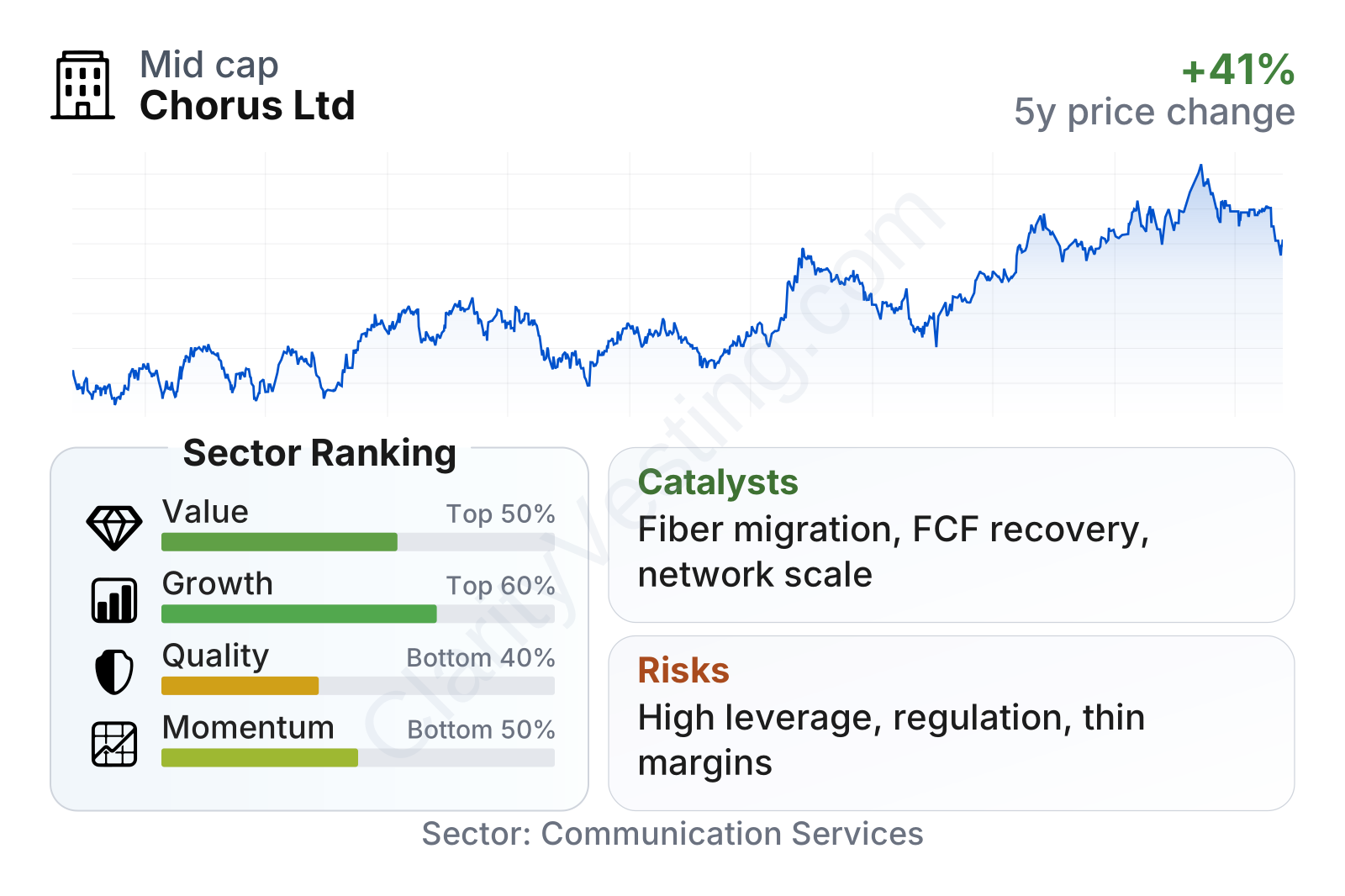
Chorus is a mid-sized telecom infrastructure company with a relatively low share-price volatility profile, as shown by its beta well below 1. Across the factor view, the picture is mixed. Value metrics are supported by a free cash flow yield above the sector median, but the headline P/E ratio is far above the sector because net profit remains compressed. Growth is moderate rather than fast, with revenue expansion below the sector median recently, although five-year free cash flow growth has been much stronger. Quality metrics are uneven: operating margins are clearly above sector norms, but leverage is materially higher and profitability after interest costs is comparatively weak.
Growth
Chorus operates in a sector with durable long-term demand. Data usage keeps rising, households are using more bandwidth-intensive applications, and businesses increasingly depend on reliable high-speed connections. Fixed fiber networks are therefore part of an expanding digital infrastructure base, even if annual revenue growth in mature telecom markets is usually not spectacular.
Its strategy broadly makes sense for that environment. Chorus has been leaning into fiber migration, network upgrades, and better utilization of an already-established access footprint. In a market like New Zealand, where the fiber build-out has already created a strong installed base, the main growth engine is not explosive customer additions but a mix of higher fiber penetration, faster speed tiers, business demand, and operating efficiency over time.
Recent topline growth appears positive but modest, closer to low single-digit percentages and below the broader sector median. That suggests Chorus is growing, but not as a high-growth telecom name. The more constructive point is that margin discipline has been better than revenue growth alone would suggest. Over the last several years, operating margin trends have improved meaningfully relative to the sector median, indicating that incremental network utilization can still create value even without rapid sales expansion.
Cash generation is an important part of the long-term case. Free cash flow has improved sharply from a negative trailing figure at the end of 2024 to a positive figure by mid-2025, and the latest metrics indicate free cash flow on a trailing basis remains substantial. For a capital-intensive network business, that improvement matters because it supports balance-sheet flexibility, dividends, and future infrastructure spending without relying entirely on new borrowing.
A notable catalyst is the continued shift from copper to fiber. Each migration step reinforces the relevance of Chorus’s modern network and reduces dependence on an aging platform. Another favorable element is that fiber infrastructure tends to be hard to replicate economically, especially at national scale. If demand for higher-speed broadband, cloud access, remote work infrastructure, and digital services keeps expanding, Chorus is positioned to benefit as the owner of a key wholesale access layer.
Risks
This article is for informational purposes only and does not constitute financial advice. Some content is AI-generated. See Disclaimer