Stock Analysis · Check Point Software Technologies Ltd (CHKP)
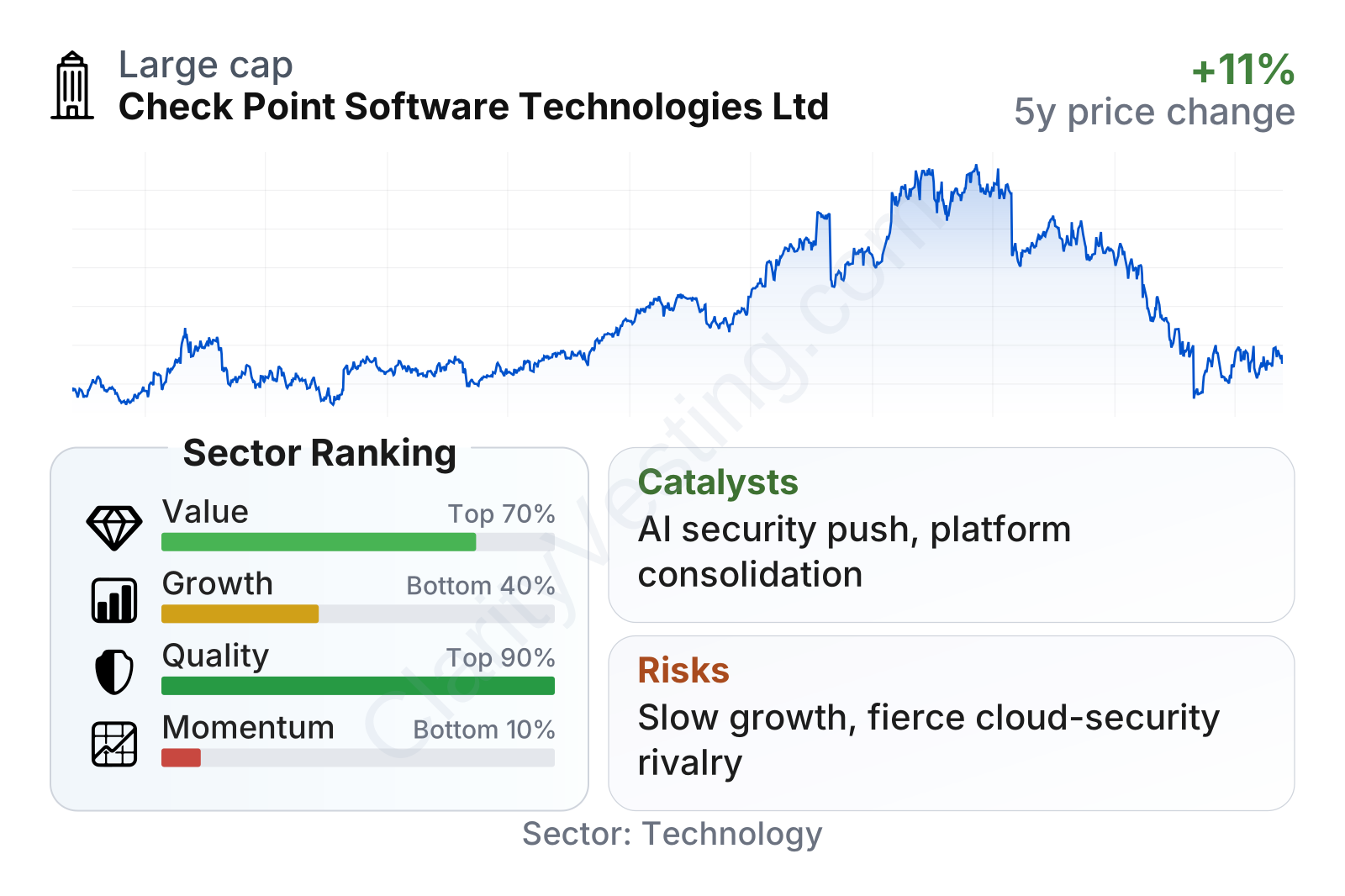
Overview
Check Point Software Technologies is a cybersecurity company focused on protecting corporate networks, cloud environments, endpoints, mobile devices, and users. In simple terms, it sells software and security services that help organizations prevent hacking, ransomware, data theft, and other digital attacks. The company has been in cybersecurity for decades and is best known for network firewall technology, but its business has expanded into cloud security, threat prevention, identity protection, and managed security offerings.
Its revenue mix is still anchored by enterprise security platforms and recurring support contracts, while subscriptions are becoming more important as customers adopt cloud-based and continuously updated protection. Based on company reporting categories, the revenue base can be described approximately as follows:
- Security subscriptions – now the largest piece, roughly around two-fifths of revenue, driven by cloud-delivered protection, threat prevention, and recurring software consumption.
- Security maintenance – another large share, also around two-fifths, coming from ongoing support and updates tied to installed products.
- Products and licenses – the smallest segment, roughly around one-fifth, mainly hardware appliances and perpetual or upfront software sales.
This mix matters because subscriptions and maintenance are generally more predictable than one-time product sales. It also shows a company that is gradually shifting from traditional hardware-centered security toward recurring software and platform revenue. Over the last several years, revenue has moved steadily higher while gross profit has remained very strong, which is typical of a software business with pricing power and a large installed base. At the same time, spending on research and development has risen, signaling that Check Point is investing to stay relevant in a fast-changing threat environment.
The business structure points to a company with high gross margins, disciplined operations, and a strong ability to convert sales into profit and cash. The key question for long-term analysis is less about survival or profitability and more about whether Check Point can accelerate growth enough to remain strategically important as cybersecurity budgets increasingly shift toward cloud-native and AI-enhanced platforms.
Key Figures
| Metric | Value | Sector ⓘ |
|---|---|---|
| Date | Jul 18, 2026 | |
| Context | ||
| Sector | Technology | |
| Industry | Software - Infrastructure | |
| Market Cap ⓘ | $14.26B | |
| Beta ⓘ | 0.49 | |
Value (Cheapness) | ||
| P/E Ratio ⓘ | 14.02 | 31.76 |
| FCF Yield ⓘ | 9.18% | 4.18% |
| EBIT / EV ⓘ | 7.08% | 2.56% |
| PEG ⓘ | 1.31 | |
Growth (Business expansion) | ||
| Revenue Growth ⓘ | 4.80% | 13.50% |
| RPS Growth (5Y CAGR) ⓘ | 11.30% | 8.57% |
| EPS Growth (5Y CAGR) ⓘ | -26.77% | -21.87% |
| Margin Growth (5Y Trend) ⓘ | -9.36% | 0.41% |
| FCF Growth (5Y CAGR) ⓘ | 0.41% | 9.76% |
Quality (Business durability) | ||
| ROIC (Latest) ⓘ | 27.19% | 8.54% |
| ROIC (5Y Median) ⓘ | 27.65% | 8.12% |
| Net Debt / EBIT (Latest) ⓘ | 0.95 | 0.38 |
| Net Debt / EBIT (5Y Median) ⓘ | -0.28 | 0.38 |
| Operating Margin (Latest) ⓘ | 34.40% | 9.58% |
| Operating Margin (5Y Median) ⓘ | 39.92% | 8.25% |
| Debt to Equity (Latest) ⓘ | 70.12% | 33.52% |
| Profit Margin (Latest) ⓘ | 38.37% | 6.96% |
| Free Cash Flow (Latest) ⓘ | $1.31B | |
Momentum (Price trend) | ||
| 3Y Return ⓘ | +7.22% | +30.91% |
| 12M Return (excl. last month) ⓘ | -44.40% | +28.90% |
| 6M Return ⓘ | -27.28% | +5.38% |
| Price vs. 200-Day MA ⓘ | -15.61% | +7.61% |
Check Point stands out for quality and cash generation more than for speed. It has a market value of roughly $13 billion and a relatively low beta, meaning the stock has historically moved less than the broader market. In profitability, returns on invested capital and margins are far above much of the software infrastructure sector, which reflects a mature business with efficient operations and a durable customer base.
On valuation metrics, the company looks inexpensive relative to many technology peers. Its earnings multiple is well below the sector median, while free cash flow yield and operating earnings relative to enterprise value compare favorably. The weaker area is growth: recent revenue expansion has been modest compared with the broader sector, and multi-year free cash flow growth has been far less impressive than current cash generation levels might suggest. Price performance has also been soft lately, which helps explain why the valuation has compressed so sharply.
Growth
Cybersecurity remains one of the more attractive long-term areas in technology. Digital systems are becoming more complex, companies are spreading data across on-premise infrastructure and multiple clouds, and attacks continue to grow in frequency and sophistication. That broad industry backdrop supports steady demand for prevention, monitoring, and secure access tools. In that sense, Check Point operates in a growing sector.
The more nuanced issue is whether it is growing fast enough inside that sector. Recent revenue growth has generally stayed in the mid-single-digit range, showing a stable but not especially dynamic profile. That is respectable for a mature cybersecurity vendor, but it trails many faster-moving rivals that are benefiting from cloud migration, AI-driven security tools, and platform consolidation trends.
The revenue trend suggests consistency rather than breakout expansion. Growth has remained positive and fairly resilient, which is valuable in a mission-critical industry, but it has not yet shown the kind of acceleration that would clearly reposition the company among the sector’s fastest-growing names.
Check Point’s strategy for future growth still makes sense. Management has been pushing a unified platform approach centered on network, cloud, workspace, and operations security, while highlighting AI-based threat prevention and automated protection. That approach is logical because many customers prefer fewer vendors, integrated management, and consistent policy enforcement across different environments. The company also benefits from a large installed base that can be upgraded into broader subscriptions over time.
A meaningful catalyst is cash generation. Check Point continues to produce large amounts of free cash flow, giving it room to fund research, acquisitions, and shareholder returns without placing major strain on the balance sheet. That financial flexibility matters in cybersecurity, where product relevance can shift quickly and sustained development spending is essential.
Free cash flow has rebounded to a high level after a softer stretch, which reinforces the idea that this is a business with strong underlying economics even when revenue growth is moderate. If management can convert that cash into stronger innovation, better cloud penetration, and broader subscription adoption, the growth profile could improve without requiring a radical overhaul of the business.
Recent company updates have also emphasized AI-related security capabilities and continued expansion of the Infinity platform. Those developments matter because AI is becoming both a tool for defenders and a weapon for attackers. A vendor that can use AI to improve prevention and simplify operations has a clearer chance to stay relevant with enterprise customers. For Check Point, the opportunity is not just selling more products, but becoming more deeply embedded across a customer’s full security architecture.
Risks
The main risk is competitive intensity. Cybersecurity is crowded and moves quickly. Check Point competes with larger and faster-growing rivals such as Palo Alto Networks, Fortinet, CrowdStrike, Zscaler, and Cisco in different parts of the market. Some of these competitors are perceived as stronger in cloud-native security, endpoint protection, or security platform consolidation. That can make it harder for Check Point to win the highest-growth parts of enterprise spending.
Another risk is that the company’s strong profitability could gradually narrow if it needs to spend more aggressively to defend market share. Check Point’s margins are excellent today, but mature vendors often face a trade-off between protecting profitability and accelerating product investment or go-to-market expansion.
The balance sheet has historically been very conservative, but leverage moved up sharply in the most recent period. Even so, the broader picture remains manageable because the company continues to generate substantial operating earnings and cash. This is not the kind of debt profile that currently defines the investment case, but the change is worth monitoring because it marks a departure from the extremely low leverage seen in prior years.
Profitability remains a major strength. Net margin is extraordinarily high for the sector and has stayed far above typical software infrastructure peers. That gives Check Point a real competitive advantage: it can fund product development internally, absorb pressure better than weaker rivals, and remain disciplined even in tougher demand periods. Still, very high margins do not automatically translate into leadership if competitors are pulling ahead in innovation or customer mindshare.
Check Point does have durable advantages. It has a long-established brand in enterprise security, deep relationships with large organizations, a broad product portfolio, and a reputation for prevention-focused security. These traits support retention and recurring revenue. However, it is not the clear overall leader across the entire cybersecurity market today. Instead, it is better described as a financially strong incumbent with recognized expertise, especially in network security, working to expand its relevance in cloud and platform-led security.
There are no widely visible public red flags suggesting a major scandal or governance breakdown in the recent period. The more practical risk is strategic: if cloud, AI, and platform security demand shifts faster than Check Point’s execution, the company could remain profitable but lose relative importance in the sector’s most attractive segments.
Valuation
Check Point’s valuation looks restrained compared with both its own history and the broader software sector. The earnings multiple has fallen to a level that is well below many technology peers, especially those with weaker profits but faster top-line growth. That gap reflects the market’s current view: Check Point is trusted for cash generation and margins, but not rewarded with a premium growth multiple.
The valuation trend shows a meaningful de-rating from prior years. At earlier points, the stock traded closer to sector norms, but the multiple has compressed as recent share performance weakened and growth remained moderate. On a pure fundamentals basis, the current pricing appears supported by strong margins, healthy cash flow, and a still-solid position in a mission-critical industry. At the same time, the discount exists for a reason: the company is not delivering the expansion profile that usually commands a higher software valuation.
This leaves Check Point in an interesting middle ground. It does not look expensive relative to profitability and cash generation, and its free cash flow yield is notably strong. But a low multiple alone is not enough to make the valuation look especially compelling unless the company can show that its platform strategy, subscription mix, and AI security offerings can translate into more durable growth. In other words, the market seems to be pricing Check Point as a high-quality but slower-moving cybersecurity franchise rather than as a premium growth leader.
Conclusion
Check Point is a financially strong cybersecurity company with unusually high margins, robust cash generation, and a revenue base supported by recurring subscriptions and maintenance. Its business sits in an attractive sector with long-term demand drivers that are unlikely to fade, and its long operating history gives it credibility with large enterprise customers. Those qualities create a sturdy operating profile that many software companies cannot match.
The challenge is that cybersecurity rewards innovation speed as much as stability. Check Point remains highly profitable, but its recent growth has been modest compared with leading competitors pushing harder in cloud-native security, endpoint protection, and broader platform consolidation. That does not weaken the company’s fundamentals, but it does limit the enthusiasm the market is willing to place on the shares.
Overall, Check Point currently looks more like a disciplined, cash-rich incumbent than a fast-reaccelerating sector leader. The stock’s valuation reflects that cooler view, which makes the business look more attractive on profitability than on momentum. For long-term analysis, the central issue is whether management can turn its strong economics and installed base into faster strategic relevance in the next phase of cybersecurity.
Sources:
- Check Point Software Technologies Ltd. — Annual Report on Form 10-K for fiscal year 2025
- Check Point Software Technologies Ltd. — Quarterly Report on Form 10-Q for quarter ended March 31, 2026
- SEC EDGAR — Check Point Software Technologies filings
- Check Point Software Technologies Investor Relations — Earnings releases and shareholder materials
- Check Point Software Technologies — Company website product and platform descriptions
- Wikipedia — Check Point Software Technologies basic company history and background
This article is for informational purposes only and does not constitute financial advice. Some content is AI-generated. See Disclaimer


