Stock Analysis · Churchill Downs Incorporated (CHDN)
Overview
Churchill Downs Incorporated is a U.S. gaming and entertainment company best known for the Kentucky Derby and the Churchill Downs Racetrack. Over time, it has become much more than a horse racing business. Today, the company combines three main activities: live and historical horse racing venues, regional casinos, and online wagering through TwinSpires. That mix gives it exposure to both physical gaming properties and digital betting.
The business is organized around a portfolio of assets that includes racetracks, historical racing machine venues, traditional casinos, hotel and entertainment properties, and advance-deposit wagering platforms. The company has also expanded through acquisitions and development projects, especially in regional gaming and venue-based wagering.
Based on recent company reporting, revenue is led by its gaming properties rather than by the famous racing event itself. The main sources of revenue can be summarized approximately as follows:
- Live and Historical Racing: about 40% to 45% of revenue. This includes Churchill Downs Racetrack, Derby-related operations, and a growing network of historical racing machine properties such as Derby City Gaming and other venue-based racing entertainment assets.
- Gaming: about 35% to 40% of revenue. This covers regional casinos and associated hospitality activity, including table games, slot-style gaming, food, beverage, and hotel revenue where applicable.
- TwinSpires: about 15% to 20% of revenue. This segment mainly includes online pari-mutuel horse race wagering and related digital wagering activity. After exiting large parts of online sports betting in prior years, this business is more focused than before.
One important takeaway is that Churchill Downs is no longer dependent on a single event or a single format of gambling. The Kentucky Derby remains its best-known brand asset, but the earnings base is broader and increasingly tied to recurring gaming spend at regional properties.
The long-term financial pattern has been notable: revenue has climbed from about $1.6 billion in 2021 to roughly $2.9 billion in 2025, while operating income has remained strong. At the same time, interest expense has also risen materially, showing that expansion has come with a meaningful use of debt.
Key Figures
| Metric | Value | Sector ⓘ |
|---|---|---|
| Date | Sep 12, 2026 | |
| Context | ||
| Sector | Consumer Cyclical | |
| Industry | Gambling | |
| Market Cap ⓘ | $5.77B | |
| Beta ⓘ | 0.67 | |
Value (Cheapness) | ||
| P/E Ratio ⓘ | 14.27 | 17.10 |
| FCF Yield ⓘ | 6.63% | 8.53% |
| EBIT / EV ⓘ | 8.41% | 6.46% |
| PEG ⓘ | 1.69 | |
Growth (Business expansion) | ||
| Revenue Growth ⓘ | 4.90% | 5.75% |
| RPS Growth (5Y CAGR) ⓘ | 19.09% | 9.14% |
| EPS Growth (5Y CAGR) ⓘ | -0.90% | -18.21% |
| Margin Growth (5Y Trend) ⓘ | 1.56% | -0.23% |
| FCF Growth (5Y CAGR) ⓘ | 6.17% | 4.91% |
Quality (Business durability) | ||
| ROIC (Latest) ⓘ | 10.08% | 12.61% |
| ROIC (5Y Median) ⓘ | 11.33% | 10.72% |
| Net Debt / EBIT (Latest) ⓘ | 5.22 | 2.10 |
| Net Debt / EBIT (5Y Median) ⓘ | 5.66 | 2.32 |
| Operating Margin (Latest) ⓘ | 29.37% | 9.25% |
| Operating Margin (5Y Median) ⓘ | 31.56% | 9.64% |
| Debt to Equity (Latest) ⓘ | 356.52% | 75.78% |
| Profit Margin (Latest) ⓘ | 13.80% | 5.33% |
| Free Cash Flow (Latest) ⓘ | $382.60M | |
Momentum (Price trend) | ||
| 3Y Return ⓘ | -28.24% | +14.53% |
| 12M Return (excl. last month) ⓘ | -13.00% | +3.08% |
| 6M Return ⓘ | -0.26% | +0.55% |
| Price vs. 200-Day MA ⓘ | -10.48% | -0.54% |
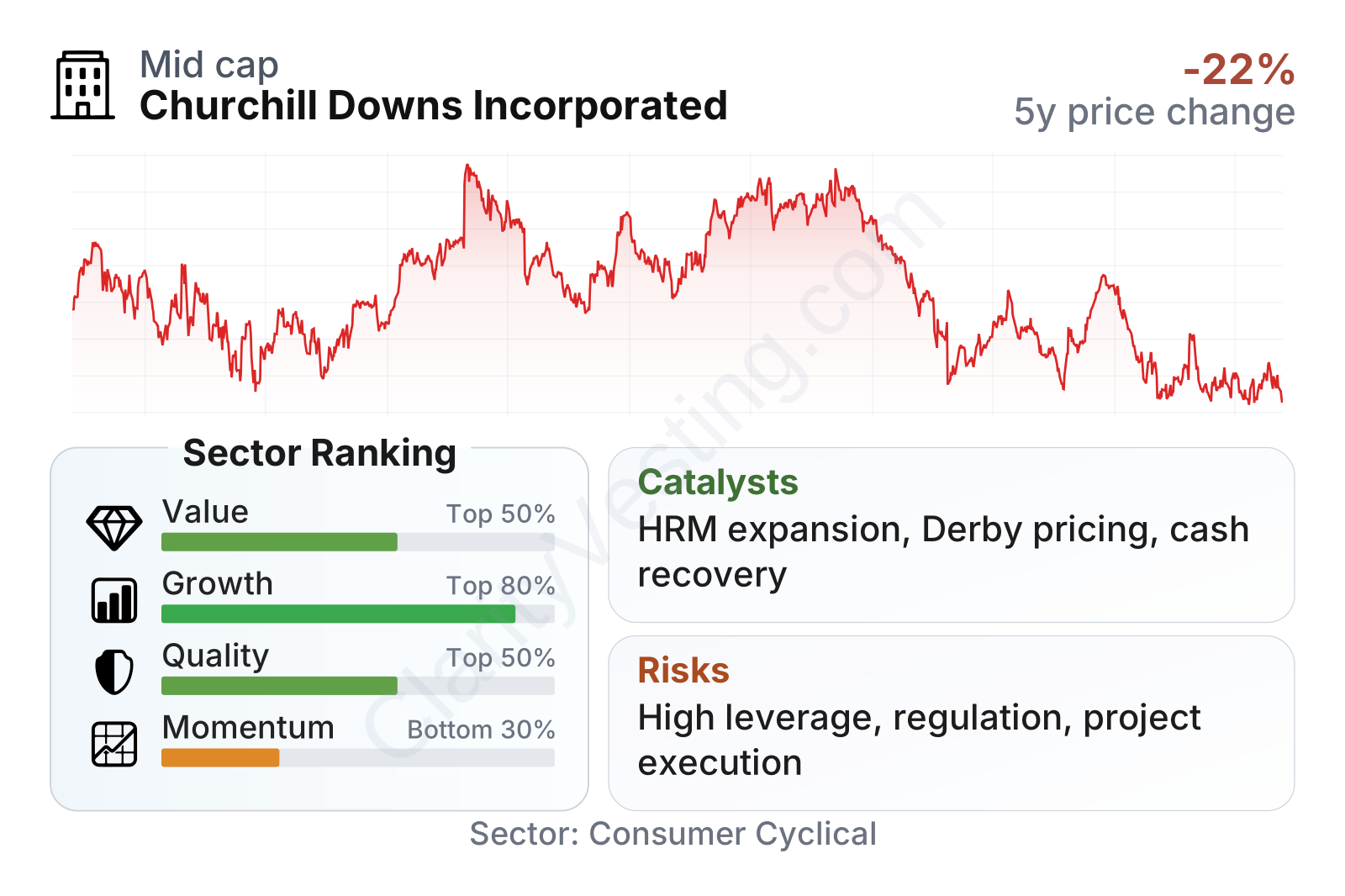
Churchill Downs sits in the mid-cap range, with a stock that has been less volatile than the broader market, as shown by its beta below 1. On valuation, the earnings multiple is currently below the sector median, while operating earnings relative to enterprise value look stronger than many peers. Growth and quality are more mixed: margins are well above the sector median, but leverage is also much higher. Market performance has been weak lately, with the stock trailing the sector over the past several months and over a multi-year period.
Growth
Churchill Downs operates in a part of the consumer economy that has structural support: gambling demand has been expanding across digital channels, regional gaming markets, and alternative wagering formats. In the company’s case, the strongest long-term growth angle is not pure online betting leadership, but its ability to build high-return destination properties around racing and gaming in states where regulation allows historical racing machines and casino-style operations.
The strategy is fairly easy to understand. Churchill Downs uses a rare brand asset, the Kentucky Derby, to strengthen its identity, while investing capital into properties that can generate year-round cash flow. That matters for long-term analysis because the Derby is highly visible, but recurring revenue comes from assets that operate every week, not just from one major event.
Revenue growth has cooled from the very rapid post-acquisition and post-expansion gains seen in 2023, but it remains positive. More recent year-over-year growth has been in the mid-single-digit range, which suggests the business is now moving from a step-change expansion phase into a steadier operating phase. Over five years, revenue per share growth has still been much stronger than the sector median, indicating that the company has created scale faster than many peers.
Free cash flow has been uneven, which is common for companies that are developing and upgrading gaming properties. After turning negative during a heavier investment period, free cash flow has recovered strongly and recently moved back toward the upper hundreds of millions of dollars on a trailing basis. That is an important sign because it shows the asset base can still convert earnings into cash after a period of elevated spending.
Future growth catalysts are tied to property development, venue expansions, and the continued rollout of historical racing machine capacity. This niche has been attractive because it can deliver casino-like economics in certain jurisdictions without requiring the exact same regulatory framework as full casinos. Churchill Downs has been especially active in this area, and its track record suggests management sees these projects as one of the clearest ways to compound revenue and cash flow.
Another positive factor is pricing power. Premium events such as the Kentucky Derby and high-traffic gaming venues can support higher spending per guest, especially when paired with hospitality upgrades. That does not guarantee rapid growth every year, but it can support margin resilience and incremental revenue over time.
Risks
This article is for informational purposes only and does not constitute financial advice. Some content is AI-generated. See Disclaimer