Stock Analysis · Chiba Bank Ltd (CHBAY)
Overview
Chiba Bank is a Japanese regional bank based in Chiba Prefecture, the large metropolitan area east of Tokyo. Its business is centered on traditional banking: collecting deposits, making loans, handling payments, managing securities portfolios, and offering services to households, small and medium-sized companies, and larger corporate clients. Like many Japanese regional banks, it also expands beyond plain lending through fee businesses such as asset management, settlement services, leasing, and other financial solutions.
Revenue mainly comes from banking spread income and fees. Public disclosures for Japanese banks usually separate ordinary income by activity rather than in the exact format many U.S. investors may expect, so percentage splits are often approximate. Based on the company’s recent annual materials, the broad revenue mix can be described as follows:
- Interest income from loans and securities: approximately 70% to 80% of ordinary banking income. This includes interest earned on corporate and retail loans, as well as income from Japanese government bonds and other securities.
- Fees and commissions: approximately 10% to 20%. This includes settlement fees, investment trust and insurance sales, asset management-related fees, and various corporate solution services.
- Trading and other operating income: approximately 5% to 10%. This includes gains from market operations, foreign exchange-related activities, and other financial transactions.
- Other ordinary income: usually a smaller share, coming from affiliates, recoveries, and miscellaneous banking-related items.
Chiba Bank’s franchise is stronger than the average small regional lender because it operates in one of Japan’s more economically active prefectures, with exposure to the Tokyo metropolitan economy. That gives it access to a larger base of businesses, commuters, housing demand, and wealth management opportunities than many peers in more rural areas.
The business flow over the last five fiscal years shows a clear rise in revenue and net income, with operating income also expanding. The notable point is that profit growth has not come only from cost cutting; revenue itself has moved materially higher, which is more durable if supported by loan demand and better interest margins.
Key Figures
| Metric | Value | Sector ⓘ |
|---|---|---|
| Date | Nov 21, 2026 | |
| Context | ||
| Sector | Financial Services | |
| Industry | Banks - Regional | |
| Market Cap ⓘ | $12.38B | |
| Beta ⓘ | 0.14 | |
Value (Cheapness) | ||
| P/E Ratio ⓘ | 18.61 | 12.01 |
| P/B Ratio ⓘ | N/A | 1.48 |
| FCF Yield ⓘ | 0.97% | 8.77% |
| Dividend Yield ⓘ | 0.96% | 3.01% |
| EBIT / EV ⓘ | N/A | 8.31% |
| PEG ⓘ | N/A | |
Growth (Business expansion) | ||
| Revenue Growth ⓘ | 12.10% | 6.70% |
| RPS Growth (5Y CAGR) ⓘ | 19.88% | 12.35% |
| EPS Growth (5Y CAGR) ⓘ | -21.89% | -0.27% |
| BVPS Growth (5Y CAGR) ⓘ | 5.90% | 4.83% |
| Margin Growth (5Y Trend) ⓘ | -2.16% | -4.16% |
| FCF Growth (5Y CAGR) ⓘ | -37.70% | 4.69% |
| DPS Growth (5Y CAGR) ⓘ | 22.13% | 8.82% |
Quality (Business durability) | ||
| ROIC (Latest) ⓘ | N/A | 9.49% |
| ROE (Latest) ⓘ | 8.55% | 14.02% |
| ROA (Latest) ⓘ | 0.52% | 1.53% |
| ROIC (5Y Median) ⓘ | 1.82% | 7.80% |
| ROE (5Y Median) ⓘ | 5.69% | 12.09% |
| ROA (5Y Median) ⓘ | 0.31% | 1.28% |
| Net Debt / EBIT (Latest) ⓘ | N/A | 0.88 |
| Net Debt / EBIT (5Y Median) ⓘ | -16.88 | 0.73 |
| Net Debt / EBITDA (Latest) ⓘ | -0.36 | 0.71 |
| Operating Margin (Latest) ⓘ | N/A | 23.37% |
| Operating Margin (5Y Median) ⓘ | 34.13% | 24.29% |
| Debt to Equity (Latest) ⓘ | 153.52% | 59.34% |
| Profit Margin (Latest) ⓘ | 28.22% | 26.65% |
| Free Cash Flow (Latest) ⓘ | $119.57M | |
Momentum (Price trend) | ||
| 3Y Return ⓘ | +164.17% | +73.29% |
| 12M Return (excl. last month) ⓘ | +94.98% | +18.35% |
| 6M Return ⓘ | +27.96% | +3.24% |
| Price vs. 200-Day MA ⓘ | +61.23% | +2.17% |
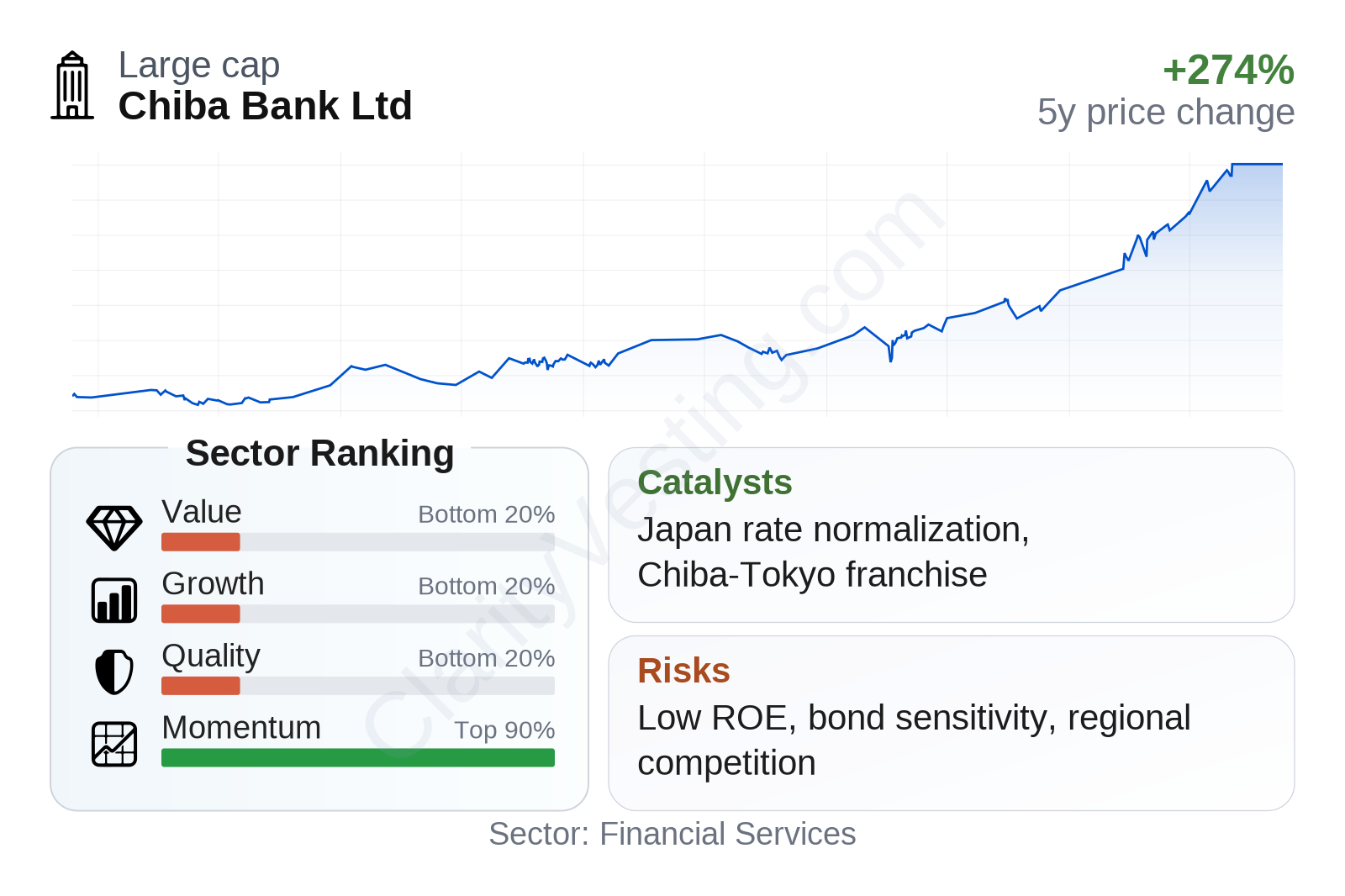
Chiba Bank is a large regional bank by market value, but the share behavior has recently looked much stronger than most companies in its sector. Over three years, the stock has risen far more than the sector median, and the 12-month and 6-month moves have also been notably strong. At the same time, the factor summary points to a more mixed fundamental profile: valuation screens do not look cheap relative to the sector, while profitability and efficiency remain below many peers. In simple terms, the market has rewarded the bank’s improving earnings outlook faster than the quality metrics have fully caught up.
Another useful point is volatility. The beta is very low, which means the stock has historically moved less aggressively than the broader equity market. That can happen with banks whose shares are more influenced by local banking conditions, interest rates, and domestic policy than by high-growth market themes.
Growth
Chiba Bank operates in a sector that has been structurally difficult for years in Japan because of low interest rates, aging demographics, and intense competition in local banking. However, the environment has started to improve for stronger regional banks. The most important change is the gradual normalization of Japanese interest rates. When rates rise from very low levels, banks can often improve the spread between what they earn on loans and securities and what they pay on deposits. That can be especially meaningful for deposit-rich lenders such as Chiba Bank.
The company’s strategy also appears sensible for long-term expansion within the limits of a mature sector. Management has emphasized strengthening customer relationships in its home market, deepening corporate services, building non-interest income, and using alliances and digital tools to improve efficiency. For a regional bank, this matters because pure balance-sheet growth is rarely enough; stronger fee income and better productivity are needed to offset demographic pressure.
The recent earnings pattern supports the idea that operating conditions are improving. Revenue growth over the last year was above the sector median, and five-year revenue per share growth has also outpaced the median. Dividend growth has been particularly strong over five years. The weaker point is that five-year earnings-per-share growth remains negative because earlier years were softer, but the more recent direction is better than that long-term average suggests.
The earnings path shows a dip and then a recovery, with the last two fiscal years looking stronger. That matters because it suggests the bank is not simply benefiting from a one-off accounting event; profitability has been rebuilding over time.
Book value per share has also trended upward overall, despite a temporary pause. For banks, this is an important sign because book value represents the capital base supporting future lending and resilience. The longer-term increase indicates that the company has been adding value internally, even if not at a pace that makes it stand out among the very best banks globally.
A major catalyst is the Japanese rate backdrop. Even small changes in domestic rates can have a large effect on bank earnings after years of compressed margins. A second catalyst is Chiba Bank’s location. Chiba Prefecture benefits from its proximity to Tokyo, major transport links, logistics activity, and a relatively large local economy, which should support lending, transaction banking, and wealth management more effectively than in many shrinking rural markets. A third opportunity comes from industry consolidation and partnerships among regional banks, where scale, systems integration, and shared platforms can improve returns over time.
Recent company materials for fiscal 2026 also show profit and revenue reaching higher levels than in prior years, which strengthens the case that the bank is participating in this more favorable phase for Japanese lenders rather than standing still.
Risks
This article is for informational purposes only and does not constitute financial advice. Some content is AI-generated. See Disclaimer