Stock Analysis · Cognex Corporation (CGNX)
Overview
Cognex Corporation develops machine vision systems, barcode readers, vision software, and related sensors used to automate inspection and identification tasks in factories and logistics facilities. In simple terms, its products help machines “see” so manufacturers and warehouse operators can check quality, guide robots, read codes, and sort items with less human intervention. The company serves a wide range of industries, including consumer electronics, automotive, logistics, packaging, medical-related manufacturing, and semiconductor production.
Cognex’s revenue mainly comes from selling hardware and software for industrial automation. Based on recent annual filings, the business can be understood through a few main streams:
- Vision and ID products for factory automation: approximately 70% to 80% of revenue. This includes machine vision systems, smart cameras, sensors, and software used to inspect products, guide assembly, and verify quality on production lines.
- Logistics automation solutions: approximately 20% to 30% of revenue. This includes barcode reading, image-based identification, and tracking systems used in warehouses, parcel sorting, and e-commerce fulfillment.
- Services and other revenue: a small share of revenue. This generally includes support, training, and other related items.
Geographically, Cognex is highly international, with a large portion of sales generated outside the United States, particularly in Asia and Europe. That matters because the company is exposed not only to global automation demand, but also to shifts in regional manufacturing cycles, especially in China and broader Asian electronics markets.
The business model is attractive when demand is strong: gross margins have historically been high because the company sells specialized, value-added products rather than commodity equipment. At the same time, results can swing meaningfully because many customers operate in cyclical end markets and may delay automation projects during periods of economic weakness.
The long-term pattern shows a business that kept strong gross profitability even during a revenue downturn, but operating profit narrowed when sales slowed and selling costs stayed elevated. More recently, revenue and operating income have been recovering, which suggests the core model remains intact, though not yet back to earlier peak efficiency.
Key Figures
| Metric | Value | Sector ⓘ |
|---|---|---|
| Date | Sep 12, 2026 | |
| Context | ||
| Sector | Technology | |
| Industry | Scientific & Technical Instruments | |
| Market Cap ⓘ | $10.80B | |
| Beta ⓘ | 1.49 | |
Value (Cheapness) | ||
| P/E Ratio ⓘ | 61.75 | 29.51 |
| FCF Yield ⓘ | 2.48% | 4.25% |
| EBIT / EV ⓘ | 2.49% | 2.85% |
| PEG ⓘ | 2.71 | |
Growth (Business expansion) | ||
| Revenue Growth ⓘ | 16.90% | 15.40% |
| RPS Growth (5Y CAGR) ⓘ | 0.46% | 8.56% |
| EPS Growth (5Y CAGR) ⓘ | -13.47% | -11.88% |
| Margin Growth (5Y Trend) ⓘ | -12.37% | 0.46% |
| FCF Growth (5Y CAGR) ⓘ | -5.64% | 9.80% |
Quality (Business durability) | ||
| ROIC (Latest) ⓘ | 11.08% | 9.44% |
| ROIC (5Y Median) ⓘ | 7.61% | 8.30% |
| Net Debt / EBIT (Latest) ⓘ | -0.92 | 0.54 |
| Net Debt / EBIT (5Y Median) ⓘ | -0.88 | 0.44 |
| Operating Margin (Latest) ⓘ | 23.00% | 9.58% |
| Operating Margin (5Y Median) ⓘ | 18.38% | 8.25% |
| Debt to Equity (Latest) ⓘ | 4.45% | 33.33% |
| Profit Margin (Latest) ⓘ | 16.05% | 7.14% |
| Free Cash Flow (Latest) ⓘ | $268.30M | |
Momentum (Price trend) | ||
| 3Y Return ⓘ | +54.34% | +45.48% |
| 12M Return (excl. last month) ⓘ | +44.76% | +23.48% |
| 6M Return ⓘ | +32.04% | +20.93% |
| Price vs. 200-Day MA ⓘ | +19.06% | +7.43% |
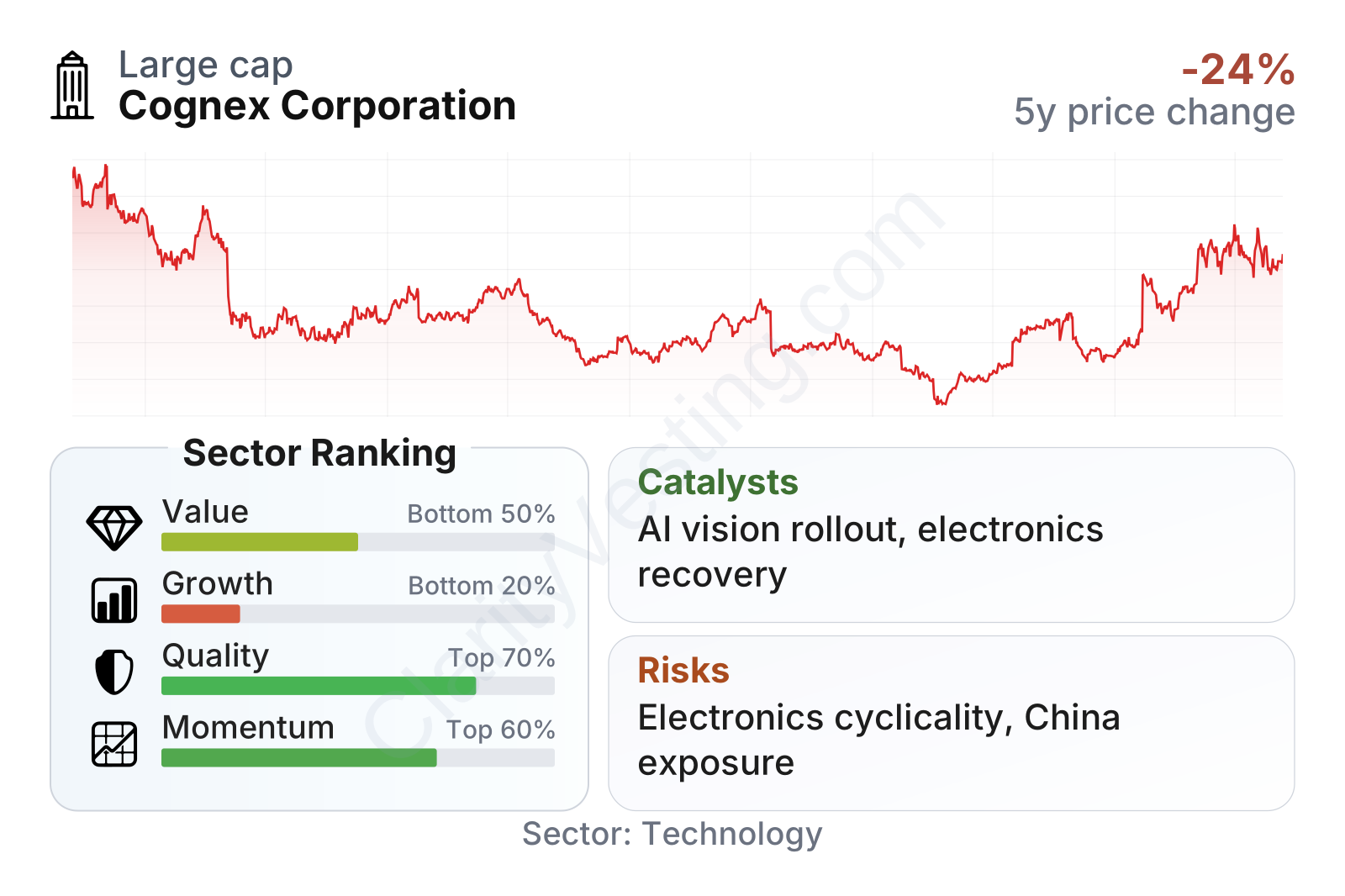
Cognex stands out for balance-sheet strength and profitability, while growth and valuation look less comfortable. Debt is very low, margins remain well above the sector median, and returns on invested capital are solid. On the other hand, the growth profile over the last five years has been weaker than many peers, and the shares trade at a clear premium to the sector despite that uneven record. Recent stock momentum has been strong, which helps explain why valuation now looks more demanding.
Cognex is a mid-to-large size industrial technology company with a market value above $11 billion and a beta around 1.5, which signals that the stock has tended to move more sharply than the broader market. That combination often fits a business with real quality but meaningful sensitivity to changes in industrial demand and sentiment.
Growth
Cognex operates in a sector with a credible long-term tailwind. Manufacturers and logistics operators continue to invest in automation to improve quality, reduce labor dependence, increase throughput, and make production more flexible. Machine vision is a key enabling technology in that shift because robots and automated systems need reliable visual inspection and identification tools. This does not mean growth is linear, but it does support a favorable long-range backdrop.
The company’s strategy also makes industrial sense. Cognex focuses on applications where accuracy and reliability matter more than price alone, such as electronics inspection, barcode reading in high-speed logistics, and increasingly complex automation tasks. Its software, algorithms, and installed base can help it remain relevant as customers upgrade lines and deploy more sophisticated systems. Recent product development around AI-enabled vision tools is especially important because it can expand the range of inspection tasks that traditional rule-based systems struggled to handle.
Recent revenue trends point to a recovery after a difficult stretch in 2022 and 2023. Growth turned positive again in 2024 and accelerated further into 2025 and early 2026, with recent year-over-year gains moving into the high-teens to mid-20% range at points. That rebound matters because it suggests demand is improving across at least part of the company’s end markets, even though the five-year growth picture remains modest.
Cash generation has also improved from the low point seen during the downturn. Free cash flow recovered materially from 2024 levels and has moved back toward the company’s more normal historical range. For a business like Cognex, that is a useful sign because it shows profits are not only accounting results; the company is again converting more of its activity into cash that can support research, acquisitions, and shareholder returns.
One of the most important catalysts is the possibility of a broader recovery in consumer electronics and semiconductor-related capital spending. Cognex has meaningful exposure to these areas, and they have historically driven both strong growth phases and sharp slowdowns. A healthier investment cycle in advanced manufacturing could therefore have an outsized effect on revenue. Another important opportunity is logistics automation, where warehouses and parcel hubs still need faster and more accurate machine-based identification systems as e-commerce networks become more demanding.
Recent company communications in 2026 have continued to emphasize product innovation, including AI-based machine vision capabilities and new applications in industrial automation. The significance is not just marketing: easier-to-deploy AI tools can expand Cognex’s addressable market by making vision systems more effective in messy, variable real-world environments where older solutions were harder to implement.
Risks
This article is for informational purposes only and does not constitute financial advice. Some content is AI-generated. See Disclaimer


