Stock Analysis · Cullen/Frost Bankers Inc (CFR)
Overview
Cullen/Frost Bankers is a Texas-based regional banking company best known through its Frost Bank franchise. It provides traditional banking services such as commercial and consumer lending, checking and savings accounts, treasury and cash-management tools, and wealth-related services including trust, brokerage, and investment management. Its footprint is concentrated in Texas, which matters because the company’s results are closely tied to the state’s economy, population growth, business formation, and real estate activity.
Like most banks, Cullen/Frost does not make money the same way an industrial company does. The biggest driver is net interest income, which is the spread between what it earns on loans and securities and what it pays on deposits and other funding. A second revenue stream comes from fees tied to customer activity and asset-based services.
Based on recent annual reporting, the company’s revenue mix is approximately:
- Net interest income: about 74% to 78% of total revenue. This includes interest earned on loans, securities, and other interest-earning assets, minus interest paid on deposits and borrowings.
- Non-interest income: about 22% to 26% of total revenue. This includes trust and investment management fees, service charges on deposit accounts, card-related income, insurance-related commissions, brokerage activity, and other banking fees.
Within fee income, wealth management and service-based activities are important support businesses, but they are still materially smaller than the core spread-based banking business. That makes deposit quality, loan growth, and interest-rate management central to understanding the company.
The profit structure has improved meaningfully since 2021, with total revenue rising from roughly $1.4 billion to about $2.9 billion by 2025, while net income also moved higher overall despite pressure from funding costs during the industry’s rate reset.
The long-term pattern shows a bank that expanded revenue strongly as rates rose, although part of that gain was offset by higher interest expense and operating costs. Profitability remained solid rather than explosive, which is typical for a conservatively run regional bank.
Key Figures
| Metric | Value | Sector ⓘ |
|---|---|---|
| Date | Nov 21, 2026 | |
| Context | ||
| Sector | Financial Services | |
| Industry | Banks - Regional | |
| Market Cap ⓘ | $9.24B | |
| Beta ⓘ | 0.51 | |
Value (Cheapness) | ||
| P/E Ratio ⓘ | 13.82 | 12.01 |
| P/B Ratio ⓘ | 2.29 | 1.48 |
| FCF Yield ⓘ | 6.26% | 8.77% |
| Dividend Yield ⓘ | 2.70% | 3.01% |
| EBIT / EV ⓘ | 9.22% | 8.31% |
| PEG ⓘ | 2.73 | |
Growth (Business expansion) | ||
| Revenue Growth ⓘ | 5.60% | 6.70% |
| RPS Growth (5Y CAGR) ⓘ | 20.27% | 12.35% |
| EPS Growth (5Y CAGR) ⓘ | -1.61% | -0.27% |
| BVPS Growth (5Y CAGR) ⓘ | 1.58% | 4.83% |
| Margin Growth (5Y Trend) ⓘ | -8.65% | -4.16% |
| FCF Growth (5Y CAGR) ⓘ | -31.62% | 4.69% |
| DPS Growth (5Y CAGR) ⓘ | 7.54% | 8.82% |
Quality (Business durability) | ||
| ROIC (Latest) ⓘ | 14.78% | 9.49% |
| ROE (Latest) ⓘ | 16.06% | 14.02% |
| ROA (Latest) ⓘ | 1.28% | 1.53% |
| ROIC (5Y Median) ⓘ | 15.00% | 7.80% |
| ROE (5Y Median) ⓘ | 15.00% | 12.09% |
| ROA (5Y Median) ⓘ | 1.14% | 1.28% |
| Net Debt / EBIT (Latest) ⓘ | 5.81 | 0.88 |
| Net Debt / EBIT (5Y Median) ⓘ | -11.76 | 0.73 |
| Net Debt / EBITDA (Latest) ⓘ | -1.67 | 0.71 |
| Operating Margin (Latest) ⓘ | 30.75% | 23.37% |
| Operating Margin (5Y Median) ⓘ | 35.08% | 24.29% |
| Debt to Equity (Latest) ⓘ | 134.87% | 59.34% |
| Profit Margin (Latest) ⓘ | 30.03% | 26.65% |
| Free Cash Flow (Latest) ⓘ | $578.46M | |
Momentum (Price trend) | ||
| 3Y Return ⓘ | +59.75% | +73.29% |
| 12M Return (excl. last month) ⓘ | +28.25% | +18.35% |
| 6M Return ⓘ | +5.46% | +3.24% |
| Price vs. 200-Day MA ⓘ | -2.91% | +2.17% |
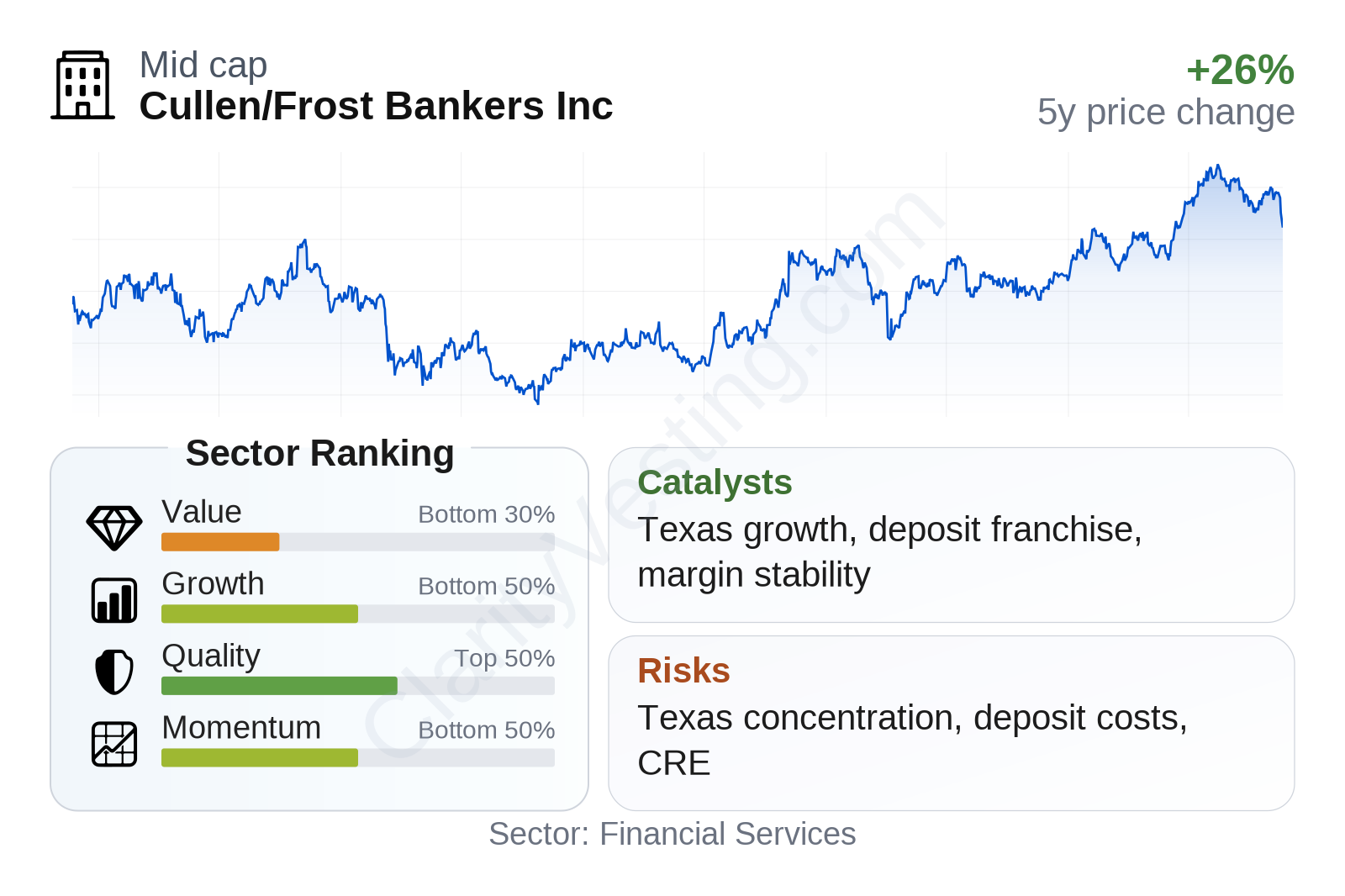
Cullen/Frost is a mid-sized regional bank with a relatively low beta of about 0.55, meaning the stock has historically moved less than the broader market. In the factor table, quality and momentum look better than value. Profitability measures are generally above the regional-bank median, especially return on equity and operating margin, while valuation multiples sit above sector medians. Growth is mixed: long-term revenue per share has been strong, but earnings and book value growth have been less consistent than the best peers.
The share-price path also reflects this profile. After the 2023 regional-bank selloff, the stock recovered strongly and recently moved above prior levels, showing that the market has rewarded Cullen/Frost’s perceived balance-sheet strength and franchise durability.
Growth
The company operates in a sector that is mature overall, but its geography gives it a better backdrop than many regional banks. Texas has benefited from population inflows, business relocations, energy and infrastructure investment, and a relatively healthy job market. For a bank with a dense in-state network and a long local operating history, that can translate into loan demand, deposit gathering, and more wealth-management relationships over time.
Cullen/Frost’s strategy is straightforward and sensible for long-term expansion: build low-cost customer relationships, keep a conservative credit culture, grow commercial banking in attractive Texas markets, and deepen ties through treasury management and wealth services. This is not a rapid-expansion model, but it can be durable if execution stays disciplined.
Earnings per share show that the business has remained profitable through very different rate environments. EPS climbed strongly from 2021 through 2023, dipped in 2024, and then recovered in 2025. That pattern suggests earnings are resilient, but still sensitive to funding costs and the pace of balance-sheet growth. The more important point for a long-term view is that the company kept profitability at a solid level instead of suffering the severe earnings disruption seen at weaker banks.
Book value per share is also worth watching for banks because it reflects capital accumulation over time. Cullen/Frost saw a sharp decline in 2022, then a steady rebuilding through 2025 to a level above 2021. That recovery indicates the balance sheet absorbed the interest-rate shock and then regained strength, which supports the idea that the franchise came through the cycle in good condition.
Recent company updates in 2026 have continued to point to healthy profitability and stable credit performance rather than a dramatic strategic shift. The more realistic catalyst is not a one-time event but continued deposit franchise strength in Texas, combined with gradual loan growth and a more favorable funding mix if deposit costs stabilize. In a bank like Cullen/Frost, steady compounding matters more than transformational announcements.
Risks
This article is for informational purposes only and does not constitute financial advice. Some content is AI-generated. See Disclaimer