Stock Analysis · CEVA Inc (CEVA)
Overview
CEVA Inc is a small semiconductor intellectual property company. Instead of manufacturing chips, it develops and licenses specialized processor designs, software, and wireless connectivity technologies that other companies embed into their own chips and devices. Its technologies are used in products such as smartphones, consumer electronics, industrial equipment, smart edge devices, automotive systems, cellular IoT modules, and a growing range of AI-enabled products.
The business model is relatively simple. CEVA typically earns money in two stages: first when a customer signs a license to use its technology, and later when that customer ships products containing CEVA-based designs and pays royalties. This means revenue can be uneven from quarter to quarter, because license deals are lumpy while royalties depend on customers’ end-market demand.
Based on the company’s recent annual disclosures, CEVA’s revenue is mainly split into two broad sources:
- Licensing and related revenue: approximately 55% to 65% of revenue in recent years. This includes upfront or milestone-based payments for access to CEVA’s DSP, AI, sensing, and wireless IP, along with development tools and certain related services.
- Royalties: approximately 35% to 45% of revenue in recent years. This comes from unit shipments by customers using CEVA technology in chips and end devices, especially in Bluetooth, Wi-Fi, cellular IoT, and baseband-connected products.
Within those categories, CEVA is increasingly positioning itself around several themes: wireless connectivity IP, embedded AI and neural processing software, smart sensing, and low-power edge computing. That mix matters because it gives the company exposure to multiple long-term technology trends without requiring the large capital spending of a chip manufacturer.
Financially, CEVA’s model still shows one attractive structural feature: gross profit remains very high because IP licensing has low direct production costs. The weaker point is below that line. Research and development spending has stayed heavy, generally around the low- to mid-70% range of annual revenue in recent years, which has kept operating profit under pressure even when sales have recovered.
The revenue base has been fairly stable around the low hundred-million-dollar range, and gross profit has remained strong, but operating expenses—especially R&D—have absorbed most of that value. The main debate for long-term shareholders is therefore not whether the products are technically relevant, but whether CEVA can convert that relevance into more consistent royalty scale and sustainable profitability.
Key Figures
| Metric | Value | Sector ⓘ |
|---|---|---|
| Date | Sep 12, 2026 | |
| Context | ||
| Sector | Technology | |
| Industry | Semiconductors | |
| Market Cap ⓘ | $855.04M | |
| Beta ⓘ | 2.01 | |
Value (Cheapness) | ||
| P/E Ratio ⓘ | N/A | 29.51 |
| FCF Yield ⓘ | -0.12% | 4.25% |
| EBIT / EV ⓘ | -0.68% | 2.85% |
| PEG ⓘ | 3.13 | |
Growth (Business expansion) | ||
| Revenue Growth ⓘ | 13.10% | 15.40% |
| RPS Growth (5Y CAGR) ⓘ | -2.02% | 8.56% |
| EPS Growth (5Y CAGR) ⓘ | -57.40% | -11.88% |
| Margin Growth (5Y Trend) ⓘ | N/A | 0.46% |
| FCF Growth (5Y CAGR) ⓘ | -61.55% | 9.80% |
Quality (Business durability) | ||
| ROIC (Latest) ⓘ | -2.05% | 9.44% |
| ROIC (5Y Median) ⓘ | -1.21% | 8.30% |
| Net Debt / EBIT (Latest) ⓘ | N/A | 0.54 |
| Net Debt / EBIT (5Y Median) ⓘ | N/A | 0.44 |
| Operating Margin (Latest) ⓘ | -4.89% | 9.58% |
| Operating Margin (5Y Median) ⓘ | -2.58% | 8.25% |
| Debt to Equity (Latest) ⓘ | 5.12% | 33.33% |
| Profit Margin (Latest) ⓘ | -9.48% | 7.14% |
| Free Cash Flow (Latest) ⓘ | -$1.06M | |
Momentum (Price trend) | ||
| 3Y Return ⓘ | +46.50% | +45.48% |
| 12M Return (excl. last month) ⓘ | +93.04% | +23.48% |
| 6M Return ⓘ | +28.25% | +20.93% |
| Price vs. 200-Day MA ⓘ | +6.38% | +7.43% |
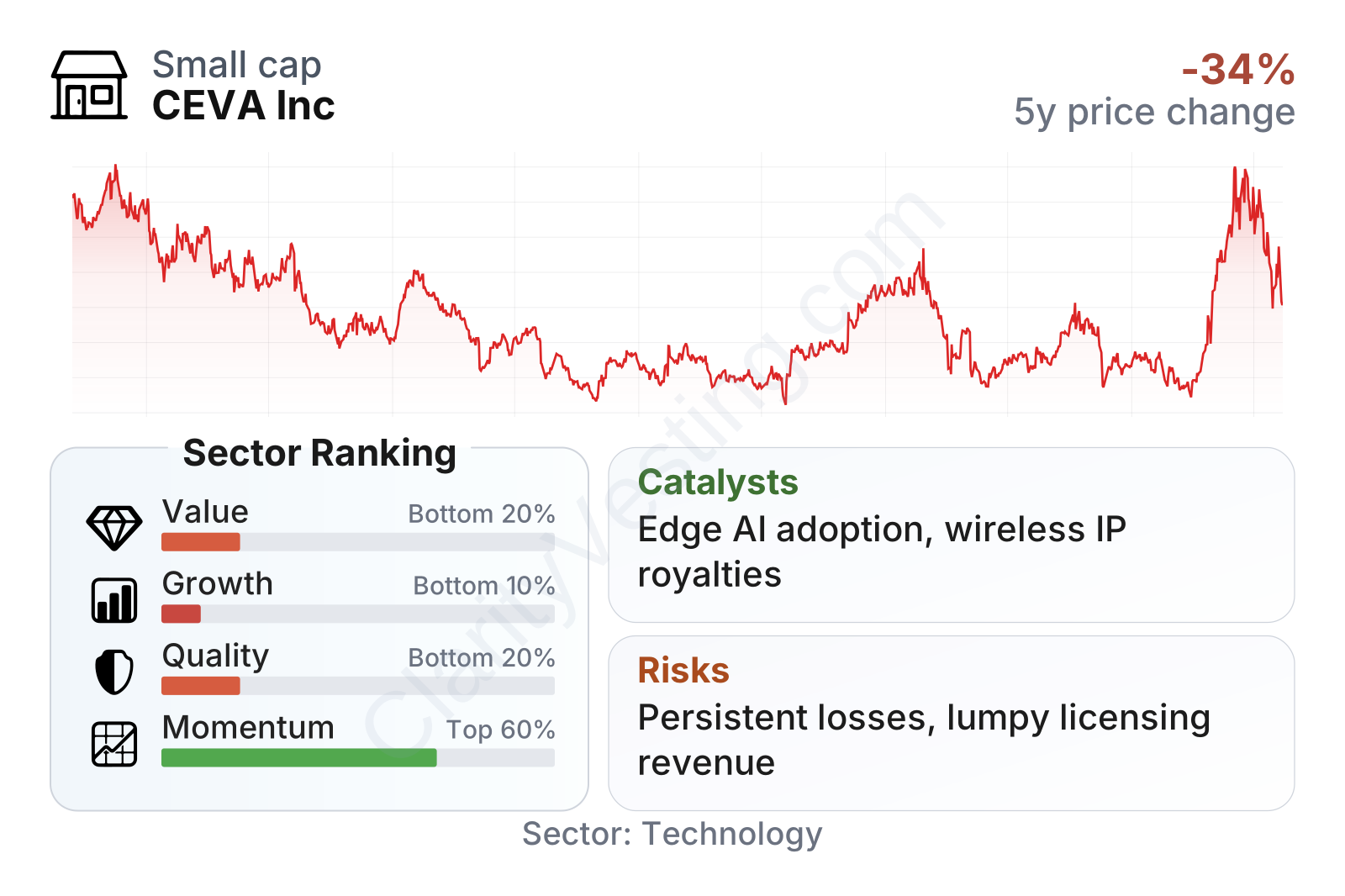
CEVA sits in the smaller end of the semiconductor universe, with a market value under $1 billion, and the stock has been notably volatile, as reflected by a beta around 2. The share price has experienced large swings over the last few years, which is common for smaller technology companies tied to semiconductor cycles and changing expectations around AI and connectivity demand.
The factor profile is mixed. Market momentum has been better than much of the sector over the last year, but value, growth, and quality metrics rank in the weaker end of semiconductor peers. That combination suggests the market has recently become more optimistic about CEVA’s future potential even though the underlying financial profile still looks fragile, with negative margins, negative returns on capital, and free cash flow near break-even to slightly negative.
Growth
CEVA operates in parts of the semiconductor market that are structurally attractive for the long run. Demand for connected devices, industrial IoT, smart wearables, edge AI, and software-defined wireless products is expected to keep expanding over time. The company does not need to dominate the entire semiconductor stack to benefit; it mainly needs its IP blocks to remain relevant in enough end devices and chip programs.
Its strategy broadly makes sense for that environment. CEVA focuses on technologies that solve recurring design problems for chipmakers: low-power wireless connectivity, digital signal processing, embedded AI inference, and sensing. These are capabilities many customers would rather license than build entirely in-house, especially in markets where development speed, power efficiency, and standards compliance matter.
Recent revenue trends show a business that has moved out of the steep 2023 downturn and returned to growth, with year-over-year expansion back into the low-teens range by the latest periods. That is an improvement, but it is not yet a strong multi-year growth pattern. Over a five-year view, revenue per share has still trended slightly downward, which shows the recovery is real but not yet enough to erase earlier weakness.
Cash generation tells a similar story. Free cash flow has improved from deeper negative levels seen earlier in the cycle, but it has remained inconsistent and recently stayed around break-even to negative territory. For a long-term case to strengthen materially, CEVA likely needs royalties to scale faster than operating expenses, because the present cost structure leaves little room for error.
One of the more important catalysts is the company’s exposure to edge AI and wireless standards. If AI processing increasingly moves from the cloud into devices, CEVA’s low-power AI software and processor IP could become more valuable. At the same time, growth in Bluetooth, Wi-Fi, UWB, and cellular IoT devices can support royalties over a wider installed base. Recent company communications have also highlighted customer engagement around generative AI at the edge, smart sensing, and next-generation connected products, which points to a potentially larger design-win pipeline even if revenue recognition takes time.
Risks
This article is for informational purposes only and does not constitute financial advice. Some content is AI-generated. See Disclaimer


