Stock Analysis · CDW Corp (CDW)
Stock Analysis · CDW Corp (CDW)

Overview

CDW is a large technology solutions provider that helps businesses, governments, schools, and healthcare organizations buy, design, implement, and manage IT systems. In simple terms, it sits between technology vendors and end customers. It sells hardware and software, but it also provides services such as cloud support, security, networking, data center work, and IT lifecycle help. That makes CDW more than a reseller: it is a broad IT partner for organizations that often prefer one trusted provider rather than managing dozens of vendors themselves.

The business is diversified across customer groups and product categories, which helps reduce reliance on any single technology trend. Based on company filings, revenue is generated mainly from product sales, while services contribute a smaller but strategically important share because they can deepen customer relationships and support recurring demand.

Main revenue sources can be summarized approximately as follows:

  • Hardware – the largest category, including notebooks, desktops, servers, storage, networking equipment, and peripherals; roughly around 45% to 50% of revenue.
  • Software – operating systems, security, productivity, and other enterprise software; roughly around 25% to 30%.
  • Services – consulting, implementation, managed and professional services; roughly around 10% to 15%.
  • Cloud and other solutions – cloud subscriptions and related offerings, often blended with software and services; a growing but still smaller portion in reported mix.

CDW also organizes its business by customer end markets, with sales spread across Corporate, Small Business, Public customers such as government and education, and operations in the United Kingdom and Canada. This customer breadth is one of the company’s defining features, because IT spending tends to weaken in some areas while remaining resilient in others.

The company’s economics show the typical pattern of a high-volume technology distributor and solutions provider: revenue is large, gross margins are modest, and disciplined operating execution matters a lot. Over the last several years, revenue has moved up and down with enterprise hardware cycles, but gross profit has held up better than sales, suggesting that the mix has gradually shifted toward higher-value categories and services.

One useful takeaway from the business flow is that CDW converts a very large revenue base into a much smaller but fairly steady profit pool. Gross profit has remained relatively resilient even when total sales softened, which supports the view that the company’s role in customer IT environments is broader than simple box-moving.

Key Figures

MetricValueSector
DateJul 18, 2026
Context
SectorTechnology
IndustryInformation Technology Services
Market Cap $17.16B
Beta 0.96
Value
(Cheapness)
P/E Ratio 16.3931.76
FCF Yield 6.27%4.18%
EBIT / EV 6.96%2.56%
PEG 1.33
Growth
(Business expansion)
Revenue Growth 9.20%13.50%
RPS Growth (5Y CAGR) 3.45%8.57%
EPS Growth (5Y CAGR) -34.08%-21.87%
Margin Growth (5Y Trend) 0.42%0.41%
FCF Growth (5Y CAGR) 12.28%9.76%
Quality
(Business durability)
ROIC (Latest) 14.24%8.54%
ROIC (5Y Median) 17.51%8.12%
Net Debt / EBIT (Latest) 3.570.38
Net Debt / EBIT (5Y Median) 3.360.38
Operating Margin (Latest) 6.80%9.58%
Operating Margin (5Y Median) 7.38%8.25%
Debt to Equity (Latest) 240.52%33.52%
Profit Margin (Latest) 4.70%6.96%
Free Cash Flow (Latest) $1.08B
Momentum
(Price trend)
3Y Return -26.11%+30.91%
12M Return (excl. last month) -24.39%+28.90%
6M Return +1.83%+5.38%
Price vs. 200-Day MA +0.51%+7.61%
Better than sector median
Slightly worse than sector median
More than 20% worse than sector median

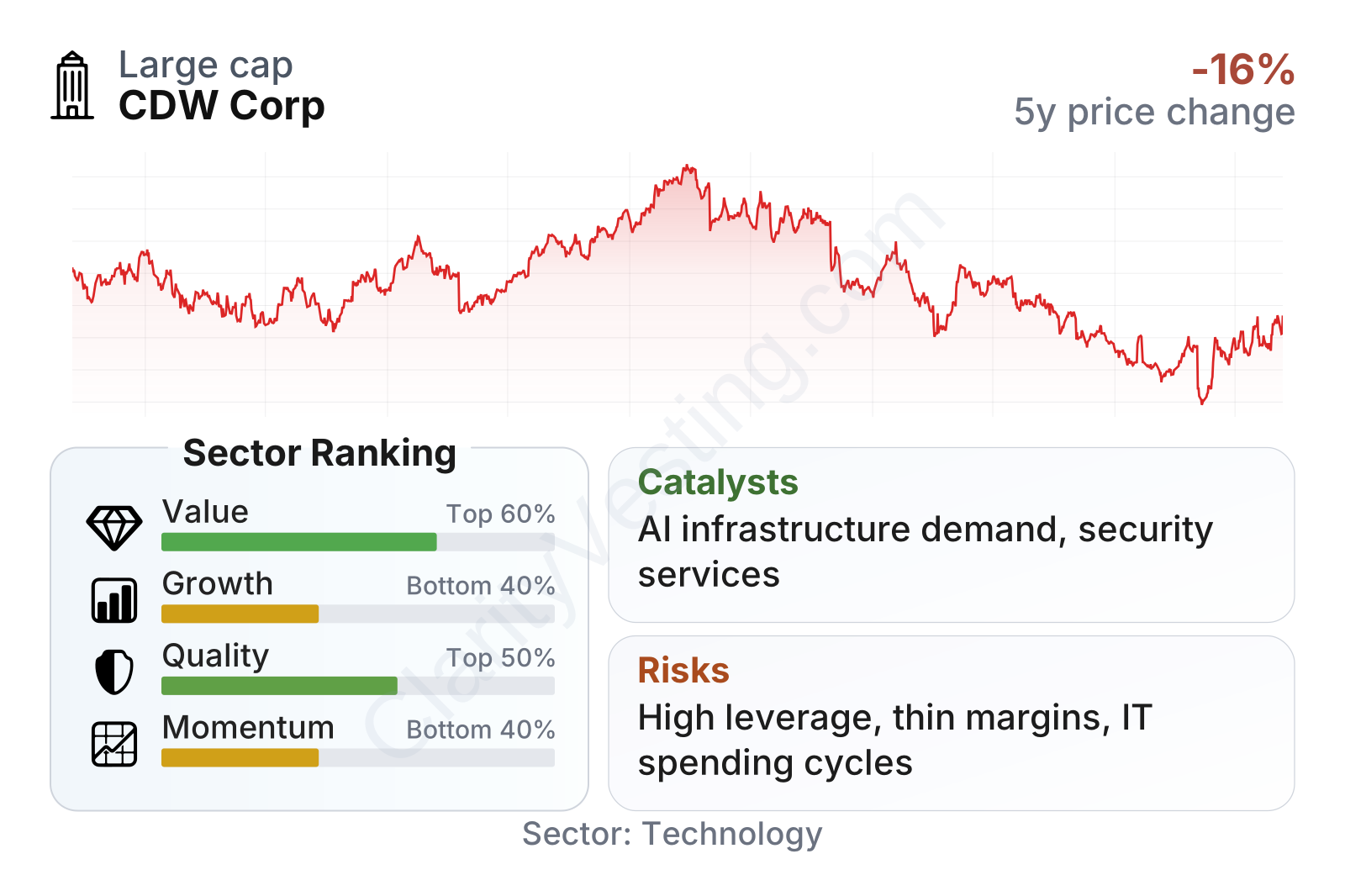
At a high level, CDW combines solid business quality with slower growth and weak recent stock momentum. Profitability on invested capital stands above the sector median, which suggests that the company has been effective at turning its asset base and customer relationships into earnings. Cash generation is also notable, with free cash flow yield and operating earnings relative to enterprise value comparing favorably with many technology peers. On the other hand, growth metrics are less impressive, reflecting the mature nature of the business and the uneven demand environment in PCs, devices, and enterprise hardware. The balance sheet is the main area that deserves closer attention, as leverage remains meaningfully higher than the sector norm.

The share price history also shows that sentiment has changed substantially. After a strong run into 2024, the stock pulled back sharply through 2025 and into early 2026. That decline has reduced valuation multiples, but it also signals that the market has become more cautious about growth and margins.

Growth

CDW operates in a sector that should continue to expand over the long run because organizations keep spending on digital infrastructure, cybersecurity, cloud architecture, networking, device refreshes, and data management. Even when budgets tighten, most institutions cannot simply stop investing in technology. They may delay projects, but they still need secure networks, modern endpoints, software licensing, collaboration tools, and support services. That creates a long-term demand base for a company that can help customers navigate complexity across many vendors and product categories.

Its strategy for future growth is sensible because it is built around areas where customers often need integration rather than one-off purchases. Management has continued to emphasize customer solutions, services, software, cloud, and security. Those categories generally offer better stickiness than commodity hardware and can strengthen repeat business. For a company like CDW, the most attractive path is not necessarily explosive top-line expansion, but gradually increasing the share of revenue tied to higher-value work.

The recent revenue pattern reflects a cyclical recovery rather than a straight line upward. After a difficult period of declining year-over-year sales in 2023 and much of 2024, growth turned positive again and has recently moved back toward high-single-digit levels. That matters because it suggests demand conditions have improved from the post-pandemic digestion phase, when many customers had already completed large device and infrastructure purchases.

Free cash flow remains one of the stronger parts of the investment profile. It rose sharply from 2022 to 2024, then cooled, but stayed above the billion-dollar mark on a trailing basis. That level of cash generation gives the company flexibility to support acquisitions, debt service, and shareholder returns even during uneven demand periods. For a business with modest margins, durable cash conversion is an important sign of operating discipline.

One of the clearest catalysts is the ongoing need for AI-related infrastructure and broader data center modernization. CDW is not an AI model developer, but it can benefit as customers upgrade servers, storage, networking, security, and software environments to support heavier workloads. A second catalyst is the continuing rise of cybersecurity spending, which tends to remain necessary even when other IT budgets become selective. A third is public-sector and education demand, where refresh cycles and modernization programs can provide steadier support than some corporate categories.

Recent company communications have also highlighted continued customer interest in hybrid cloud, security, and services-led solutions. That is significant because it points to opportunities that are less tied to pure hardware volume and more connected to recurring technology complexity.

Risks

CDW’s biggest risk is that it operates in a competitive, relatively low-margin part of the technology market. Even though the company adds value through services and integration, a large share of revenue still comes from products where pricing pressure can be intense. That means execution needs to stay sharp: small changes in gross margin, vendor incentives, or operating costs can noticeably affect profits.

A second major risk is customer spending cyclicality. Corporate clients may delay endpoint refreshes, infrastructure upgrades, or software projects during economic slowdowns. Public customers are often steadier, but government and education budgets can also shift with funding conditions and procurement cycles. The company’s results in recent years already showed how quickly growth can reverse after a period of strong demand.

Leverage is another point that deserves attention. Debt to equity has improved significantly from earlier peaks, but it remains far above the sector median. Net debt relative to EBIT is also elevated versus many technology peers. This does not automatically signal distress, especially given CDW’s cash generation, but it does reduce flexibility if operating conditions weaken or financing costs stay higher for longer.

Profit margins are modest and currently below the sector median. They have been fairly stable rather than collapsing, which is encouraging, but the business does not have the kind of wide margin cushion seen in software-heavy companies. That makes scale, customer retention, and procurement efficiency especially important. In other words, CDW can be a strong operator without looking like a high-margin technology company.

On competitive positioning, CDW has meaningful advantages. It has scale, long-standing vendor relationships, a broad customer base, technical capabilities across many IT domains, and a reputation built over decades. These features make it a difficult company to displace in large accounts. Still, it is not alone. Main competitors include Insight Enterprises, SHI International, Connection, and large global IT services and infrastructure players that overlap in selected categories. Compared with many of these rivals, CDW stands out for its size, balanced end-market exposure, and established presence in public-sector channels. It is one of the leaders in U.S. IT solutions distribution and integration, though not an uncontested monopoly in any core area.

No major public red flag stands out in recent company disclosures in the form of scandal or governance breakdown. The more relevant risk is operational: if customers remain cautious, hardware refresh activity stays soft, or vendor ecosystems change in ways that reduce reseller relevance, earnings pressure could persist longer than expected.

Valuation

CDW’s valuation looks noticeably lower than the broader technology sector. The current earnings multiple sits in the mid-teens, while the sector median is roughly around twice that level. That discount is not surprising: CDW is a mature, lower-margin, services-and-distribution business rather than a fast-growing software platform. Even so, the gap suggests the market is already recognizing the company’s slower growth profile and higher leverage.

The longer valuation trend is also important. Over the last several years, the stock’s price-to-earnings ratio has compressed from the mid-20s and above to the mid-teens, while the sector median stayed much higher. This means the current valuation is not simply low relative to peers today; it is also low compared with where the market historically valued CDW itself. That usually reflects a combination of weaker sentiment, lower growth expectations, and concern about the quality of future demand.

At the same time, valuation cannot be judged in isolation. CDW still produces strong free cash flow, earns healthy returns on invested capital, and occupies a durable position in enterprise and public-sector IT procurement. Those strengths support a case for a lower multiple than software leaders, but not necessarily an overly distressed one. In that sense, the current price appears to reflect a more conservative view of the business rather than a view that the company’s model is broken.

The central valuation question is whether the recent slowdown proves temporary or structural. If growth stabilizes and services, software, security, and infrastructure demand continue to improve mix, the current multiple looks restrained relative to business quality. If demand remains muted and leverage becomes more constraining, the discount can remain in place.

Conclusion

CDW stands out as a large, well-established technology solutions provider with broad customer reach, strong vendor relationships, and consistently solid cash generation. It is not a high-growth software name, and its margins are too thin to ignore, but it has shown that it can remain profitable and cash generative across shifting IT spending cycles. The company’s role in helping organizations buy and manage increasingly complex technology environments gives it a durable place in the market.

The main challenge is that durability does not automatically translate into fast expansion. Growth has been uneven, leverage is higher than ideal, and recent stock performance shows that the market has become less willing to pay premium multiples for this kind of business. Still, the company retains credible strengths: above-average returns on capital, resilient gross profit, and exposure to long-running themes such as cybersecurity, cloud architecture, infrastructure refresh, and AI-related enterprise spending.

Overall, CDW currently looks like a financially solid but operationally demanding business whose market position remains attractive, while its valuation now reflects more caution than optimism. The balance of evidence points to a company with enduring relevance and respectable underlying quality, but one that still needs steadier growth and disciplined balance sheet management to fully improve its market standing.

Sources:

  • CDW Corporation – Annual Report on Form 10-K for fiscal year 2025
  • CDW Corporation – Quarterly Report on Form 10-Q for quarter ended March 31, 2026
  • CDW Corporation – Investor Relations press releases and earnings materials, 2026
  • SEC EDGAR – CDW Corporation filings database
  • CDW Corporation – Company website and business overview materials
  • Wikipedia – CDW basic company history and corporate background

This article is for informational purposes only and does not constitute financial advice. Some content is AI-generated. See Disclaimer


Sign up for exclusive research and insights.

Unsubscribe anytime.
