Stock Analysis · Cadence Design Systems Inc (CDNS)
Overview
Cadence Design Systems is a software company that provides tools used to design advanced semiconductors, electronic systems, and increasingly complex products that combine hardware and software. Its customers include chip designers, large semiconductor manufacturers, cloud and AI infrastructure companies, automotive suppliers, aerospace and defense groups, and electronics firms. In simple terms, Cadence sells the digital “blueprints and testing environments” that help engineers create chips and electronic products before they are physically manufactured.
The company’s business is built around electronic design automation, or EDA, along with system design and analysis software, and hardware used to emulate or prototype chips during development. This is a critical part of the semiconductor value chain because modern chips are too complex to be designed efficiently without specialized software.
Based on recent company reporting, Cadence’s main revenue sources can be summarized as follows:
- Core EDA software and related IP: approximately 70% to 80% of revenue. This includes software for digital chip design, verification, custom and analog design, packaging, and semiconductor intellectual property blocks that customers can license and reuse.
- System design and analysis software: approximately 10% to 20% of revenue. This includes multiphysics, computational fluid dynamics, PCB design, and system-level tools used in markets such as automotive, aerospace, industrial, and electronics.
- Hardware-assisted verification: approximately 10% to 15% of revenue. This includes emulation and prototyping systems that help customers test chip designs faster, especially for AI, data center, and complex system-on-chip programs.
Cadence also benefits from a business model with recurring characteristics. A large portion of revenue comes from time-based software licenses, maintenance, and long customer relationships, which tends to make results more stable than many other software businesses. Over the last several years, revenue has expanded steadily while the company continued to spend heavily on research and development, showing that growth has not come from cutting innovation.
The business mix shows a company with very high gross profitability and a clear willingness to reinvest. Revenue has climbed strongly over the last five years, while research and development has remained one of the largest uses of operating spending. Even with that investment, operating income has risen meaningfully, which points to strong pricing power and disciplined execution.
Key Figures
| Metric | Value | Sector ⓘ |
|---|---|---|
| Date | Sep 12, 2026 | |
| Context | ||
| Sector | Technology | |
| Industry | Software - Application | |
| Market Cap ⓘ | $79.69B | |
| Beta ⓘ | 1.14 | |
Value (Cheapness) | ||
| P/E Ratio ⓘ | 56.52 | 29.51 |
| FCF Yield ⓘ | 2.11% | 4.25% |
| EBIT / EV ⓘ | 2.33% | 2.85% |
| PEG ⓘ | 2.15 | |
Growth (Business expansion) | ||
| Revenue Growth ⓘ | 24.20% | 15.40% |
| RPS Growth (5Y CAGR) ⓘ | 15.97% | 8.56% |
| EPS Growth (5Y CAGR) ⓘ | -5.22% | -11.88% |
| Margin Growth (5Y Trend) ⓘ | 4.65% | 0.46% |
| FCF Growth (5Y CAGR) ⓘ | 11.30% | 9.80% |
Quality (Business durability) | ||
| ROIC (Latest) ⓘ | 16.33% | 9.44% |
| ROIC (5Y Median) ⓘ | 24.00% | 8.30% |
| Net Debt / EBIT (Latest) ⓘ | 0.56 | 0.54 |
| Net Debt / EBIT (5Y Median) ⓘ | -0.18 | 0.44 |
| Operating Margin (Latest) ⓘ | 31.81% | 9.58% |
| Operating Margin (5Y Median) ⓘ | 30.94% | 8.25% |
| Debt to Equity (Latest) ⓘ | 36.19% | 33.33% |
| Profit Margin (Latest) ⓘ | 23.61% | 7.14% |
| Free Cash Flow (Latest) ⓘ | $1.68B | |
Momentum (Price trend) | ||
| 3Y Return ⓘ | +22.38% | +45.48% |
| 12M Return (excl. last month) ⓘ | -8.62% | +23.48% |
| 6M Return ⓘ | -0.33% | +20.93% |
| Price vs. 200-Day MA ⓘ | -11.45% | +7.43% |
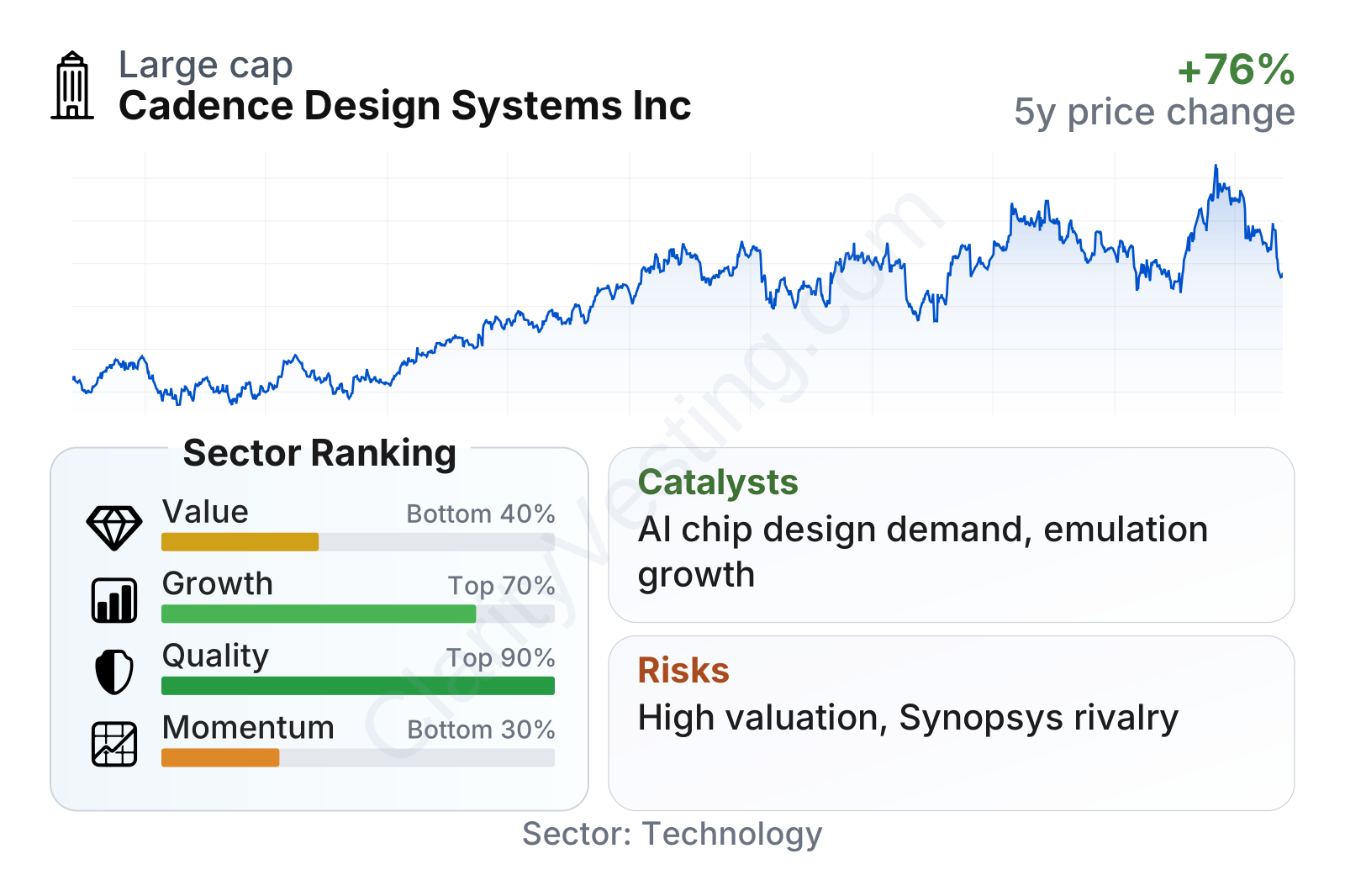
Cadence is a very large software company in its sector, with share price behavior that has generally trended upward over several years, though not in a straight line. The latest metrics suggest a mixed profile: quality is exceptionally strong, growth is above sector norms, and momentum is roughly middle-of-the-pack, while valuation is clearly demanding. Profitability stands out in particular, with operating and net margins far above the sector median, and returns on invested capital that are also well ahead of many peers. The trade-off is that the market already recognizes these strengths, which leaves less room for valuation support.
Growth
Cadence operates in a sector with durable long-term expansion drivers. Semiconductor complexity keeps rising, advanced packaging is becoming more important, AI accelerators require far more design and verification work, and automotive electronics continue to gain content. All of these trends increase the need for more sophisticated design software, reusable IP, and faster hardware-assisted verification. That creates a favorable backdrop for companies that already sit deep inside engineering workflows.
The company’s strategy appears aligned with those trends. Cadence has been broadening beyond classic chip design into a more complete stack: core EDA software, chip IP, system analysis, packaging, and emulation. This matters because customers increasingly want integrated flows rather than isolated point tools. It also helps Cadence capture a larger share of spending on each design program.
Revenue growth has not been perfectly smooth, but the broader direction has been strong. After a brief soft patch in 2024, growth re-accelerated and recently moved back into the low-to-mid 20% range year over year, clearly ahead of the sector median. Over a five-year view, revenue per share growth has also remained solid, which supports the idea that expansion is not only coming from acquisitions or financial engineering.
Cash generation reinforces that picture. Free cash flow has trended upward over time and remains comfortably above $1 billion on a trailing basis. For a software business serving technical enterprise customers, that is important: it gives Cadence room to keep funding product development, pursue selective acquisitions, and support operations without relying heavily on external financing.
A meaningful catalyst is the buildout of AI infrastructure. AI chips are becoming larger, more power-hungry, and harder to verify, which increases demand for advanced design tools and emulation systems. Another catalyst is the expansion of system design tools into automotive, aerospace, and industrial use cases, where electronics are becoming more complex and simulation is increasingly essential. Recent company updates have also highlighted continued demand tied to advanced-node design activity, hardware-assisted verification, and broader adoption of AI-enabled design capabilities inside engineering workflows.
Risks
This article is for informational purposes only and does not constitute financial advice. Some content is AI-generated. See Disclaimer


