Stock Analysis · CCC Intelligent Solutions Holdings Inc (CCC)
Overview
CCC Intelligent Solutions Holdings Inc. is a software company focused on the property and casualty insurance ecosystem, especially auto claims. Its platforms help insurers, repair shops, parts suppliers, lenders, and automakers exchange data and manage workflows across the life of a claim. In simple terms, CCC provides the digital infrastructure that helps an accident move from first notice of loss to estimate, repair, payment, and, increasingly, AI-assisted decision-making.
The business is built mainly on subscription and transaction-based software revenue. The company serves a large network of insurers and collision repairers, and that network effect is important: the more participants connected to the platform, the more useful it becomes for everyone already on it.
Based on company filings, revenue is reported primarily as software and services rather than many detailed operating segments. A practical breakdown of the business mix is therefore better understood through end markets and workflow categories than formal segment reporting.
- Insurance workflow software: the largest revenue source, likely representing a clear majority of total revenue. This includes claims management, estimating, digital appraisal, casualty and auto claims tools, fraud and workflow automation, and insurer-facing analytics.
- Repair facility and collision shop solutions: a significant secondary source. This includes estimating tools, repair workflow software, parts procurement connections, and communication tools used by body shops.
- Parts, suppliers, and other ecosystem services: a smaller but meaningful contribution. This includes data exchange, procurement-related tools, and network services connecting repairers with suppliers and other industry participants.
- Newer AI and photo-based claims solutions: still embedded within the broader software base rather than reported separately, but strategically important. These tools include image-based estimating, AI-assisted claims triage, and automation products expanded through internal development and acquisitions.
Revenue has climbed from about $688 million in 2021 to roughly $1.06 billion in 2025, while gross profit has also increased strongly. That points to a business with meaningful scale and sticky customer relationships, even if bottom-line earnings have been uneven.
The operating picture shows a favorable pattern over time: sales and gross profit have expanded steadily, while free cash generation has improved much faster than accounting earnings. At the same time, interest expense remains material, which helps explain why net income has looked more volatile than revenue.
Key Figures
| Metric | Value | Sector ⓘ |
|---|---|---|
| Date | Sep 12, 2026 | |
| Context | ||
| Sector | Technology | |
| Industry | Software - Application | |
| Market Cap ⓘ | $4.03B | |
| Beta ⓘ | 0.48 | |
Value (Cheapness) | ||
| P/E Ratio ⓘ | 97.86 | 29.51 |
| FCF Yield ⓘ | 7.62% | 4.25% |
| EBIT / EV ⓘ | 3.58% | 2.85% |
| PEG ⓘ | N/A | |
Growth (Business expansion) | ||
| Revenue Growth ⓘ | 9.80% | 15.40% |
| RPS Growth (5Y CAGR) ⓘ | 6.88% | 8.56% |
| EPS Growth (5Y CAGR) ⓘ | -6.08% | -11.88% |
| Margin Growth (5Y Trend) ⓘ | 40.13% | 0.46% |
| FCF Growth (5Y CAGR) ⓘ | 30.05% | 9.80% |
Quality (Business durability) | ||
| ROIC (Latest) ⓘ | N/A | 9.44% |
| ROIC (5Y Median) ⓘ | N/A | 8.30% |
| Net Debt / EBIT (Latest) ⓘ | 6.62 | 0.54 |
| Net Debt / EBIT (5Y Median) ⓘ | 6.18 | 0.44 |
| Operating Margin (Latest) ⓘ | 16.85% | 9.58% |
| Operating Margin (5Y Median) ⓘ | 8.75% | 8.25% |
| Debt to Equity (Latest) ⓘ | 76.53% | 33.33% |
| Profit Margin (Latest) ⓘ | 3.81% | 7.14% |
| Free Cash Flow (Latest) ⓘ | $307.54M | |
Momentum (Price trend) | ||
| 3Y Return ⓘ | -37.19% | +45.48% |
| 12M Return (excl. last month) ⓘ | -25.37% | +23.48% |
| 6M Return ⓘ | +18.79% | +20.93% |
| Price vs. 200-Day MA ⓘ | +11.21% | +7.43% |
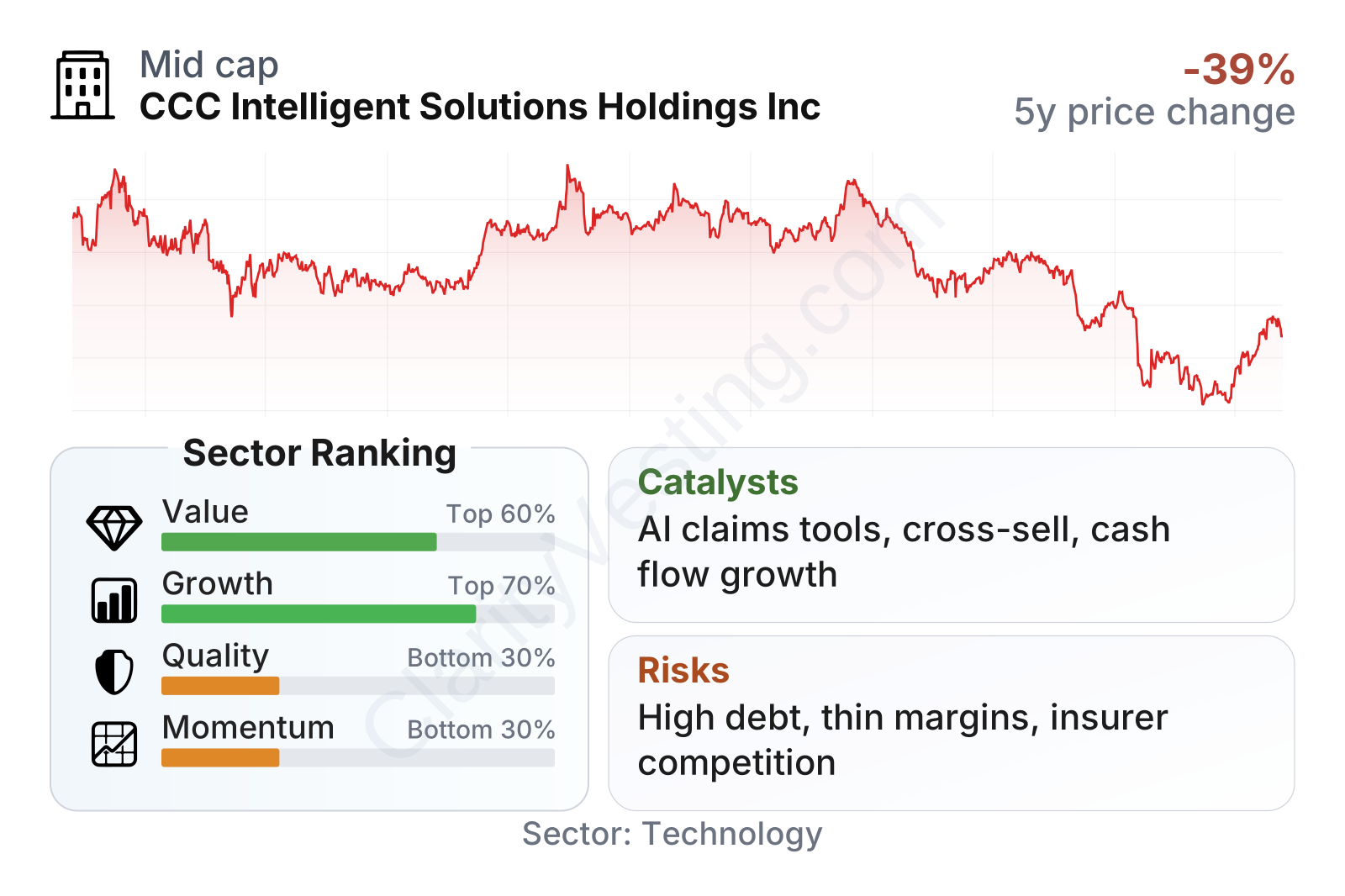
CCC is a mid-sized software company with unusually low share-price volatility for the technology sector, as reflected by a beta near 0.5. The overall factor profile is mixed. Value metrics are not especially cheap on earnings, but cash flow measures look stronger than the sector median. Growth ranks in the upper part of the sector, largely supported by solid revenue expansion and very strong multi-year free cash flow growth. Quality is held back by leverage and margins that remain below many software peers, while stock momentum has been weak across most measured periods.
The stock chart also shows a long period of sideways trading followed by a marked decline into 2026. That drop has compressed the company’s size in market terms, but it has not been matched by a collapse in revenue, which creates an important difference between business performance and market sentiment.
Growth
CCC operates in a sector with durable long-term demand. Auto insurance claims are recurring, highly data-heavy, and still undergoing digitization. Insurers need faster claims handling, repair networks want smoother workflows, and all participants are under pressure to reduce labor intensity. That gives CCC exposure to a real structural trend rather than a short-lived software niche.
The company’s strategy also makes sense. It is not trying to win through a single app or one-off product launch; it is deepening its role inside an established transaction network. That tends to support retention and cross-selling. Once an insurer, repairer, and supplier are already connected through the same system, replacing that workflow can become disruptive and expensive.
Revenue growth has been consistently positive, generally running around high-single-digit to low-double-digit percentages in recent years. That is not hypergrowth, but it is steady and notable for a company serving an established industry. Compared with the broader software sector, growth is somewhat slower than the median, yet the consistency matters because claims software is typically less cyclical than many other technology categories.
One of the most encouraging trends is cash generation. Free cash flow has risen sharply over the past several years, moving from just above $100 million in 2021 to more than $250 million on a trailing basis by early 2026, with the latest quality snapshot closer to just above $300 million. That suggests the business model can convert revenue into cash even when net income remains thin. For a subscription-heavy software platform, that is an important sign of resilience.
Recent company updates have emphasized AI-enabled claims automation, including image-driven estimating and decision support tools. This is a meaningful catalyst because it expands CCC’s role from workflow software into higher-value judgment assistance. If adoption increases, AI features could raise wallet share within existing customers before the company even needs large new customer wins.
Another notable opportunity is ecosystem expansion beyond the traditional repair estimate. As vehicles become more complex and insurers seek more automation, CCC has room to add services around total loss, casualty, subrogation, diagnostics, and digital communication across more steps of the claims process.
Risks
This article is for informational purposes only and does not constitute financial advice. Some content is AI-generated. See Disclaimer


