Stock Analysis · Cerebras Systems Inc (CBRS)
Overview
Cerebras Systems designs high-performance computing systems built for artificial intelligence. Its best-known product is a very large processor called the Wafer-Scale Engine, which is designed to train and run large AI models faster and with less complexity than traditional clusters made from many smaller chips. Around that core technology, the company sells complete AI systems, software tools, and access to cloud-based AI computing.
For a long-term reader, the simplest way to think about Cerebras is this: it is trying to become an alternative to conventional GPU-based AI infrastructure. Instead of linking together very large numbers of smaller processors, Cerebras promotes a system built around fewer, much larger chips and tightly integrated hardware and software. If that approach keeps proving useful for model training and inference, the company could occupy a valuable niche in the AI computing market.
The company’s revenue mix is not disclosed in fine detail in the financial information available to the public, but its business can be grouped into a few main sources.
- AI systems and hardware sales: likely the largest source of revenue. This includes Cerebras CS systems built around its wafer-scale chips, along with related equipment delivered to enterprise, research, and government customers.
- Service and support revenue: recurring revenue tied to installation, maintenance, technical support, and system-related services.
- Cloud and AI compute access: revenue from giving customers access to Cerebras-powered computing capacity through cloud or hosted environments.
- Software and related platform revenue: tools that help customers train, deploy, and manage models on Cerebras hardware, usually bundled with broader system relationships rather than reported as a large stand-alone segment.
The broad financial progression is notable. Revenue increased from about $25 million in 2022 to about $79 million in 2023, then to about $290 million in 2024 and roughly $510 million in 2025. Over the same period, gross profit improved sharply, showing that commercial adoption has been scaling. The biggest issue is that operating costs, especially research and development, have remained extremely high because Cerebras is still investing heavily to establish its technology position.
The operating picture has changed quickly: earlier years showed a business with modest sales and very large losses, while 2025 shows a much larger revenue base and positive operating income. That shift suggests the company has moved beyond pure development mode, although the path is still likely to remain uneven because large hardware deals can be lumpy from one period to another.
Key Figures
| Metric | Value | Sector ⓘ |
|---|---|---|
| Date | Nov 21, 2026 | |
| Context | ||
| Sector | Technology | |
| Industry | Semiconductors | |
| Market Cap ⓘ | $24.54B | |
| Beta ⓘ | N/A | |
Value (Cheapness) | ||
| P/E Ratio ⓘ | N/A | 26.18 |
| FCF Yield ⓘ | -6.48% | 3.74% |
| Dividend Yield ⓘ | N/A | 1.32% |
| EBIT / EV ⓘ | N/A | 3.92% |
| PEG ⓘ | N/A | |
Growth (Business expansion) | ||
| Revenue Growth ⓘ | 55.30% | 17.95% |
| RPS Growth (5Y CAGR) ⓘ | 174.58% | 8.44% |
| EPS Growth (5Y CAGR) ⓘ | N/A | -6.06% |
| Margin Growth (5Y Trend) ⓘ | N/A | 0.56% |
| FCF Growth (5Y CAGR) ⓘ | N/A | 9.84% |
| DPS Growth (5Y CAGR) ⓘ | N/A | 7.96% |
Quality (Business durability) | ||
| ROIC (Latest) ⓘ | N/A | 10.05% |
| ROIC (5Y Median) ⓘ | N/A | 8.19% |
| Net Debt / EBIT (Latest) ⓘ | N/A | 0.61 |
| Net Debt / EBIT (5Y Median) ⓘ | N/A | 0.48 |
| Net Debt / EBITDA (Latest) ⓘ | N/A | 0.33 |
| Net Debt / Assets ⓘ | -13.61% | 4.20% |
| EBITDA / Interest ⓘ | N/A | 13.53 |
| Operating Margin (Latest) ⓘ | N/A | 10.59% |
| Operating Margin (5Y Median) ⓘ | -163.29% | 8.53% |
| Debt to Equity (Latest) ⓘ | 15.83% | 34.34% |
| Profit Margin (Latest) ⓘ | -86.19% | 7.54% |
| Free Cash Flow (Latest) ⓘ | -$1.59B | |
Momentum (Price trend) | ||
| 3Y Return ⓘ | -55.31% | +26.20% |
| 12M Return (excl. last month) ⓘ | N/A | +11.65% |
| 6M Return ⓘ | -70.67% | -4.21% |
| Price vs. 200-Day MA ⓘ | N/A | -4.34% |
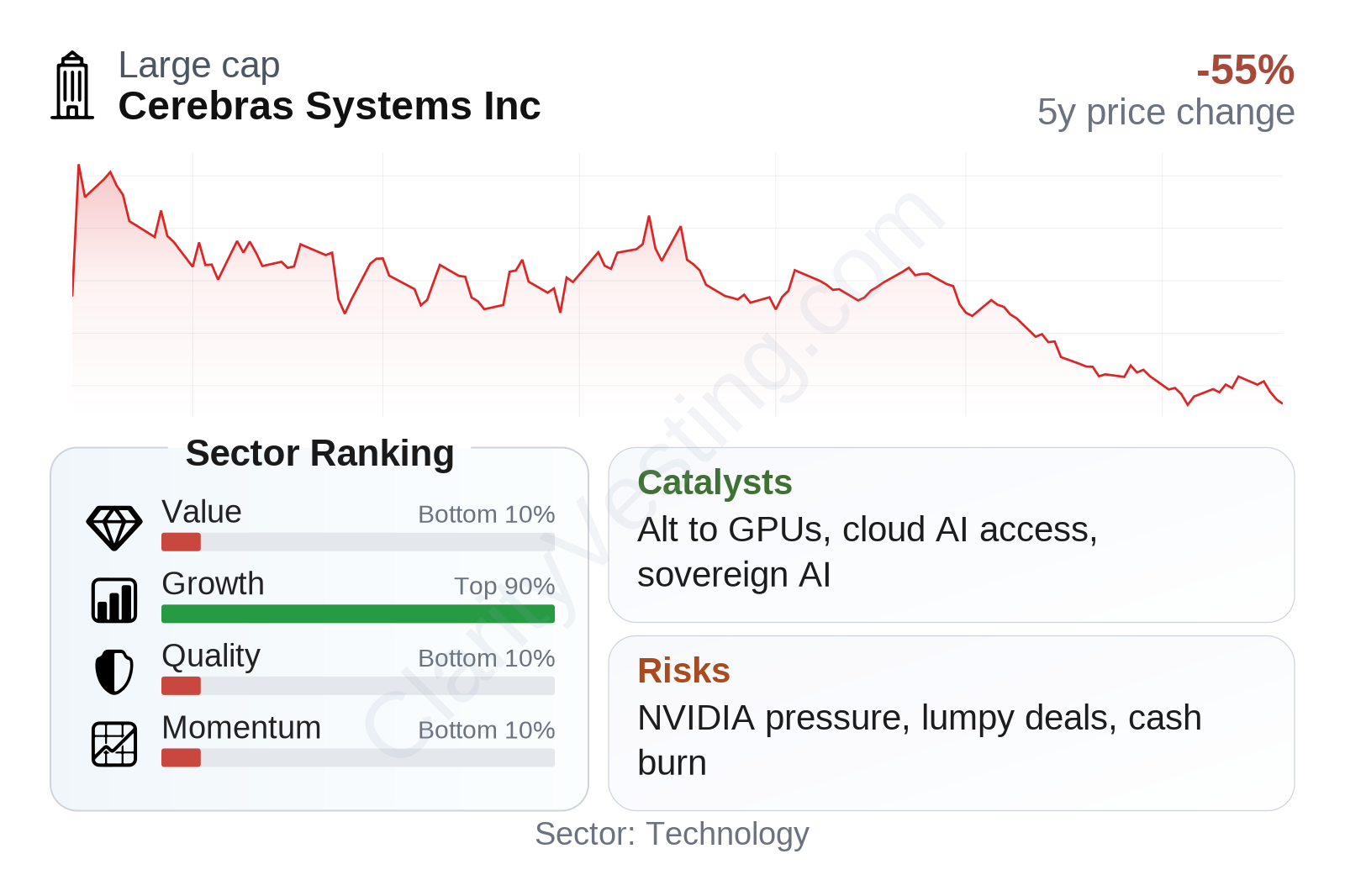
The overall profile is unusual but clear. Growth metrics rank near the top of the semiconductor sector, with year-over-year revenue growth around 55% and a very strong multi-year expansion rate. At the same time, value, quality, and momentum measures rank near the bottom of the sector. In plain terms, the market is looking at a business with exceptional top-line expansion but a limited margin of safety if execution weakens. Cash generation is still negative, profitability has been volatile, and the stock has been highly unstable over recent months.
The share-price pattern reinforces that point. The stock climbed strongly during the middle of 2026 and then fell sharply by November, which is often what happens when expectations are high and the market is reassessing the timing of future results. This kind of movement does not say whether the business model will work long term, but it does show that the market is treating Cerebras as a high-expectation, high-uncertainty company rather than a mature semiconductor name.
Growth
Cerebras operates in one of the fastest-growing areas in technology: AI infrastructure. Demand for computing power used to train and run large language models, scientific models, and other AI applications continues to expand across cloud providers, enterprises, governments, and research institutions. That gives the company exposure to a real and growing market rather than a speculative one created only by hype.
Its strategy also has internal logic. The company is not trying to be another standard chip vendor selling interchangeable components into a crowded market. It is offering a differentiated architecture built for specific AI workloads, and it wraps that architecture into systems, software, and cloud access. That can matter because customers buying AI infrastructure often care about total performance, energy efficiency, deployment speed, and ease of scaling rather than just the chip alone.
A major catalyst is the possibility that more customers decide they need alternatives to the dominant AI hardware ecosystem. If large model developers, sovereign AI initiatives, defense-related programs, and research institutions want a second source of high-end AI compute, Cerebras could benefit. Another meaningful catalyst is the growing importance of inference, where lower latency and simpler scaling can become a commercial advantage if the company’s architecture performs as advertised in real-world use.
Recent company communications have also emphasized partnerships, customer wins, and the expansion of cloud-based access to Cerebras systems. Those developments matter because they can reduce dependence on one-time hardware shipments and broaden the company’s reach beyond organizations willing to buy full systems outright. For a business still proving scale, every step that makes adoption easier can support future revenue growth.
Risks
This article is for informational purposes only and does not constitute financial advice. Some content is AI-generated. See Disclaimer