Stock Analysis · Cracker Barrel Old Country Store (CBRL)
Overview
Cracker Barrel Old Country Store is a restaurant-and-retail chain built around a very specific concept: full-service Southern-style dining paired with a country-themed gift shop under the same roof. The company operates primarily in the United States and is best known for its highway-adjacent locations, where travelers, families, and older customers can stop for both meals and shopping. In recent years, the company has also expanded its second restaurant brand, Maple Street Biscuit Company, though Cracker Barrel remains the core of the business by a very wide margin.
The business model is fairly easy to understand. A guest visits for breakfast, lunch, or dinner, and many also browse or purchase merchandise such as seasonal décor, toys, apparel, candy, and gifts. That dual format gives the company two revenue streams tied to the same customer visit, which is unusual in casual dining and helps differentiate the brand from standard restaurant chains.
Based on recent company reporting, revenue is still heavily concentrated in the legacy Cracker Barrel brand, with food sales clearly leading and retail merchandise second. Maple Street contributes only a small share of total sales today.
- Restaurant sales: roughly 75% to 80% of total revenue, making it the largest source by far.
- Retail sales: roughly 20% to 25% of total revenue, generated by the in-store gift shops.
- Maple Street Biscuit Company: a small low-single-digit share of total revenue, but strategically important as a possible growth vehicle outside the mature core brand.
One important takeaway is that Cracker Barrel is not a pure restaurant company. Its economics depend on both dining traffic and merchandise productivity, which can be helpful when the concept is working well, but can also add complexity when consumer demand weakens.
The longer financial pattern shows that revenue has been relatively stable near the mid-$3 billion range in recent years, but profitability has compressed sharply. Sales have held up much better than earnings, which suggests the main issue has been cost pressure rather than a collapse in the top line.
That long-term picture highlights the central challenge: the company has largely preserved its revenue base, but a much smaller share of each dollar of sales is reaching operating income and net income than it did a few years ago.
Key Figures
| Metric | Value | Sector ⓘ |
|---|---|---|
| Date | Sep 12, 2026 | |
| Context | ||
| Sector | Consumer Cyclical | |
| Industry | Restaurants | |
| Market Cap ⓘ | $1.11B | |
| Beta ⓘ | 1.18 | |
Value (Cheapness) | ||
| P/E Ratio ⓘ | 44.54 | 17.10 |
| FCF Yield ⓘ | 5.36% | 8.53% |
| EBIT / EV ⓘ | 1.31% | 6.46% |
| PEG ⓘ | 1.56 | |
Growth (Business expansion) | ||
| Revenue Growth ⓘ | -2.90% | 5.75% |
| RPS Growth (5Y CAGR) ⓘ | 6.91% | 9.14% |
| EPS Growth (5Y CAGR) ⓘ | N/A | -18.21% |
| Margin Growth (5Y Trend) ⓘ | -11.32% | -0.23% |
| FCF Growth (5Y CAGR) ⓘ | -28.74% | 4.91% |
Quality (Business durability) | ||
| ROIC (Latest) ⓘ | 4.21% | 12.61% |
| ROIC (5Y Median) ⓘ | 14.34% | 10.72% |
| Net Debt / EBIT (Latest) ⓘ | 36.88 | 2.10 |
| Net Debt / EBIT (5Y Median) ⓘ | 9.44 | 2.32 |
| Operating Margin (Latest) ⓘ | 0.87% | 9.25% |
| Operating Margin (5Y Median) ⓘ | 3.50% | 9.64% |
| Debt to Equity (Latest) ⓘ | 235.18% | 75.78% |
| Profit Margin (Latest) ⓘ | 0.79% | 5.33% |
| Free Cash Flow (Latest) ⓘ | $59.18M | |
Momentum (Price trend) | ||
| 3Y Return ⓘ | -25.61% | +14.53% |
| 12M Return (excl. last month) ⓘ | +0.72% | +3.08% |
| 6M Return ⓘ | +82.15% | +0.55% |
| Price vs. 200-Day MA ⓘ | +33.04% | -0.54% |
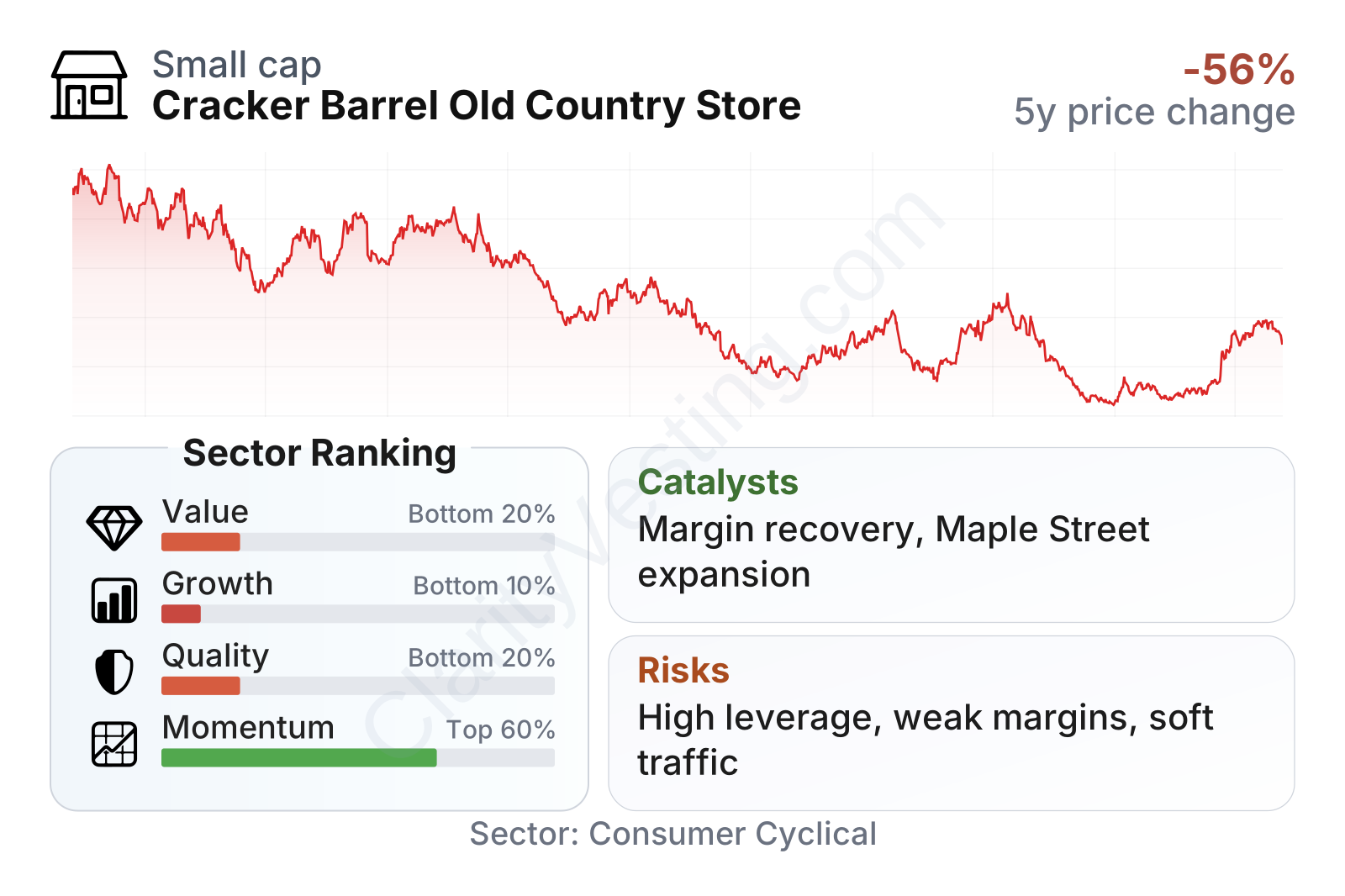
Cracker Barrel is currently a small-cap consumer company with a market value around $1 billion and share-price volatility somewhat above the broader market. The overall metric profile is weak relative to much of the sector: valuation measures do not screen as cheap, growth ranks near the bottom of the group, and quality is held back by thin margins and heavy leverage. There is one notable contrast, though: the stock’s recent shorter-term rebound has been strong even after a much weaker multiyear share-price record.
The biggest financial contradiction is that the business still produces meaningful revenue and some free cash flow, yet recent returns on capital and operating profitability are far below sector norms. That means the debate around Cracker Barrel is less about whether the brand still attracts customers and more about whether management can restore acceptable margins without damaging traffic.
Growth
Cracker Barrel operates in a large, established sector rather than a fast-growing one. Casual dining is not a high-growth industry in the way software, semiconductors, or cloud infrastructure can be. Demand is tied to household budgets, highway travel, wage inflation, and food costs, so growth tends to be incremental and execution-driven. That makes concept strength, pricing discipline, and cost control especially important.
For future expansion, the company’s strategy appears to have three main pillars: improving traffic at the core Cracker Barrel brand, modernizing operations and menu offerings, and developing Maple Street Biscuit Company as a smaller but potentially more flexible growth concept. This makes strategic sense because the original Cracker Barrel format is well known but mature, while Maple Street offers a way to reach different occasions and trade areas.
The recent revenue trend has been soft. After a post-pandemic recovery period, year-over-year growth cooled and then turned negative in the latest stretch. In other words, the company is no longer benefiting from easy comparisons, and it has not yet found a strong enough traffic or pricing engine to return to sustained top-line momentum. That weak growth profile is a major reason the company ranks poorly on growth compared with the broader consumer sector.
Cash generation has also become less dependable. Free cash flow was much stronger a few years ago, then dropped sharply and even turned negative before recovering to a modest positive level in the latest trailing period shown in the table. For a restaurant operator with debt and a meaningful dividend tradition, that matters a lot. It suggests the business still has cash-producing capacity, but the cushion is much thinner than it used to be.
A realistic catalyst would be margin recovery rather than explosive revenue growth. If management can lift store-level efficiency, improve labor scheduling, reduce waste, and drive better same-store sales, even modest revenue gains could produce a larger change in earnings because profitability has fallen so low. Expansion of Maple Street is another possible catalyst, though it is still too small to transform the company on its own in the near term.
Recent company communications have also focused on transformation efforts, menu and value initiatives, and operating improvements. The significance of those updates is not that they guarantee acceleration, but that they show the company is actively trying to reshape a mature brand rather than simply relying on legacy traffic patterns.
Risks
This article is for informational purposes only and does not constitute financial advice. Some content is AI-generated. See Disclaimer