Stock Analysis · Maplebear Inc (CART)
Overview
Maplebear Inc., better known as Instacart, operates an online grocery technology platform that connects consumers, retailers, brands, and shoppers who pick and deliver orders. In simple terms, it helps people order groceries and household goods from local stores through an app or website, while also selling software and advertising tools to retailers and consumer packaged goods companies. This makes the business broader than a standard delivery app: it sits between shoppers, stores, and brands, and earns money from several parts of that ecosystem.
The company’s revenue mix is led by transaction-based activity tied to grocery orders, but advertising and software have become increasingly important. Based on recent company filings, the main sources of revenue can be summarized as follows:
- Transactions revenue: about 70% to 75% — fees linked to orders placed on the platform, including consumer fees, retailer-related fees, and fulfillment-related economics tied to grocery delivery and pickup.
- Advertising and other revenue: about 25% to 30% — mainly advertising sold to brands and retailers that want better product visibility inside the app, plus software and enterprise tools that help retailers run digital commerce operations.
That mix matters because advertising and software tend to be more profitable than pure delivery. Over the last few years, the company has also shown that revenue has kept rising while operating expenses have become more controlled after a period distorted by large stock-based compensation charges following the IPO.
The long-term pattern shows a business that expanded revenue from roughly $1.8 billion in 2021 to about $3.7 billion in 2025, while moving from losses to sustained operating profitability. It also shows that research and development remains a major spending area, reflecting the company’s effort to deepen retailer technology, ads, and platform tools rather than relying only on delivery fees.
Key Figures
| Metric | Value | Sector ⓘ |
|---|---|---|
| Date | Sep 12, 2026 | |
| Context | ||
| Sector | Consumer Cyclical | |
| Industry | Internet Retail | |
| Market Cap ⓘ | $11.28B | |
| Beta ⓘ | 0.80 | |
Value (Cheapness) | ||
| P/E Ratio ⓘ | 26.63 | 17.10 |
| FCF Yield ⓘ | 10.42% | 8.53% |
| EBIT / EV ⓘ | 6.18% | 6.46% |
| PEG ⓘ | 1.63 | |
Growth (Business expansion) | ||
| Revenue Growth ⓘ | 14.10% | 5.75% |
| RPS Growth (5Y CAGR) ⓘ | 19.20% | 9.14% |
| EPS Growth (5Y CAGR) ⓘ | -25.17% | -18.21% |
| Margin Growth (5Y Trend) ⓘ | 18.78% | -0.23% |
| FCF Growth (5Y CAGR) ⓘ | N/A | 4.91% |
Quality (Business durability) | ||
| ROIC (Latest) ⓘ | 17.95% | 12.61% |
| ROIC (5Y Median) ⓘ | 13.36% | 10.72% |
| Net Debt / EBIT (Latest) ⓘ | -1.16 | 2.10 |
| Net Debt / EBIT (5Y Median) ⓘ | -2.54 | 2.32 |
| Operating Margin (Latest) ⓘ | 15.65% | 9.25% |
| Operating Margin (5Y Median) ⓘ | 2.78% | 9.64% |
| Debt to Equity (Latest) ⓘ | 1.46% | 75.78% |
| Profit Margin (Latest) ⓘ | 12.05% | 5.33% |
| Free Cash Flow (Latest) ⓘ | $1.18B | |
Momentum (Price trend) | ||
| 3Y Return ⓘ | N/A | +14.53% |
| 12M Return (excl. last month) ⓘ | -4.96% | +3.08% |
| 6M Return ⓘ | +29.22% | +0.55% |
| Price vs. 200-Day MA ⓘ | +14.69% | -0.54% |
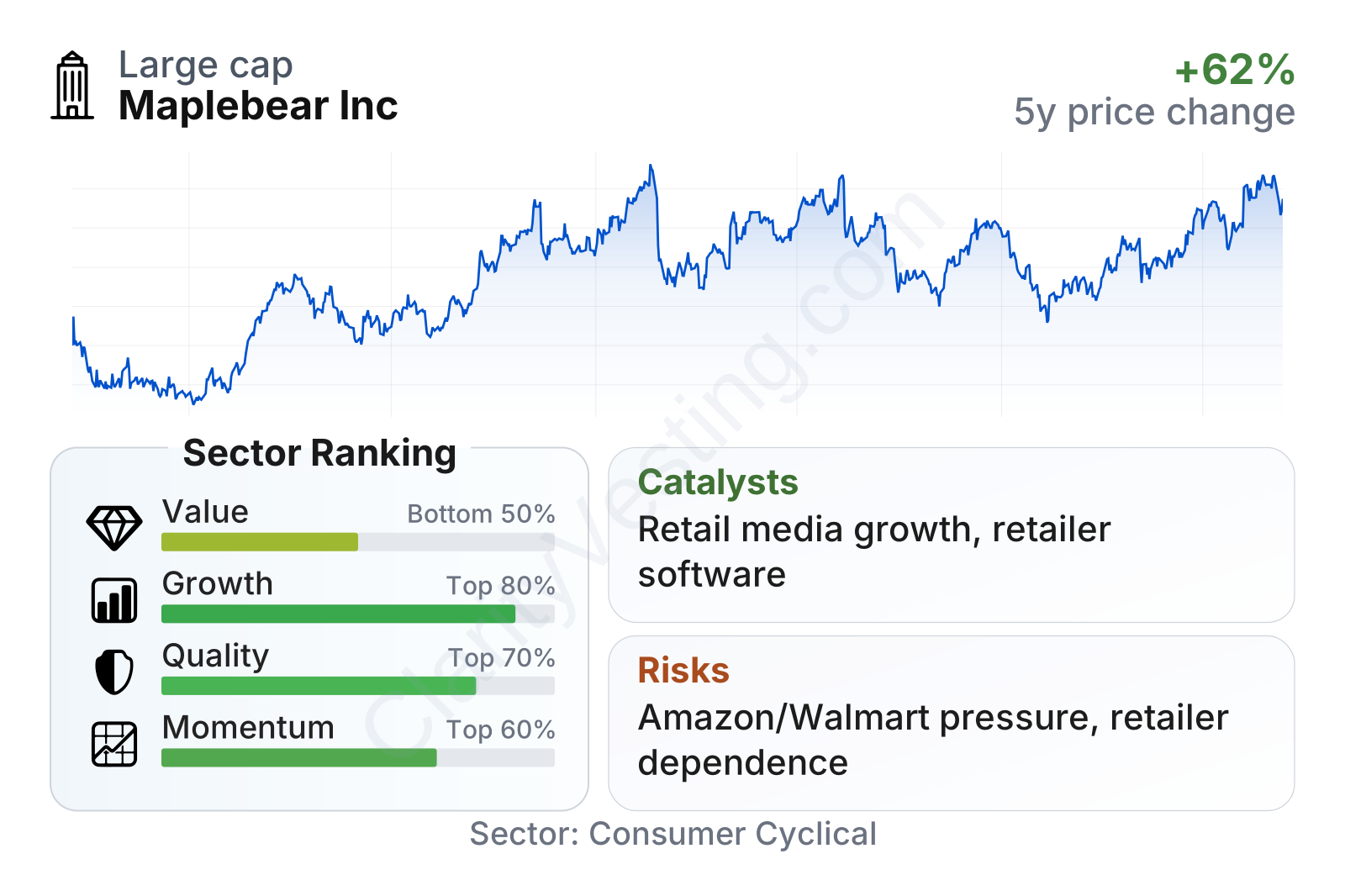
Maplebear is now a mid-sized public company with a market value around the low tens of billions of dollars. The overall profile is unusual in a positive way for an online retail platform: growth ranks well above the sector median, profitability is stronger than many peers, and balance sheet risk is very low. Value metrics are more mixed, with earnings multiples above the sector median, although cash generation partly offsets that richer pricing. Share-price behavior has also been volatile since the listing, but recent momentum has been much stronger than the broader sector.
The stock’s trading history shows a company still being re-rated by the market as it proves it can be both profitable and cash generative. That is common for younger platform businesses that began with questions around the durability of post-pandemic demand and later had to demonstrate that margins could hold up in a more normal environment.
Growth
Online grocery remains a growing part of retail, even if it is not expanding as explosively as it did during the pandemic years. The bigger long-term theme is that supermarkets and brands need stronger digital tools, better fulfillment, and more measurable advertising inside retail apps. Maplebear is positioned across all three needs: consumer ordering, retailer enablement, and retail media. That gives it more than one path to expand.
Recent revenue growth has stayed in the low-teens range, which is clearly above the sector median. That suggests the platform is still gaining scale rather than simply defending a mature position. Revenue per share growth over five years has also been strong, indicating that expansion has not been purely cosmetic. In addition, operating margin improvement over time has been significant, which matters because many delivery-related businesses struggle to turn growth into durable earnings.
Cash generation has also moved in the right direction. Trailing free cash flow has risen from a little over $0.5 billion in early 2024 to close to $0.9 billion by early 2026 on the chart, while the latest trailing twelve-month level in the metrics table is above $1.1 billion. That combination of growth and cash conversion gives the company more flexibility to invest in new products, partnerships, and acquisitions without depending heavily on debt.
The growth strategy makes sense because it is not limited to increasing grocery order volume. Management has been building retailer software, in-store technology, connected shopping tools, and ad products that can grow even when consumer spending is uneven. A particularly important catalyst is the expansion of retail media: brands increasingly want to advertise close to the point of purchase, and grocery platforms can offer exactly that. Another meaningful catalyst is deeper integration with retailers that want digital capabilities without building everything in-house.
Recent company communications have also emphasized new retailer partnerships, expanded enterprise offerings, and ad-tech development. Those initiatives matter because they can increase revenue per order and strengthen the company’s role in the grocery ecosystem, not just as a delivery intermediary but as a commerce infrastructure provider.
Risks
This article is for informational purposes only and does not constitute financial advice. Some content is AI-generated. See Disclaimer


