Stock Analysis · CarGurus (CARG)
Overview
CarGurus runs a digital automotive marketplace centered on helping shoppers find, compare, and finance vehicles, while helping dealers reach those shoppers and manage transactions. The company started as an online listings and car-shopping platform, but over time it expanded into dealer software, digital retail tools, financing-related services, and a wholesale auction business for dealers. Its best-known consumer brands are CarGurus in the U.S., U.K., and Canada, and PistonHeads in the U.K.
Revenue comes from a mix of marketplace subscriptions, product add-ons sold to dealers, and transaction-related services. Based on recent company reporting, the revenue mix is led by its higher-margin marketplace activities, with digital wholesale making up a smaller but still meaningful share.
- Marketplace and dealer services: about 85% to 90% of revenue. This includes dealer subscription products, advertising, lead generation, digital retail tools, and related software and services sold to dealerships.
- Digital wholesale / product-related transaction revenue: about 10% to 15% of revenue. This mainly reflects the company’s dealer-to-dealer wholesale auction activity and related transaction services.
- Geographic mix: the U.S. remains the clear core business, while international operations in Canada and the U.K. add a smaller contribution.
The business model has an attractive feature for long-term analysis: much of CarGurus’ core marketplace revenue is recurring or repeat-driven because dealers typically pay monthly to maintain visibility and access to shopper traffic. That makes the company less dependent on one-time consumer purchases than a traditional car retailer.
The broader financial flow also shows a favorable profile. Revenue has become more concentrated in gross profit rather than low-margin activity, and operating income improved again in 2025 after a weaker 2023 period. Research and development remains a meaningful expense, which suggests management is still funding product depth rather than simply harvesting the existing platform.
Key Figures
| Metric | Value | Sector ⓘ |
|---|---|---|
| Date | Sep 12, 2026 | |
| Context | ||
| Sector | Communication Services | |
| Industry | Internet Content & Information | |
| Market Cap ⓘ | $3.03B | |
| Beta ⓘ | 1.16 | |
Value (Cheapness) | ||
| P/E Ratio ⓘ | 17.51 | 18.61 |
| FCF Yield ⓘ | 10.23% | 13.68% |
| EBIT / EV ⓘ | 7.64% | 4.54% |
| PEG ⓘ | 0.72 | |
Growth (Business expansion) | ||
| Revenue Growth ⓘ | 13.10% | 5.40% |
| RPS Growth (5Y CAGR) ⓘ | 4.55% | 4.62% |
| EPS Growth (5Y CAGR) ⓘ | 0.51% | -18.01% |
| Margin Growth (5Y Trend) ⓘ | 5.90% | 1.10% |
| FCF Growth (5Y CAGR) ⓘ | 36.01% | 5.88% |
Quality (Business durability) | ||
| ROIC (Latest) ⓘ | 57.51% | 8.38% |
| ROIC (5Y Median) ⓘ | 21.72% | 8.32% |
| Net Debt / EBIT (Latest) ⓘ | 0.27 | 1.99 |
| Net Debt / EBIT (5Y Median) ⓘ | -1.08 | 2.94 |
| Operating Margin (Latest) ⓘ | 23.76% | 14.89% |
| Operating Margin (5Y Median) ⓘ | 15.70% | 12.96% |
| Debt to Equity (Latest) ⓘ | 70.04% | 59.59% |
| Profit Margin (Latest) ⓘ | 18.19% | 8.77% |
| Free Cash Flow (Latest) ⓘ | $309.42M | |
Momentum (Price trend) | ||
| 3Y Return ⓘ | +89.56% | +46.64% |
| 12M Return (excl. last month) ⓘ | +20.52% | +2.16% |
| 6M Return ⓘ | +11.19% | +5.05% |
| Price vs. 200-Day MA ⓘ | +1.41% | +2.88% |
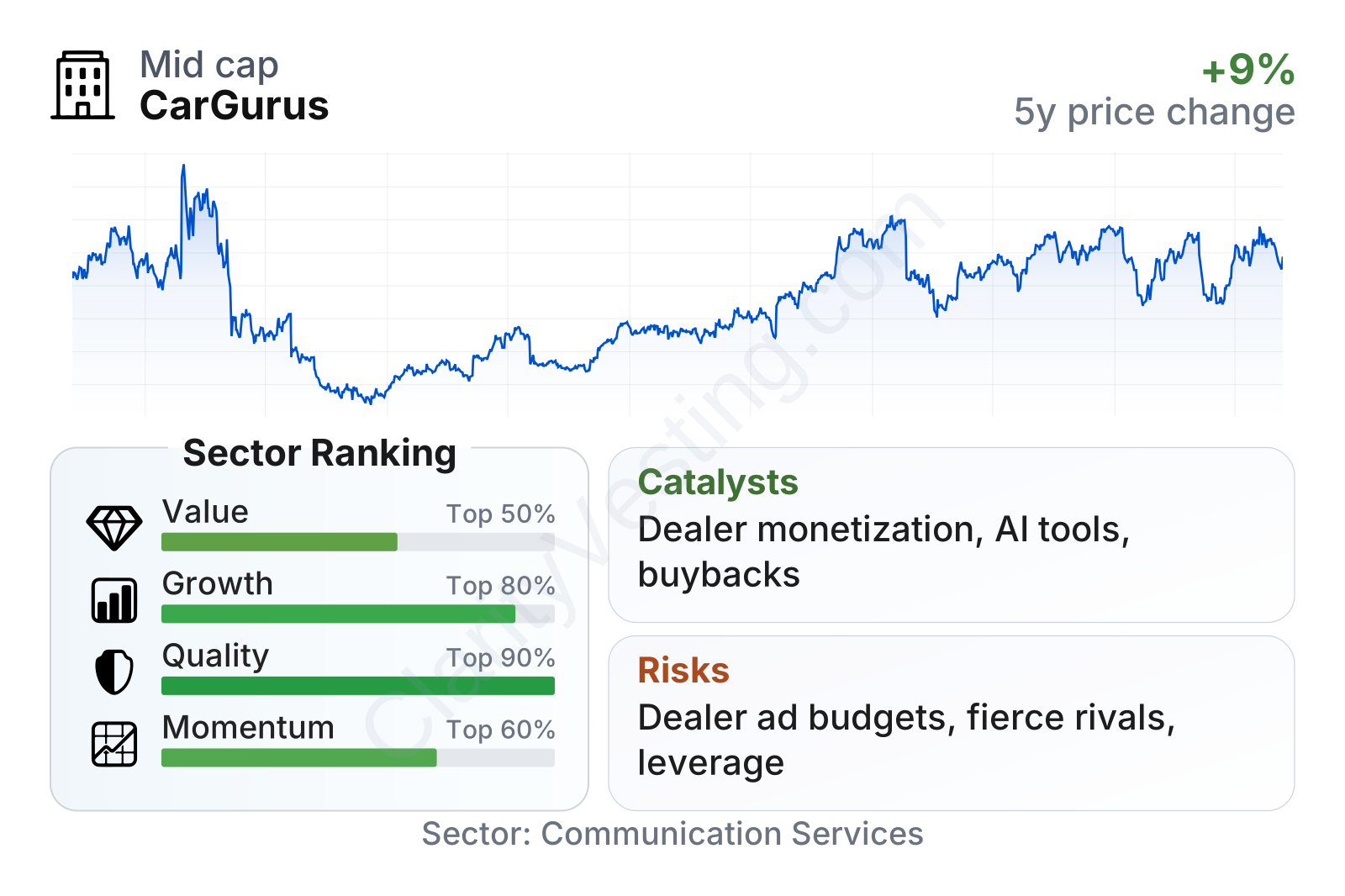
CarGurus is a mid-sized internet platform with a market value around $3 billion and share-price volatility a bit above the broader market. The overall metric profile is solid. Quality stands out the most, with very strong returns on invested capital, healthy operating profitability, and low net debt relative to earnings. Growth metrics are also favorable versus much of the sector, especially on recent revenue growth, margin improvement, and free cash flow expansion. Value looks roughly in line with the sector on earnings, while cash-flow-based measures are somewhat mixed. Momentum has been positive over a multiyear period, although the shorter-term trend has cooled.
Growth
CarGurus operates in a sector that still has room to grow over the long run. Auto retail continues shifting toward digital search, pricing transparency, online financing, and software tools that help dealers manage inventory and customer acquisition. Vehicle shopping remains a large market, and dealerships still need efficient digital channels to find buyers and measure return on advertising spend. That supports the core marketplace business.
The company’s strategy also appears coherent. Rather than relying only on listing fees, CarGurus has been building a broader dealer platform: marketplace exposure, retail technology, financing-related tools, and wholesale services. This makes the business more useful to dealers across several parts of the car-selling process. A broader product set can deepen customer relationships and lift revenue per dealer over time.
Recent growth has looked healthier than the difficult period in 2023, when revenue contracted sharply. Since then, the trend has turned positive again, and recent year-over-year growth has been running in the high-single-digit range. That is not explosive, but it is a meaningful improvement and compares well with much of the broader sector. The recovery matters because it suggests the core marketplace and dealer-facing products are regaining traction after a weaker cycle.
Cash generation is another important growth support. Free cash flow has risen strongly from earlier levels and is now above $300 million on a trailing basis. For a platform business, that matters because internally generated cash can fund product development, acquisitions, and shareholder returns without placing heavy pressure on the balance sheet. The five-year free cash flow growth rate is especially strong, pointing to better monetization and cost discipline.
A notable catalyst is the continued integration of artificial intelligence into search, pricing, recommendations, and dealer tools. CarGurus has emphasized product innovation around shopper experience and dealer efficiency, and that fits naturally with the data-rich nature of automotive marketplaces. Another catalyst is the company’s ability to cross-sell more products to existing dealers rather than relying only on adding new ones. In a maturing marketplace, deeper monetization of the installed customer base can be more important than pure customer count growth.
Recent company updates have also highlighted ongoing share repurchases and continued investment in product capabilities, signaling confidence in cash generation while still funding future expansion. In addition, the company has continued to refine its wholesale and digital transaction activities, which could provide another leg of growth if execution remains disciplined.
Risks
This article is for informational purposes only and does not constitute financial advice. Some content is AI-generated. See Disclaimer