Stock Analysis · Camtek Ltd (CAMT)
Overview
Camtek Ltd is a semiconductor equipment company focused on inspection and metrology. In simple terms, it sells machines and software that help chip manufacturers and advanced packaging companies detect defects, measure critical features, and improve production yields. Its tools are used in areas where accuracy matters a great deal, especially advanced packaging, high-bandwidth memory-related processes, heterogeneous integration, and compound semiconductor applications.
The business model is relatively straightforward: Camtek develops and sells capital equipment, then supports those systems through service, maintenance, and related activities. That makes the company part of the broader semiconductor equipment industry, a field that tends to benefit from long-term growth in chips but can still move sharply with customer spending cycles.
Based on recent annual reporting and management disclosures, revenue is primarily generated from the following sources:
- Inspection and metrology systems: approximately 85% to 90% of revenue. This is the core activity and includes tools used to inspect wafers and advanced packaging steps for defects and process control.
- Services and support: approximately 10% to 15% of revenue. This includes maintenance, spare parts, customer support, and other post-installation activities tied to the installed base.
Geographically, revenue is diversified across major semiconductor manufacturing regions, with a meaningful share tied to Asia, where much of the world’s packaging and chip production capacity is located. That regional exposure is important because Camtek’s growth is closely linked to customer expansion plans in advanced semiconductor manufacturing.
Over the last several years, the company has shown a clear pattern of scaling revenue faster than operating expenses for much of the period, which supported strong profitability through 2024. The 2025 income profile looks weaker despite higher sales, pointing to a period of heavier cost pressure, acquisition-related effects, or integration spending that long-term readers should keep in mind when assessing the business.
Key Figures
| Metric | Value | Sector ⓘ |
|---|---|---|
| Date | Nov 14, 2026 | |
| Context | ||
| Sector | Technology | |
| Industry | Semiconductor Equipment & Materials | |
| Market Cap ⓘ | $4.77B | |
| Beta ⓘ | 1.73 | |
Value (Cheapness) | ||
| P/E Ratio ⓘ | 38.42 | 27.44 |
| FCF Yield ⓘ | 0.48% | 3.74% |
| Dividend Yield ⓘ | N/A | 1.37% |
| EBIT / EV ⓘ | 1.08% | 3.90% |
| PEG ⓘ | 1.47 | |
Growth (Business expansion) | ||
| Revenue Growth ⓘ | 28.00% | 17.35% |
| RPS Growth (5Y CAGR) ⓘ | 13.47% | 8.55% |
| EPS Growth (5Y CAGR) ⓘ | 6.25% | -6.27% |
| Margin Growth (5Y Trend) ⓘ | -15.74% | 0.58% |
| FCF Growth (5Y CAGR) ⓘ | 22.35% | 9.93% |
| DPS Growth (5Y CAGR) ⓘ | N/A | 8.22% |
Quality (Business durability) | ||
| ROIC (Latest) ⓘ | 3.45% | 10.31% |
| ROIC (5Y Median) ⓘ | 13.83% | 8.31% |
| Net Debt / EBIT (Latest) ⓘ | 4.03 | 0.61 |
| Net Debt / EBIT (5Y Median) ⓘ | 0.63 | 0.51 |
| Net Debt / EBITDA (Latest) ⓘ | 1.58 | 0.36 |
| Net Debt / Assets ⓘ | 14.74% | 3.99% |
| EBITDA / Interest ⓘ | N/A | 13.61 |
| Operating Margin (Latest) ⓘ | 9.52% | 10.52% |
| Operating Margin (5Y Median) ⓘ | 26.29% | 8.51% |
| Debt to Equity (Latest) ⓘ | 64.84% | 33.78% |
| Profit Margin (Latest) ⓘ | 24.56% | 7.49% |
| Free Cash Flow (Latest) ⓘ | $23.01M | |
Momentum (Price trend) | ||
| 3Y Return ⓘ | +58.59% | +42.96% |
| 12M Return (excl. last month) ⓘ | +12.14% | +13.23% |
| 6M Return ⓘ | -40.63% | +0.74% |
| Price vs. 200-Day MA ⓘ | -34.52% | +0.87% |
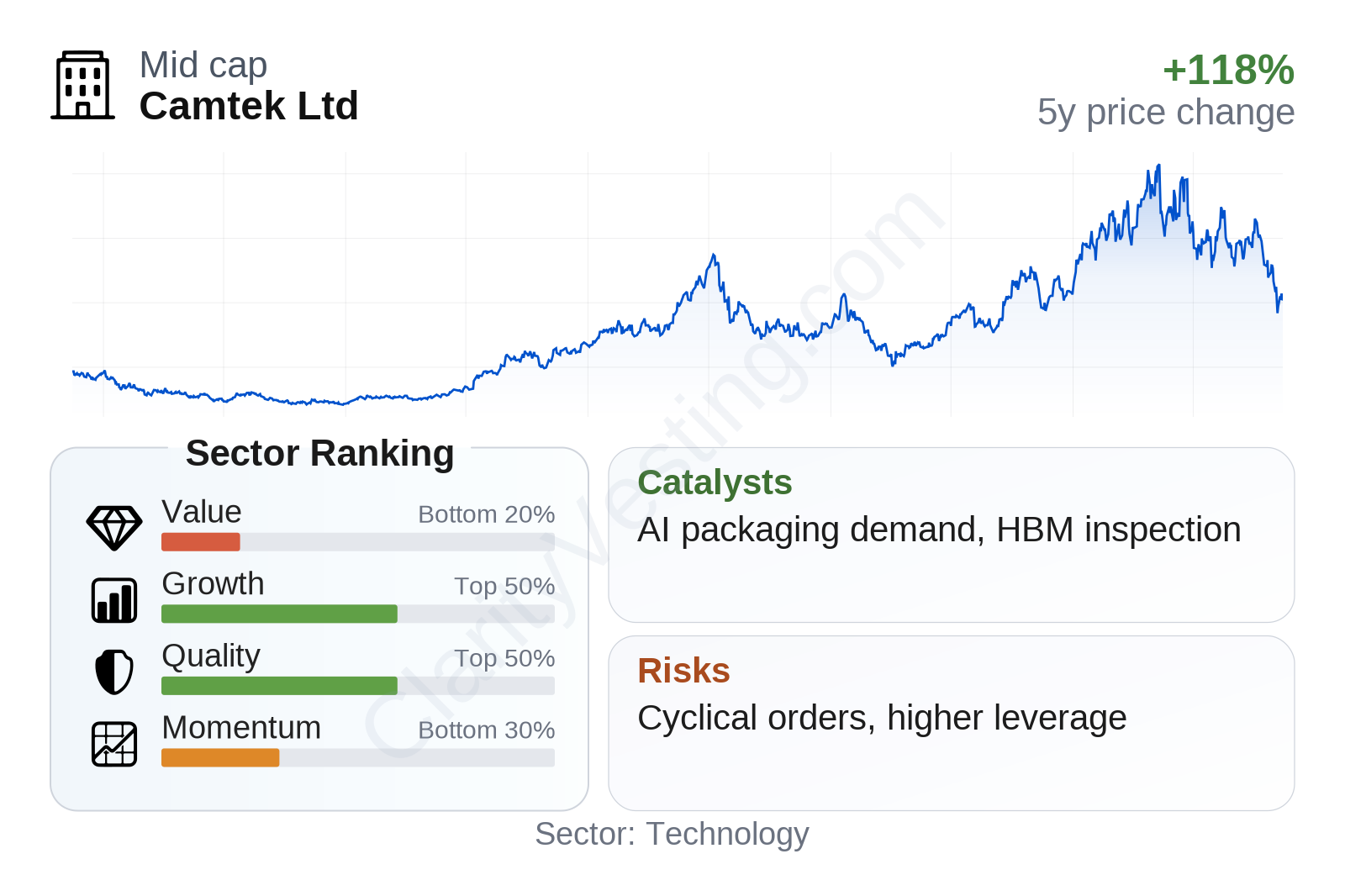
Camtek is a mid-sized semiconductor equipment company with a stock that has been notably more volatile than the broader market, which fits the cyclical nature of the industry. The latest metrics show a mixed picture: growth and overall business quality rank around the better half of the sector, but valuation appears demanding and recent market momentum has weakened sharply after a strong multi-year run. Free cash flow yield and earnings-based valuation measures sit below the sector median on attractiveness, suggesting the market is still assigning a premium to the company’s long-term prospects even after a sizable share-price pullback from recent highs.
Growth
Camtek operates in a part of the semiconductor value chain that still has strong structural growth drivers. The most important one is the rising complexity of chip production. As leading-edge chips become harder to manufacture, and as advanced packaging becomes more important for AI, data centers, high-performance computing, and memory, the need for inspection and measurement rises as well. More complexity usually means more opportunities for defects, and that raises the value of tools that can catch problems early.
Camtek’s strategy appears aligned with that trend. The company has concentrated on advanced packaging and high-value inspection applications rather than trying to compete across every category of semiconductor equipment. That narrower focus can be an advantage because advanced packaging has become one of the most active spending areas in the industry, especially as chip designers look for performance gains through packaging innovation rather than only through smaller transistor sizes.
The revenue trend shows why the market has paid attention to the company. After a softer period in 2023, growth reaccelerated strongly in 2024, stayed positive through 2025, and appears to have improved again by late 2026. The latest year-over-year growth rate is well above the sector median, while five-year growth in revenue per share and free cash flow has also been stronger than typical peers. That points to a business that has not only grown, but has done so with meaningful operating leverage over time, even if recent margins have been less stable.
A major catalyst is the industry’s push into AI infrastructure. AI servers, advanced memory, and complex chip packaging require tighter inspection standards, and Camtek is positioned directly in that workflow. Company communications in recent periods have also highlighted demand related to high-bandwidth memory and advanced packaging capacity additions. If those customer investment plans continue, Camtek has a credible path to further growth without needing to become a broad-line equipment supplier.
Another positive factor is that the company’s installed base can create follow-on revenue. Once a tool is qualified inside a semiconductor production process, customers are less likely to change vendors quickly because process consistency matters. That does not make revenue immune to cycles, but it can support repeat orders, service revenue, and a stronger competitive position over time.
Risks
This article is for informational purposes only and does not constitute financial advice. Some content is AI-generated. See Disclaimer