Stock Analysis · Callaway Golf Company (CALY)
Overview
Callaway Golf Company is a sports equipment and active lifestyle business best known for golf clubs, golf balls, and golf gear. In recent years, the company also expanded beyond traditional golf through apparel, outdoor products, and entertainment-oriented golf venues after major acquisitions. That broader strategy aimed to turn the business into a larger platform tied to golf participation, sports lifestyle spending, and golf-related experiences.
Based on the company’s recent reporting structure before the large portfolio changes underway, revenue has mainly come from a mix of golf equipment, apparel and gear, and golf entertainment operations. The exact mix can shift meaningfully because Callaway has been reshaping its business, including the planned separation of Topgolf and actions around non-core assets. Using the latest annual reporting and management disclosures, the business has recently been centered around the following sources:
- Topgolf venues and related operations: approximately 40% to 45% of revenue in the most recent full-year structure. This includes venue-based entertainment, food and beverage, events, and associated digital or sponsorship activity.
- Golf equipment: approximately 25% to 30% of revenue. This covers golf clubs, golf balls, and related performance equipment sold under brands such as Callaway and Odyssey.
- Active lifestyle and apparel: approximately 25% to 30% of revenue. This has included branded apparel, footwear, and outdoor or sports lifestyle products, notably through Jack Wolfskin and other branded operations.
- Accessories and other golf products: a smaller share, generally within the low- to mid-single-digit percentage range depending on classification and reporting period. This includes bags, gloves, training aids, and similar items.
The business mix is important because these segments behave very differently. Golf equipment can be profitable but cyclical, apparel depends heavily on consumer demand and brand execution, while entertainment venues require much more capital and carry larger fixed costs. That has made Callaway a more diversified company, but also a more complex one to analyze than a pure-play golf equipment brand.
The multi-year profit flow shows a business that expanded strongly through 2023, but profitability deteriorated sharply in 2024 as operating expenses overwhelmed revenue. The 2025 profile looks much smaller and cleaner, which fits the company’s restructuring and separation efforts. In other words, Callaway appears to be moving away from a scale-first model toward a simpler portfolio with tighter cost control.
Key Figures
| Metric | Value | Sector ⓘ |
|---|---|---|
| Date | Sep 12, 2026 | |
| Context | ||
| Sector | Consumer Cyclical | |
| Industry | Leisure | |
| Market Cap ⓘ | $2.76B | |
| Beta ⓘ | 0.93 | |
Value (Cheapness) | ||
| P/E Ratio ⓘ | 35.95 | 17.10 |
| FCF Yield ⓘ | 10.44% | 8.53% |
| EBIT / EV ⓘ | 8.18% | 6.46% |
| PEG ⓘ | 0.72 | |
Growth (Business expansion) | ||
| Revenue Growth ⓘ | 2.00% | 5.75% |
| RPS Growth (5Y CAGR) ⓘ | -11.04% | 9.14% |
| EPS Growth (5Y CAGR) ⓘ | 5.42% | -18.21% |
| Margin Growth (5Y Trend) ⓘ | -7.68% | -0.23% |
| FCF Growth (5Y CAGR) ⓘ | N/A | 4.91% |
Quality (Business durability) | ||
| ROIC (Latest) ⓘ | 4.94% | 12.61% |
| ROIC (5Y Median) ⓘ | N/A | 10.72% |
| Net Debt / EBIT (Latest) ⓘ | -0.13 | 2.10 |
| Net Debt / EBIT (5Y Median) ⓘ | 10.37 | 2.32 |
| Operating Margin (Latest) ⓘ | 8.49% | 9.25% |
| Operating Margin (5Y Median) ⓘ | 7.13% | 9.64% |
| Debt to Equity (Latest) ⓘ | 11.58% | 75.78% |
| Profit Margin (Latest) ⓘ | -12.37% | 5.33% |
| Free Cash Flow (Latest) ⓘ | $288.00M | |
Momentum (Price trend) | ||
| 3Y Return ⓘ | +26.13% | +14.53% |
| 12M Return (excl. last month) ⓘ | +99.95% | +3.08% |
| 6M Return ⓘ | +17.57% | +0.55% |
| Price vs. 200-Day MA ⓘ | +2.54% | -0.54% |
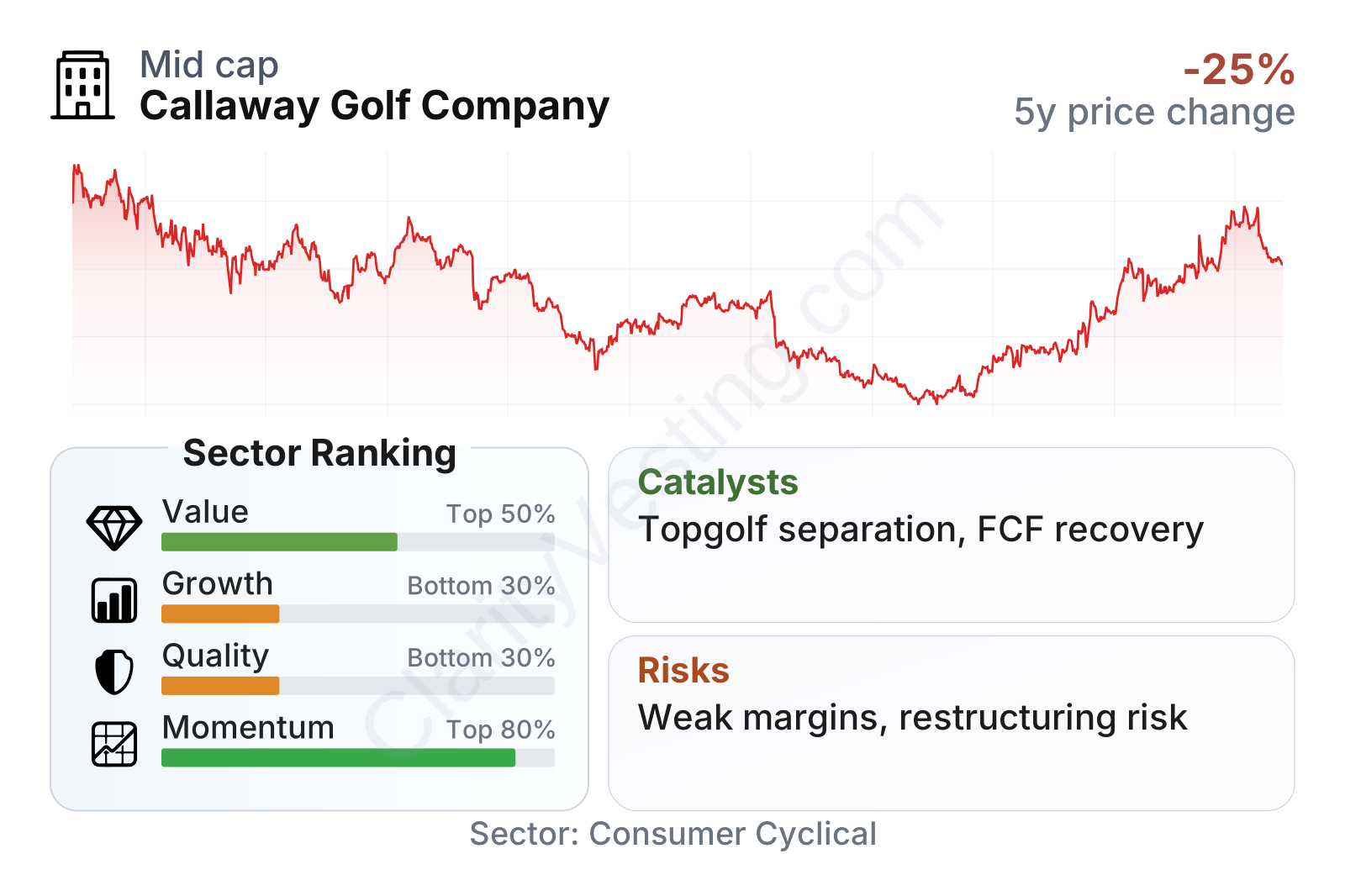
Callaway is currently a mid-sized consumer discretionary company with market behavior close to the broader market, as shown by a beta near 1. The factor profile is mixed. Momentum is unusually strong versus the sector, reflecting the sharp rebound in the stock over the last year, but value, growth, and quality rankings remain weak relative to peers. That combination usually means the market is reacting to improving expectations rather than rewarding already strong business performance.
The table also points to an important contradiction. Balance-sheet pressure has eased materially, and free cash flow has turned positive again, yet profitability and returns on capital are still below sector norms. This suggests the company has made progress stabilizing the business, but it has not yet rebuilt the earnings power that would normally support a premium valuation.
Growth
Golf has some attractive long-term characteristics. Participation has remained healthier than many expected after the pandemic boom, and the industry has broadened beyond country-club golfers into younger, more casual, and experience-driven users. Equipment replacement cycles, women’s participation, off-course formats, and digital engagement all support a reasonable long-term backdrop for the sport. That said, it is not a high-growth industry in the way software or semiconductors can be. It tends to be steady, brand-driven, and sensitive to consumer spending conditions.
Callaway’s growth strategy has made strategic sense in one important respect: it tried to connect equipment, apparel, and golf entertainment into a wider ecosystem. The idea was that a player could discover golf through a venue, buy clubs and balls from a trusted brand, and later spend on apparel or accessories. In theory, that creates cross-selling opportunities and broadens the customer base beyond traditional golfers.
In practice, the company’s more recent opportunity looks less tied to expansion and more tied to simplification. Management has been working to separate Topgolf, sharpen focus on core operations, and improve the financial profile. For a long-term view, that can be a meaningful catalyst because a cleaner structure may make Callaway easier to understand, less burdened by capital-intensive venue economics, and more centered on brands where it has deeper operating experience.
Revenue growth has clearly lost momentum. After the post-acquisition and post-pandemic surge, growth slowed, then turned negative, and the latest readings are far below the sector median. That pattern signals that the company is no longer being carried by expansion alone. Future progress likely depends more on portfolio reshaping, product execution, and margin recovery than on straightforward sales growth.
One encouraging sign is cash generation. Free cash flow moved from deeply negative territory in 2022 and 2023 to positive in 2024 and improved further through 2025 and early 2026. That is an important change because cash flow often improves before accounting results look fully healthy. It suggests the business has become more disciplined with spending and working capital, which can create room for debt reduction, restructuring, and eventual earnings normalization.
A notable recent development is the ongoing repositioning of the company around a more focused set of assets. If the Topgolf separation proceeds as intended and the remaining operations become more centered on equipment and active lifestyle brands, the market may eventually compare the company against simpler branded-goods peers rather than against a mixed portfolio with entertainment exposure. That is one of the clearest business catalysts currently visible.
Risks
This article is for informational purposes only and does not constitute financial advice. Some content is AI-generated. See Disclaimer


