Stock Analysis · Calix Inc (CALX)
Overview
Calix is a communications software and systems company focused on broadband networks. In simple terms, it helps internet service providers build, run, and improve high-speed internet offerings for homes, businesses, and communities. Its products are used by broadband providers to connect customers through fiber and other access technologies, manage the network, secure connections, and offer services such as Wi‑Fi and subscriber support.
The company’s business model combines hardware, software, and cloud-based services. That mix matters because hardware can help win deployments, while software and support can deepen customer relationships and potentially make revenue more recurring over time.
Calix does not report a detailed revenue split by product line in the same way some larger peers do, but public filings and investor materials show a broad structure that can be described as follows:
- Platform and systems revenue: the largest source, likely still a majority of total sales. This includes broadband access systems, premises equipment, and related network platforms used by service providers to deploy and expand broadband services.
- Software and cloud subscriptions: a meaningful and growing portion of revenue. This includes Calix Cloud, analytics, network management, customer experience tools, and operational software that help providers market, support, and optimize services.
- Services and support: the smallest source. This includes professional services, customer support, implementation, and training tied to deployments and ongoing operations.
One useful way to think about Calix is that it sits at the intersection of broadband infrastructure and software. It is not a giant telecom operator and not a pure chipmaker. Instead, it supplies tools that smaller and mid-sized broadband providers use to compete with larger carriers.
The financial flow over the past several years shows a business that expanded strongly through 2023, experienced a clear reset in 2024, and then recovered in 2025. Gross profit remained relatively resilient even when revenue fell, which suggests the software and platform mix helped cushion the downturn. At the same time, research and development spending has stayed high, showing that Calix is still investing heavily in future products rather than maximizing short-term profit.
Key Figures
| Metric | Value | Sector ⓘ |
|---|---|---|
| Date | Sep 12, 2026 | |
| Context | ||
| Sector | Technology | |
| Industry | Software - Infrastructure | |
| Market Cap ⓘ | $2.22B | |
| Beta ⓘ | 1.25 | |
Value (Cheapness) | ||
| P/E Ratio ⓘ | 45.77 | 29.51 |
| FCF Yield ⓘ | 3.85% | 4.25% |
| EBIT / EV ⓘ | 3.51% | 2.85% |
| PEG ⓘ | 3.34 | |
Growth (Business expansion) | ||
| Revenue Growth ⓘ | 21.30% | 15.40% |
| RPS Growth (5Y CAGR) ⓘ | 9.13% | 8.56% |
| EPS Growth (5Y CAGR) ⓘ | -15.95% | -11.88% |
| Margin Growth (5Y Trend) ⓘ | -7.34% | 0.46% |
| FCF Growth (5Y CAGR) ⓘ | 25.66% | 9.80% |
Quality (Business durability) | ||
| ROIC (Latest) ⓘ | 6.38% | 9.44% |
| ROIC (5Y Median) ⓘ | 4.19% | 8.30% |
| Net Debt / EBIT (Latest) ⓘ | -0.78 | 0.54 |
| Net Debt / EBIT (5Y Median) ⓘ | -1.30 | 0.44 |
| Operating Margin (Latest) ⓘ | 6.37% | 9.58% |
| Operating Margin (5Y Median) ⓘ | 3.42% | 8.25% |
| Debt to Equity (Latest) ⓘ | 1.97% | 33.33% |
| Profit Margin (Latest) ⓘ | 4.61% | 7.14% |
| Free Cash Flow (Latest) ⓘ | $85.42M | |
Momentum (Price trend) | ||
| 3Y Return ⓘ | -23.37% | +45.48% |
| 12M Return (excl. last month) ⓘ | -31.70% | +23.48% |
| 6M Return ⓘ | -29.19% | +20.93% |
| Price vs. 200-Day MA ⓘ | -23.05% | +7.43% |
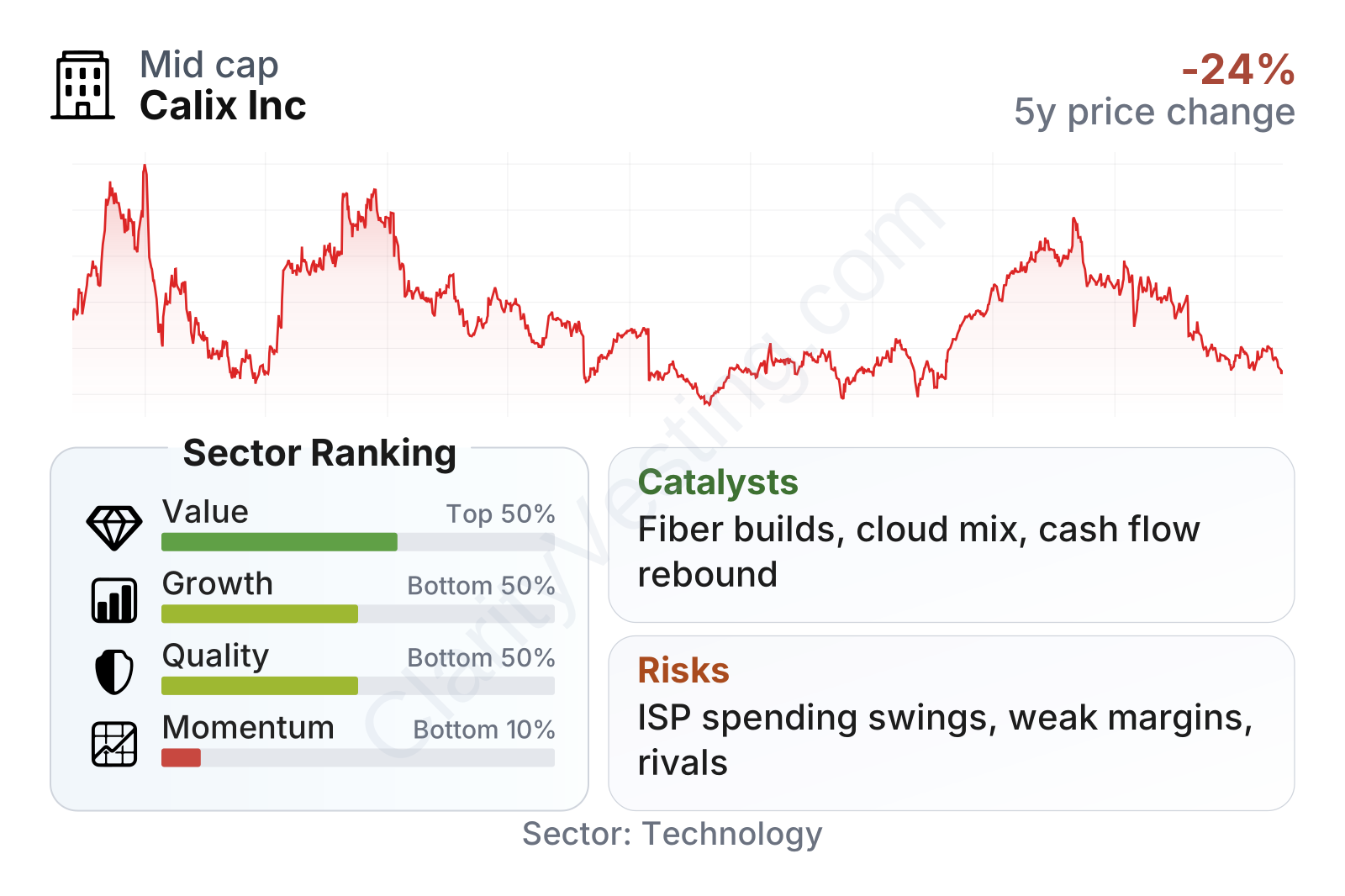
Calix is a mid-sized technology company with a stock that has been noticeably volatile over the last several years. The share price has moved through sharp up and down cycles, and recent momentum has been weak compared with the broader technology sector. In the latest factor snapshot, growth ranks in the upper half of the sector, but quality, value, and momentum rank below that. In practical terms, the company is growing again and generates cash, yet profitability and market sentiment remain less convincing than those of many peers.
Its balance sheet stands out positively. Debt is extremely low, and net cash remains a real financial cushion. That gives the company flexibility to keep investing even during uneven demand periods.
Growth
Calix operates in a sector with long-term support: broadband capacity still needs to expand, fiber deployment continues, and service providers are under pressure to improve customer experience, reduce churn, and monetize their networks better. Those trends support demand not only for access equipment, but also for software that helps providers run and market their services more efficiently.
Calix’s strategy makes sense in that context. Rather than competing everywhere, it concentrates on broadband service providers, especially regional and independent operators. It pairs network platforms with cloud software and subscriber-facing tools, which can make its offering harder to replace than a simple hardware sale. If customers adopt more of the software stack, revenue quality can improve over time because subscriptions and recurring services are generally steadier than one-time equipment orders.
Revenue growth has been cyclical. The company posted very strong expansion through 2022 and 2023, then suffered a contraction in 2024 as customers worked through inventory and slowed ordering. More recently, growth turned positive again, with year-over-year revenue gains running above 20% and ahead of the sector median. That rebound is important because it suggests the downturn was not purely structural and that customer spending has started to normalize.
Cash generation has also improved meaningfully. Free cash flow moved from a much lower level a few years ago to roughly the high tens of millions of dollars on a trailing basis, with a strong jump into 2026. That matters because it shows the recovery is not only visible in revenue; it is also appearing in the cash the business keeps after operating needs and capital spending.
A key catalyst is the continued shift toward fiber broadband and managed home connectivity. Calix has also highlighted platform adoption, software expansion, and customer wins with broadband providers as part of its growth agenda in company communications. Another supportive element is public and private investment in broadband buildouts in the United States, including rural and underserved areas, where many of Calix’s customers are active. If those projects continue moving forward, they can create both initial equipment demand and later software upsell opportunities.
Recent company updates have pointed to new product launches and customer adoption tied to broadband experience, operations, and subscriber engagement. For long-term analysis, the important point is not any single announcement, but the pattern: Calix is trying to become more central to how service providers operate, not just what boxes they install.
Risks
This article is for informational purposes only and does not constitute financial advice. Some content is AI-generated. See Disclaimer