Stock Analysis · The Cheesecake Factory (CAKE)
Overview
The Cheesecake Factory is a restaurant company best known for its large-format casual dining restaurants under The Cheesecake Factory brand. It also operates several smaller and more specialized concepts, including North Italia and Flower Child, and it licenses some restaurants internationally. In addition to serving meals in its own restaurants, the company sells cheesecakes and other baked desserts through a bakery operation that supplies both its own locations and outside foodservice customers.
The business is still centered on company-operated restaurants, which means revenue depends heavily on guest traffic, menu pricing, and restaurant-level cost control. Its brands sit mostly in the full-service dining category, where consumers pay for an in-person experience rather than fast delivery or low-price convenience. That gives the company a distinctive market position, but it also makes results more sensitive to consumer spending trends than some lower-priced restaurant models.
Based on recent company reporting, revenue is primarily generated from the following sources:
- The Cheesecake Factory restaurants: approximately 78% of total revenue. This includes food and beverage sales from the core flagship chain, which remains the company’s economic engine.
- Other company-owned restaurants: approximately 18% of total revenue. This mainly includes North Italia and Flower Child, plus a smaller contribution from Fox Restaurant Concepts’ remaining brands.
- Bakery and related sales: approximately 4% of total revenue. This includes cheesecakes and other baked desserts sold to external restaurant operators, retailers, and other customers, along with licensing-related revenue that is comparatively small.
The overall mix shows a company that is still dominated by one mature brand, but with a growing second layer of concepts that could matter more over time. Revenue has increased over the last several years, while profits have recovered from the weaker post-inflation period, although margins remain below many restaurant peers.
The broad financial flow points to a simple pattern: sales have been rising steadily, and operating profit has improved meaningfully from 2022 lows, but a large share of revenue is still absorbed by operating costs. That helps explain why earnings growth has returned faster than margin quality has fully normalized.
Key Figures
| Metric | Value | Sector ⓘ |
|---|---|---|
| Date | Sep 12, 2026 | |
| Context | ||
| Sector | Consumer Cyclical | |
| Industry | Restaurants | |
| Market Cap ⓘ | $5.03B | |
| Beta ⓘ | 1.01 | |
Value (Cheapness) | ||
| P/E Ratio ⓘ | 28.10 | 17.10 |
| FCF Yield ⓘ | 4.10% | 8.53% |
| EBIT / EV ⓘ | 2.92% | 6.46% |
| PEG ⓘ | 1.87 | |
Growth (Business expansion) | ||
| Revenue Growth ⓘ | 7.70% | 5.75% |
| RPS Growth (5Y CAGR) ⓘ | 6.49% | 9.14% |
| EPS Growth (5Y CAGR) ⓘ | 15.16% | -18.21% |
| Margin Growth (5Y Trend) ⓘ | 1.81% | -0.23% |
| FCF Growth (5Y CAGR) ⓘ | 1.61% | 4.91% |
Quality (Business durability) | ||
| ROIC (Latest) ⓘ | 17.41% | 12.61% |
| ROIC (5Y Median) ⓘ | 14.00% | 10.72% |
| Net Debt / EBIT (Latest) ⓘ | 9.18 | 2.10 |
| Net Debt / EBIT (5Y Median) ⓘ | 18.73 | 2.32 |
| Operating Margin (Latest) ⓘ | 5.30% | 9.25% |
| Operating Margin (5Y Median) ⓘ | 3.16% | 9.64% |
| Debt to Equity (Latest) ⓘ | 401.00% | 75.78% |
| Profit Margin (Latest) ⓘ | 4.61% | 5.33% |
| Free Cash Flow (Latest) ⓘ | $206.30M | |
Momentum (Price trend) | ||
| 3Y Return ⓘ | +264.37% | +14.53% |
| 12M Return (excl. last month) ⓘ | +91.52% | +3.08% |
| 6M Return ⓘ | +82.84% | +0.55% |
| Price vs. 200-Day MA ⓘ | +47.96% | -0.54% |
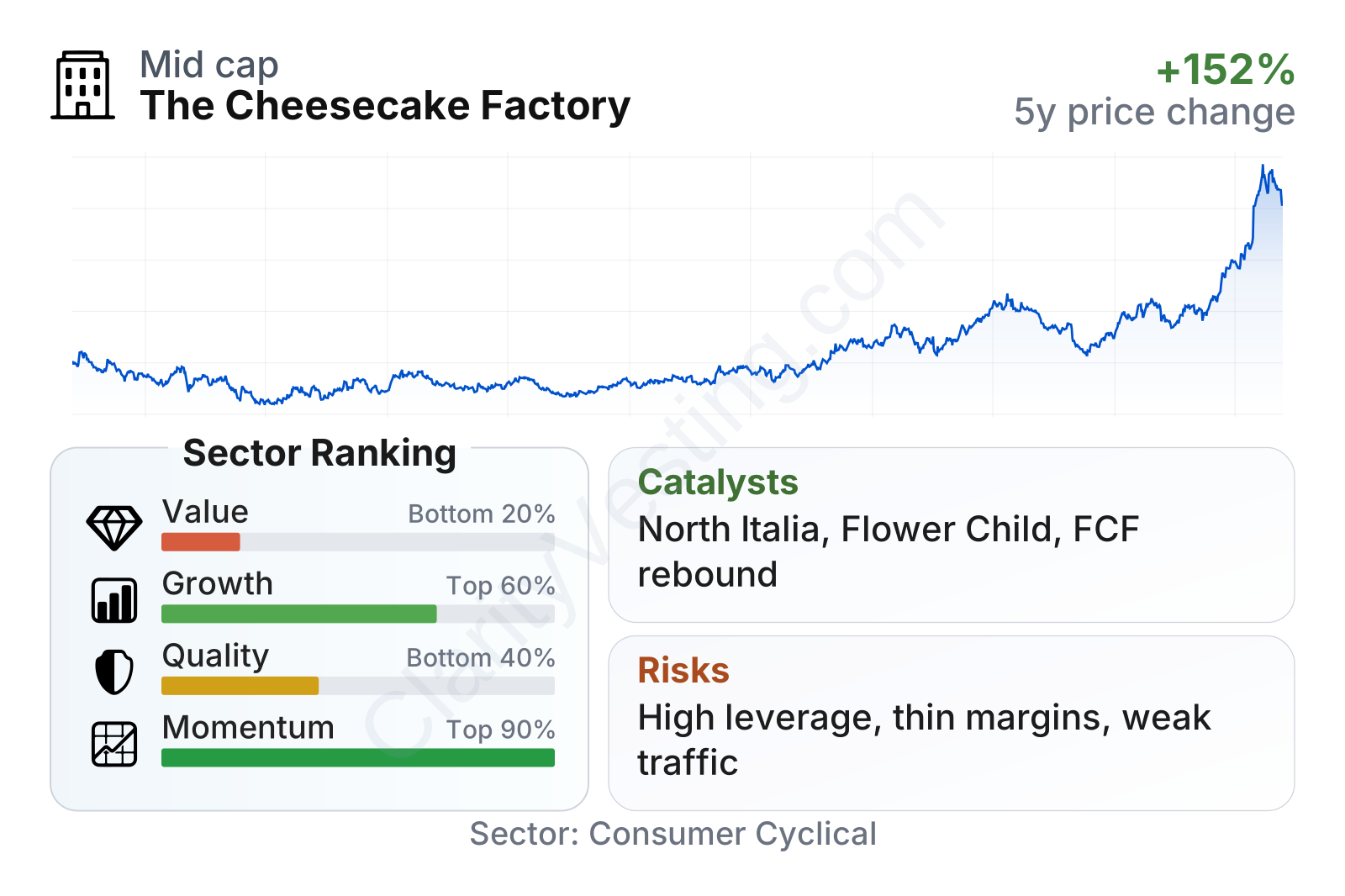
The company sits in the mid-cap range, with share price behavior that has recently been much stronger than most restaurant stocks. In the factor breakdown, momentum is notably strong and growth looks above average, but value ranks weakly because the stock trades on richer multiples than the sector median. Quality is mixed: returns on invested capital are solid, yet margins remain thinner than many peers and debt-to-equity is elevated.
This combination matters for long-term analysis. The market is recognizing improving execution and stronger earnings power, but it is also assigning a higher price to that progress. That usually leaves less room for disappointment if traffic softens or restaurant costs rise again.
Growth
The restaurant industry is not a high-growth sector in the way software or semiconductors can be, but select brands can still compound over long periods through unit expansion, same-store sales gains, menu pricing, and better operating efficiency. Cheesecake Factory’s growth case depends less on the mature flagship brand opening hundreds of new units and more on a combination of steady same-store demand, selective domestic expansion, and a bigger contribution from North Italia and Flower Child.
That strategy is sensible. The core Cheesecake Factory concept is well known, has strong average unit volumes by industry standards, and generates cash. The newer concepts expand the company into areas with more white space. North Italia targets polished casual dining, while Flower Child is positioned around a more health-focused fast-casual offering. Those brands can potentially give the company a longer runway than relying only on the flagship chain.
Recent revenue growth has been steady rather than explosive, generally landing in the mid-single-digit range and improving into the high-single digits more recently. That compares favorably with the broader sector median. The pattern suggests the company is still finding ways to grow even after the post-pandemic rebound phase has passed, which is important because it indicates performance is not being driven only by easy comparisons.
Cash generation has also moved in the right direction. Free cash flow was much lower in 2023 and 2024 than it is now, and the trailing twelve-month figure has recovered to roughly $170 million. That matters because restaurant expansion, debt management, and shareholder returns all ultimately depend on cash, not just accounting earnings. Improving free cash flow gives the company more flexibility as it develops newer brands and refreshes existing restaurants.
A meaningful catalyst is the company’s brand portfolio shift. The flagship chain is a proven cash producer, while North Italia and Flower Child offer the possibility of faster unit growth. Another positive driver is margin recovery through productivity, labor management, and sales leverage if traffic remains healthy. International licensing is smaller, but it can add growth with less capital intensity than company-owned restaurants.
Recent company updates have also pointed to continued new restaurant openings across its concepts and ongoing comparable sales support. For a business like this, evidence that multiple brands can expand at the same time is more important than one quarter of unusually strong sales, because it supports the idea that growth is becoming broader and more durable.
Risks
This article is for informational purposes only and does not constitute financial advice. Some content is AI-generated. See Disclaimer


