Stock Analysis · CACI International Inc (CACI)
Overview
CACI International is a government services and technology contractor focused mainly on U.S. federal agencies, especially the Department of Defense, intelligence community, and civilian government customers. Its work sits at the intersection of software, data, cyber operations, communications, electronic warfare, and mission support. In simple terms, CACI helps government clients run critical systems, analyze information, secure networks, modernize technology, and support military and intelligence missions.
The company’s revenue is primarily service- and solution-based rather than dependent on one consumer product. Based on recent company reporting, the business is broadly centered on national security and federal modernization needs, with defense and intelligence representing the large majority of activity.
- U.S. federal defense and intelligence work: by far the largest source of revenue, likely around three-quarters to four-fifths of total sales, driven by mission IT, intelligence support, cyber, space, and electronic warfare programs.
- Federal civilian agencies: roughly one-fifth to one-quarter of revenue, tied to modernization, data, and operational support for non-defense government departments.
- Product-related and higher-end technology offerings: a smaller but strategically important share inside the mix, including areas such as communications, spectrum, and mission hardware/software solutions.
CACI has expanded from a more traditional government IT contractor into a broader national security technology provider. That matters because the company is now more exposed to areas where demand tends to remain durable: cyber defense, intelligence, secure communications, and military modernization. Over the last several years, revenue has grown meaningfully, while profits and cash generation have also moved higher, although financing costs have become more noticeable.
The operating picture shows a business that has been scaling steadily. Revenue has advanced from a little above $6 billion to well above $8 billion in recent years, with operating income also rising. The tradeoff is that interest expense has increased faster than operating profit, reflecting heavier use of debt, which is an important theme for the risk discussion.
Key Figures
| Metric | Value | Sector ⓘ |
|---|---|---|
| Date | Jul 18, 2026 | |
| Context | ||
| Sector | Technology | |
| Industry | Information Technology Services | |
| Market Cap ⓘ | $10.20B | |
| Beta ⓘ | 0.54 | |
Value (Cheapness) | ||
| P/E Ratio ⓘ | 19.12 | 31.76 |
| FCF Yield ⓘ | 6.14% | 4.18% |
| EBIT / EV ⓘ | 5.45% | 2.56% |
| PEG ⓘ | 514.23 | |
Growth (Business expansion) | ||
| Revenue Growth ⓘ | 8.50% | 13.50% |
| RPS Growth (5Y CAGR) ⓘ | 12.35% | 8.57% |
| EPS Growth (5Y CAGR) ⓘ | 4.12% | -21.87% |
| Margin Growth (5Y Trend) ⓘ | -0.07% | 0.41% |
| FCF Growth (5Y CAGR) ⓘ | -1.87% | 9.76% |
Quality (Business durability) | ||
| ROIC (Latest) ⓘ | 9.14% | 8.54% |
| ROIC (5Y Median) ⓘ | 13.93% | 8.12% |
| Net Debt / EBIT (Latest) ⓘ | 6.39 | 0.38 |
| Net Debt / EBIT (5Y Median) ⓘ | 3.84 | 0.38 |
| Operating Margin (Latest) ⓘ | 9.32% | 9.58% |
| Operating Margin (5Y Median) ⓘ | 8.48% | 8.25% |
| Debt to Equity (Latest) ⓘ | 131.21% | 33.52% |
| Profit Margin (Latest) ⓘ | 5.86% | 6.96% |
| Free Cash Flow (Latest) ⓘ | $625.69M | |
Momentum (Price trend) | ||
| 3Y Return ⓘ | +32.78% | +30.91% |
| 12M Return (excl. last month) ⓘ | +7.89% | +28.90% |
| 6M Return ⓘ | -26.44% | +5.38% |
| Price vs. 200-Day MA ⓘ | -16.70% | +7.61% |
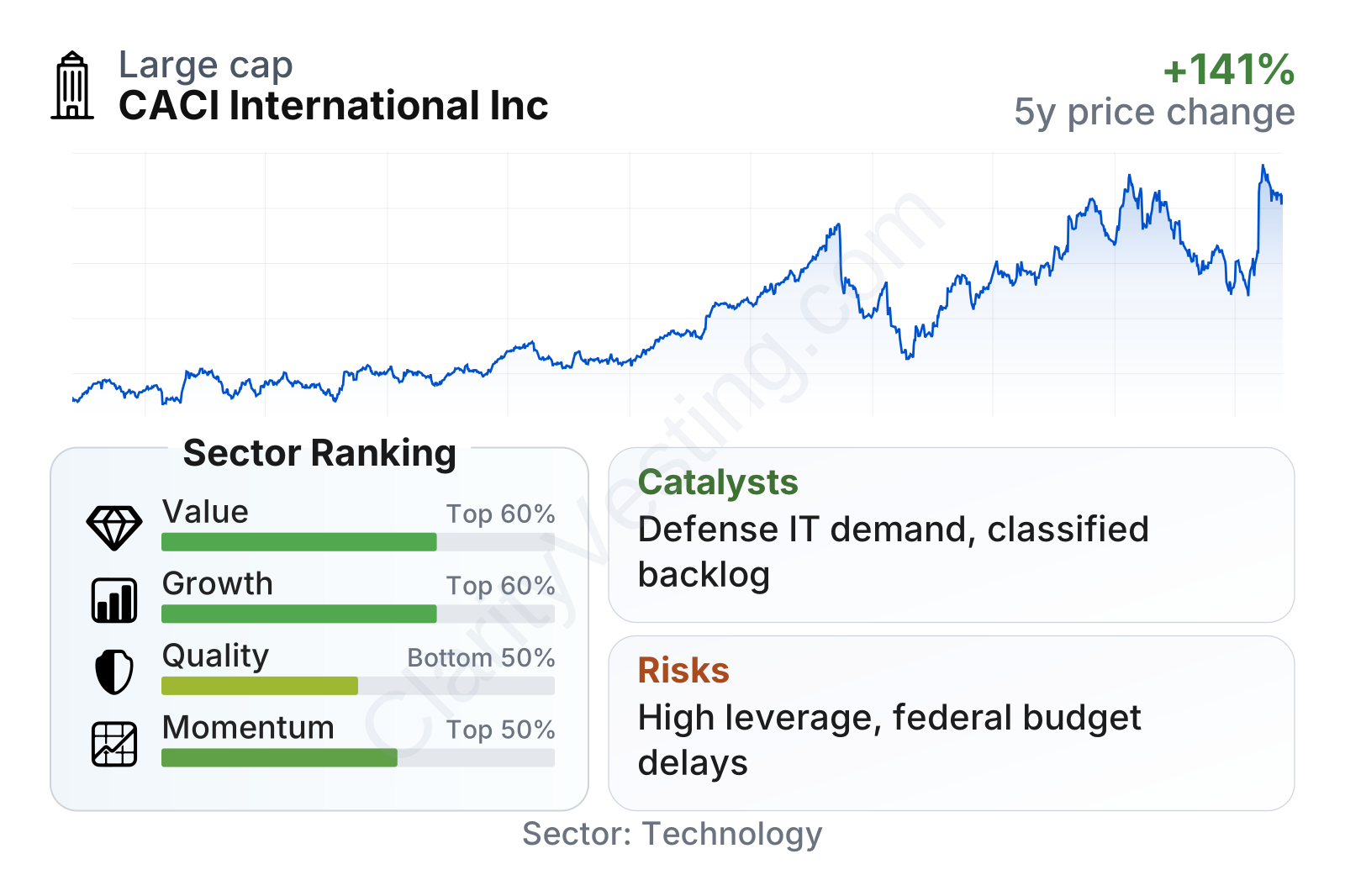
CACI stands out as a mid-to-large government technology contractor with a market value a little above $10 billion and relatively low share-price volatility versus the broader market. On valuation, its earnings multiple sits below the sector median, while cash-flow-based measures look stronger than many peers. Growth metrics are mixed: recent annual revenue growth remains healthy, long-term revenue per share growth is solid, and earnings growth over five years has been positive, but margin improvement has been limited and free cash flow growth over five years has been uneven. Quality is held back by leverage rather than by weak returns on capital. Price momentum has been softer than much of the technology sector recently, reflecting that the market has cooled after a strong multiyear run.
Growth
CACI operates in a part of the market that still appears structurally favorable. Governments continue to spend on cyber defense, secure data systems, intelligence platforms, battlefield communications, electronic warfare, and modernization of aging IT infrastructure. These are not short-lived themes. They are tied to long-term budget priorities around national security, digital resilience, and the growing complexity of military and intelligence operations.
The company’s strategy also fits that backdrop. CACI has been pushing toward higher-value work rather than competing only in lower-margin staffing or basic outsourcing. Its portfolio increasingly emphasizes mission technology, software-enabled systems, and classified or technically difficult programs. That usually supports stronger customer retention and can create a deeper role inside agency operations. In government contracting, being embedded in critical programs often matters as much as headline growth rates.
Revenue growth has generally remained positive and often strong over the past few years, with several periods above 10% and even stronger spikes around major program activity. The more recent pace is lower than the fastest periods, but still points to expansion rather than stagnation. Compared with the wider technology sector, CACI’s growth is steadier and more tied to public-sector demand than to consumer or enterprise spending cycles.
Cash generation has recovered well. Free cash flow had a weaker period earlier in the cycle but has climbed back to a high level, which is encouraging because cash flow is what ultimately supports acquisitions, debt reduction, and reinvestment. For a company like CACI, healthy cash conversion is especially important since contract timing, working capital swings, and integration costs can affect reported earnings from one period to the next.
As for catalysts, the most important ones are visible rather than speculative. Rising U.S. defense priorities, continued demand for cyber and intelligence capabilities, and larger procurement needs in areas such as electronic warfare and secure communications all support the addressable market. CACI has also used acquisitions to deepen capabilities in mission-focused technologies, which can open access to larger and more specialized contract opportunities. Recent company communications have continued to highlight backlog, pipeline strength, and demand connected to national security modernization, which reinforces the view that the growth path is tied to durable government priorities rather than a single temporary program.
Risks
The biggest risk is concentration. CACI depends heavily on U.S. government spending, especially defense and intelligence budgets. That can be a strength when national security spending is rising, but it also means the company is exposed to procurement delays, budget negotiations, shifts in political priorities, protests on awarded contracts, and occasional program cancellations. Unlike a diversified software company with millions of customers, CACI’s performance can be influenced by a limited number of large contracts and renewal decisions.
Leverage is another clear point to watch. Debt relative to equity has moved materially above the sector norm and recently stepped up further. Net debt relative to operating earnings also looks elevated for the sector. This does not automatically signal distress, especially for a business with recurring government work and solid cash flow, but it does reduce flexibility. If interest costs stay high or integration from acquisitions takes longer than planned, leverage can weigh on returns.
Profitability is respectable but not exceptional. Net margin has improved from recent lows, yet it remains below the sector median at present. That suggests CACI is not a high-margin software business; it is still fundamentally a contractor with service-heavy economics, even if its mix is shifting toward more differentiated offerings. Margin discipline therefore matters. Wage pressure, execution issues, or an unfavorable contract mix could limit earnings growth even if revenue keeps climbing.
On competitive positioning, CACI does have advantages. It operates in areas that require security clearances, established customer relationships, domain expertise, and the ability to manage sensitive missions. Those barriers are meaningful. The company is not the largest player in government services overall, but it is well positioned in specialized national security niches. Its main competitors include Leidos, Booz Allen Hamilton, SAIC, General Dynamics’ IT activities, and, in some mission areas, larger defense primes such as Northrop Grumman, Lockheed Martin, and RTX. Compared with those companies, CACI is smaller, but that can make it more focused and at times more agile in targeted technology segments. It is not the industry leader by size, yet it has a credible place in technically demanding work where scale alone is not the only advantage.
There is also execution risk around acquisitions and contract performance. CACI has used acquisitions to expand capabilities, which can support growth, but integration must translate into stronger margins and cash flow over time. In government contracting, reputational damage can come from cost overruns, compliance failures, cybersecurity incidents, or missed milestones even without a public scandal. No major recent controversy stands out as a defining red flag, but the sector always carries compliance and performance risk because customers are demanding and oversight is heavy.
Valuation
Valuation looks more restrained than much of the technology sector. CACI’s earnings multiple has typically traded below the sector median, and that remains true in the current range. On that basis alone, the stock does not appear priced like a fast-growing software name. Instead, the market seems to be assigning a more moderate multiple that reflects dependable government demand, decent growth, and solid cash flow, while also recognizing lower margins and heavier leverage.
The key question is whether that pricing fits the business mix. A multiple around the high teens to low twenties can look reasonable for a company delivering mid- to high-single-digit revenue growth, improving cash generation, and access to resilient defense and intelligence budgets. At the same time, the discount to many technology peers is understandable because CACI carries more debt than most of them and operates with contractor-style margins rather than software-style economics.
In that context, the current price appears supported by fundamentals more than by market enthusiasm. The valuation does not look stretched when compared with its own history and sector norms, but it also does not leave the impression of a deeply overlooked business. It sits in a middle ground where execution, backlog conversion, and debt management are likely to matter more than multiple expansion.
Conclusion
CACI presents itself as a focused national security technology contractor with a business tied to durable U.S. government priorities. The company has built a stronger position in cyber, intelligence, communications, and mission systems, and that has helped drive a multi-year rise in revenue, earnings, and cash flow. Its market niche is more attractive than that of a basic federal IT outsourcer because the work is more specialized and harder to replicate.
The main challenge is that the financial profile is not spotless. Leverage is high for the sector, interest expense has become more meaningful, and profitability remains solid rather than standout. That combination keeps the company from looking like a premium-quality compounder despite respectable returns on capital and a favorable demand environment.
Even so, the broader picture leans constructive. CACI appears better described as a disciplined, strategically relevant operator in a resilient market than as a speculative defense technology name. The valuation reflects that balance: not cheap enough to ignore the debt risk, but not so rich that it assumes flawless execution. For readers examining long-term business quality, the company looks more like a steadily strengthening national security platform than a fully matured contractor with limited upside.
Sources:
- SEC EDGAR — CACI International, Inc. Form 10-Q
- SEC EDGAR — CACI International, Inc. Form 10-K
- CACI International Investor Relations — Quarterly Earnings Results Press Releases
- CACI International Investor Relations — Investor Presentations
- CACI International Investor Relations — Annual Report
- Wikipedia — CACI International
This article is for informational purposes only and does not constitute financial advice. Some content is AI-generated. See Disclaimer


