Stock Analysis · Boyd Gaming Corporation (BYD)
Overview
Boyd Gaming Corporation is a U.S. casino and entertainment company. It operates gaming properties across multiple regional markets and also has a meaningful online sports betting and iGaming presence through partnerships and market access agreements. Its business is much less dependent on the Las Vegas Strip than some larger peers. Instead, Boyd is primarily focused on local and regional customers in Las Vegas, the Midwest and South, and downtown Las Vegas, which tends to make demand more tied to repeat visitation than to large convention or international tourism flows.
The company’s revenue mainly comes from casino gaming, with smaller contributions from hotel rooms, food and beverage, and entertainment or other services. Based on recent annual reporting, the mix is approximately:
- Casino revenue: about 75% to 80% — slot machines, table games, and other gaming activity across owned and managed properties.
- Food and beverage: about 10% to 12% — restaurants, bars, and on-property dining.
- Rooms revenue: about 7% to 9% — hotel stays at casino resorts and downtown Las Vegas properties.
- Other revenue: about 4% to 6% — entertainment, retail, management fees, and other guest services.
Geographically, Boyd’s business is spread across three main operating segments: Las Vegas Locals, Downtown Las Vegas, and Midwest & South. The Midwest & South segment is the largest contributor, while Las Vegas Locals is also a major earnings engine because it serves residents rather than relying mainly on destination travel. In addition, the company holds an economic interest in FanDuel Group, giving it exposure to the expanding digital betting market without having to build a dominant national online brand from scratch.
One notable pattern in the business mix over the past several years is that revenue has generally climbed, while operating income remained strong even before the large jump in 2025 accounting results. That points to a company that had already built a fairly efficient regional casino base before unusual items sharply changed reported earnings.
Key Figures
| Metric | Value | Sector ⓘ |
|---|---|---|
| Date | Sep 12, 2026 | |
| Context | ||
| Sector | Consumer Cyclical | |
| Industry | Resorts & Casinos | |
| Market Cap ⓘ | $5.59B | |
| Beta ⓘ | 1.07 | |
Value (Cheapness) | ||
| P/E Ratio ⓘ | 3.42 | 17.10 |
| FCF Yield ⓘ | 0.63% | 8.53% |
| EBIT / EV ⓘ | 22.07% | 6.46% |
| PEG ⓘ | 3.03 | |
Growth (Business expansion) | ||
| Revenue Growth ⓘ | N/A | 5.75% |
| RPS Growth (5Y CAGR) ⓘ | 14.11% | 9.14% |
| EPS Growth (5Y CAGR) ⓘ | -14.40% | -18.21% |
| Margin Growth (5Y Trend) ⓘ | 36.94% | -0.23% |
| FCF Growth (5Y CAGR) ⓘ | -16.81% | 4.91% |
Quality (Business durability) | ||
| ROIC (Latest) ⓘ | 39.87% | 12.61% |
| ROIC (5Y Median) ⓘ | 16.37% | 10.72% |
| Net Debt / EBIT (Latest) ⓘ | 1.22 | 2.10 |
| Net Debt / EBIT (5Y Median) ⓘ | 3.70 | 2.32 |
| Operating Margin (Latest) ⓘ | 58.79% | 9.25% |
| Operating Margin (5Y Median) ⓘ | 24.72% | 9.64% |
| Debt to Equity (Latest) ⓘ | 130.30% | 75.78% |
| Profit Margin (Latest) ⓘ | 44.34% | 5.33% |
| Free Cash Flow (Latest) ⓘ | $35.06M | |
Momentum (Price trend) | ||
| 3Y Return ⓘ | +24.07% | +14.53% |
| 12M Return (excl. last month) ⓘ | +0.39% | +3.08% |
| 6M Return ⓘ | -4.84% | +0.55% |
| Price vs. 200-Day MA ⓘ | -8.34% | -0.54% |
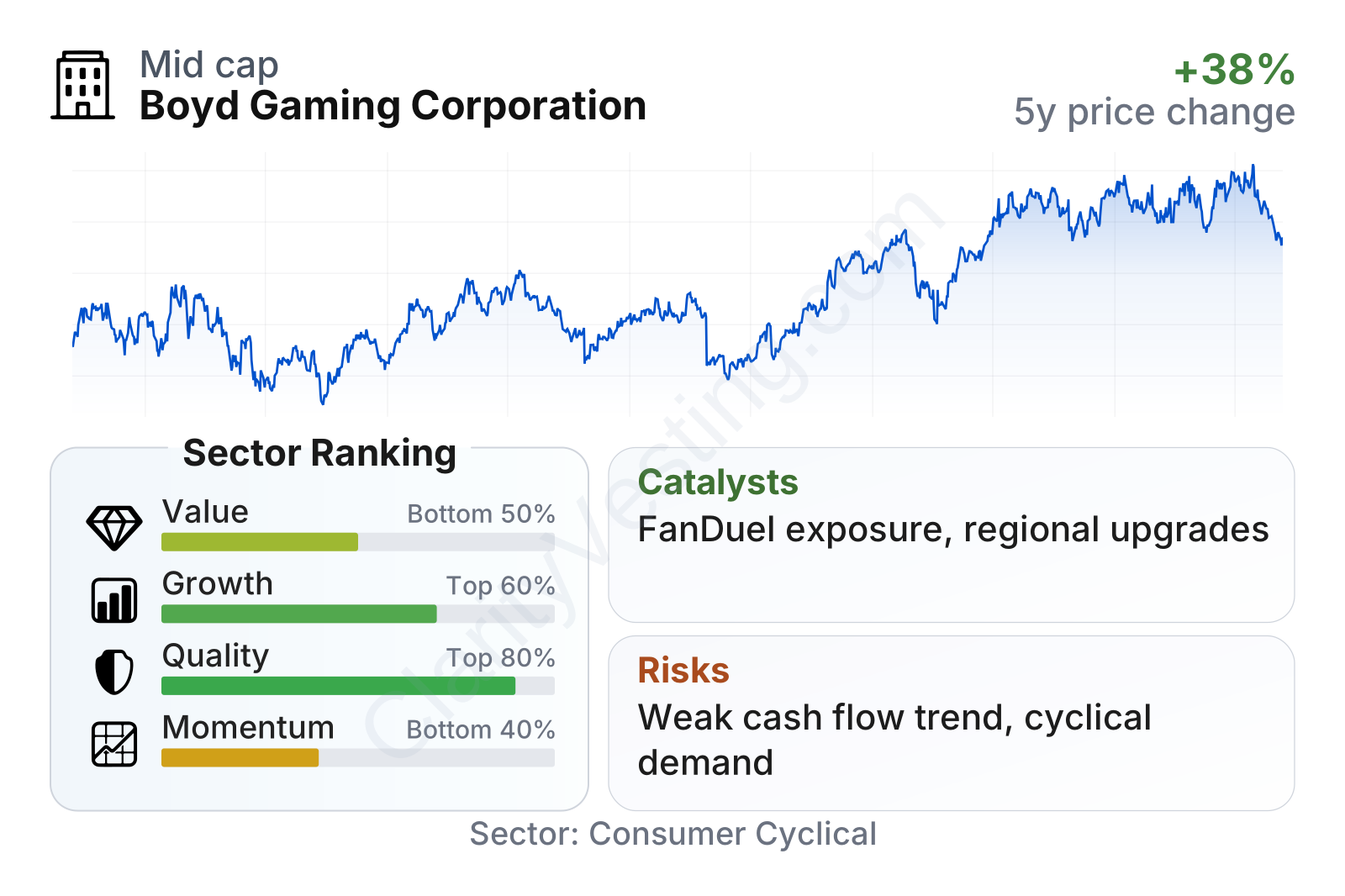
Boyd sits in the mid-cap range, with share-price volatility close to the broader market rather than at an extreme level. The overall financial profile is unusual in a good way on operating quality: profitability, return on invested capital, and net debt relative to EBIT all compare favorably with much of the sector. Growth metrics are more mixed. Long-term revenue per share has been solid, but recent top-line momentum has flattened, and free cash flow has moved down materially from the post-reopening peak. Price performance has still held up reasonably well over the last several years, suggesting the market continues to recognize the company’s durable regional casino franchise.
Growth
The regional gaming industry is not a fast-growth sector in the same way as software or semiconductors, but it can still produce attractive long-term expansion through disciplined capital spending, market-share gains, and steady cash generation. Boyd is positioned in the more stable part of the casino market: regional and local customers. That is important because repeat customers can support steadier volumes than destination-heavy models, especially when tourism is uneven.
Boyd’s strategy for future growth is logical. It combines mature regional casino assets, selective property upgrades, loyalty-driven repeat business, and digital exposure through FanDuel. This mix matters because it gives the company two different ways to grow: modest improvement in its core land-based operations and participation in online betting and iGaming without the full customer acquisition expense that has hurt many digital-only operators.
Revenue growth has cooled sharply in the most recent periods, moving from strong post-pandemic recovery rates to roughly flat year-over-year performance. That does not automatically mean the business is deteriorating; it may simply show that Boyd is now comping against a more normalized base. Still, it does mean the next stage of the investment case depends less on easy rebound growth and more on execution, property productivity, and capital allocation.
Free cash flow remains positive, but it has trended down significantly from 2022 levels. For a regional casino operator, that is worth watching closely because cash generation supports debt reduction, share repurchases, dividends, and reinvestment in properties. A business like Boyd does not need explosive sales growth to create value over time, but it does need healthy and resilient cash flow.
A meaningful catalyst is the company’s continuing exposure to online gaming through FanDuel-related arrangements and its equity interest. As more states refine sports betting and iGaming frameworks, Boyd can benefit from market access fees, partnership economics, and the value of that stake. Another catalyst is property-level reinvestment in core regional markets, where small operational improvements can have a meaningful effect because fixed costs are already largely covered.
Recent company communications have also emphasized returning capital to shareholders through buybacks and dividends while maintaining investment capacity. That does not create growth by itself, but it can improve per-share results if the underlying business stays stable.
Risks
This article is for informational purposes only and does not constitute financial advice. Some content is AI-generated. See Disclaimer


