Stock Analysis · BorgWarner Inc (BWA)
Overview
BorgWarner is an automotive supplier that makes systems used in passenger cars, commercial vehicles, and off-highway vehicles. The company has long been known for turbochargers, transmission parts, and drivetrain components, but in recent years it has been reshaping its portfolio toward electrification. Today, BorgWarner sells products for internal combustion vehicles, hybrids, and battery electric vehicles, including power electronics, eMotors, battery systems, charging components, and thermal-management products.
Its revenue comes mainly from two operating segments reported by the company: Drivetrain & Morse Systems and PowerDrive Systems. The first segment includes many of BorgWarner’s traditional products, while the second contains most of its electrification-focused activities. Based on recent annual reporting, the revenue mix is approximately:
- Drivetrain & Morse Systems: about 57% of revenue. This includes transmission components, chain systems, all-wheel-drive products, timing systems, and related parts used in combustion, hybrid, and some electrified vehicles.
- PowerDrive Systems: about 43% of revenue. This includes turbochargers, power electronics, eMotors, battery systems, heaters, charging technology, and other propulsion products tied to vehicle efficiency and electrification.
Geographically, BorgWarner is broadly diversified across North America, Europe, and Asia, which helps reduce dependence on a single auto market. Its customer base is made up largely of major global automakers, so performance depends heavily on vehicle production volumes and the pace of technology shifts inside the industry.
The business model is capital-intensive but established: BorgWarner invests heavily in engineering, wins supply programs with automakers, then produces components at scale over multi-year vehicle platforms. One useful point in the financial flow is that revenue has stayed near the mid-$14 billion range in recent years, while profitability has been more volatile. Gross profit has held up better than net income, which suggests that restructuring costs, portfolio changes, and operating expenses have mattered as much as top-line movement.
Key Figures
| Metric | Value | Sector ⓘ |
|---|---|---|
| Date | Sep 12, 2026 | |
| Context | ||
| Sector | Consumer Cyclical | |
| Industry | Auto Parts | |
| Market Cap ⓘ | $13.38B | |
| Beta ⓘ | 1.10 | |
Value (Cheapness) | ||
| P/E Ratio ⓘ | 32.20 | 17.10 |
| FCF Yield ⓘ | 9.28% | 8.53% |
| EBIT / EV ⓘ | 4.71% | 6.46% |
| PEG ⓘ | 0.35 | |
Growth (Business expansion) | ||
| Revenue Growth ⓘ | 0.30% | 5.75% |
| RPS Growth (5Y CAGR) ⓘ | 1.66% | 9.14% |
| EPS Growth (5Y CAGR) ⓘ | -14.50% | -18.21% |
| Margin Growth (5Y Trend) ⓘ | -2.24% | -0.23% |
| FCF Growth (5Y CAGR) ⓘ | 17.30% | 4.91% |
Quality (Business durability) | ||
| ROIC (Latest) ⓘ | 5.67% | 12.61% |
| ROIC (5Y Median) ⓘ | 6.90% | 10.72% |
| Net Debt / EBIT (Latest) ⓘ | 2.75 | 2.10 |
| Net Debt / EBIT (5Y Median) ⓘ | 3.10 | 2.32 |
| Operating Margin (Latest) ⓘ | 4.98% | 9.25% |
| Operating Margin (5Y Median) ⓘ | 6.17% | 9.64% |
| Debt to Equity (Latest) ⓘ | 72.32% | 75.78% |
| Profit Margin (Latest) ⓘ | 2.89% | 5.33% |
| Free Cash Flow (Latest) ⓘ | $1.24B | |
Momentum (Price trend) | ||
| 3Y Return ⓘ | +67.70% | +14.53% |
| 12M Return (excl. last month) ⓘ | +73.82% | +3.08% |
| 6M Return ⓘ | +27.62% | +0.55% |
| Price vs. 200-Day MA ⓘ | +15.31% | -0.54% |
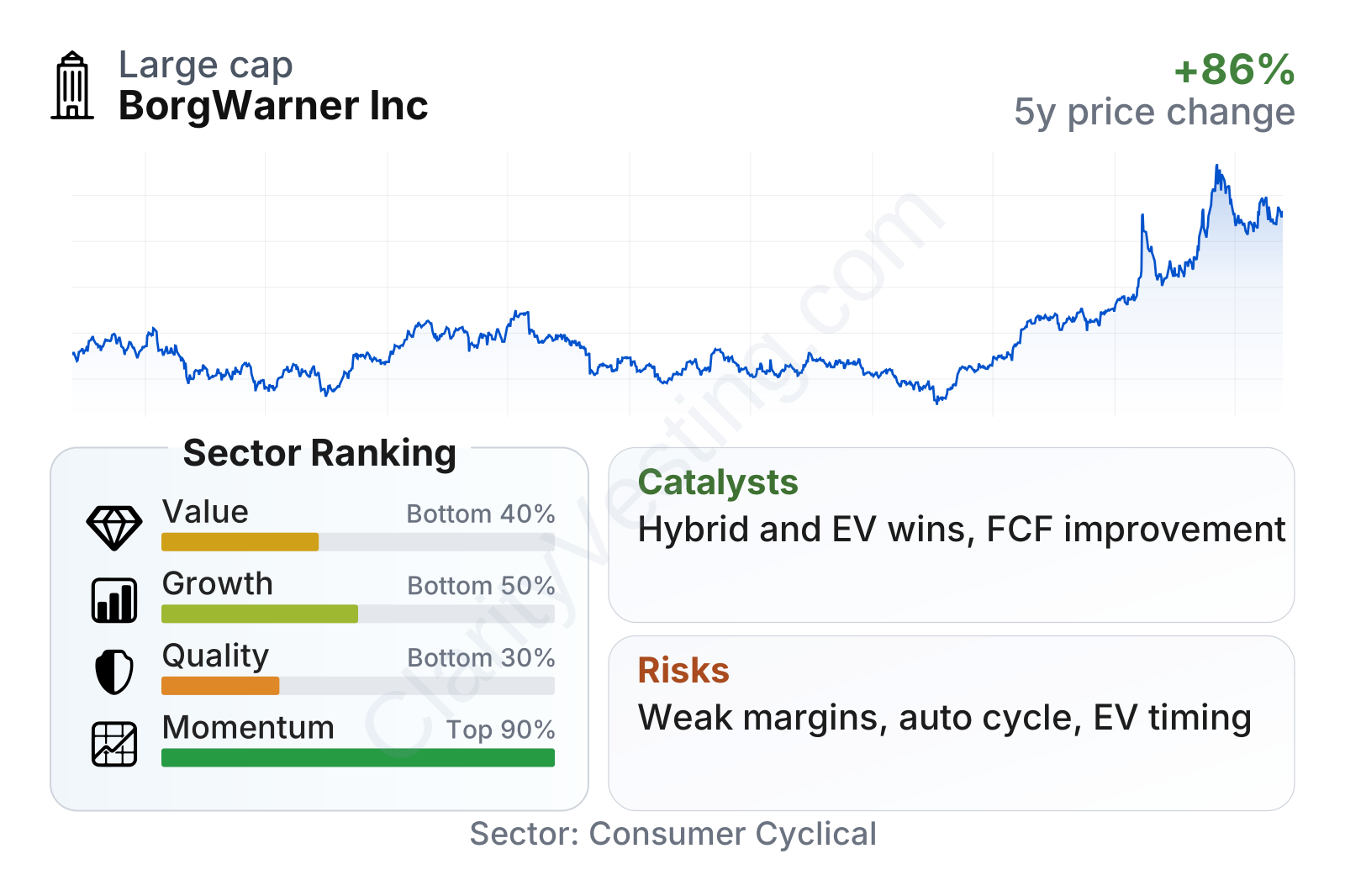
BorgWarner is a large auto-parts company with above-average share-price momentum over the last year and over the last three years. The table also shows a mixed fundamental profile. Cash generation looks solid, especially on free-cash-flow measures, but profitability and returns on capital remain below the sector median. Growth metrics are also weaker than many peers, which means the recent market re-rating has run ahead of the company’s current operating profile.
Growth
BorgWarner operates in a sector that is changing rather than expanding in a straight line. Global vehicle demand tends to be cyclical, but the content per vehicle is shifting as automakers move toward hybrids, battery electric vehicles, emissions control, efficiency improvements, and advanced power electronics. That broader transition creates a real growth lane for suppliers that can remain relevant across both legacy and next-generation platforms. BorgWarner’s strategy is built around exactly that idea: keep monetizing established combustion and hybrid products while building a larger electrification business.
The logic of that strategy is sound. Auto manufacturing does not switch technologies overnight, so suppliers with exposure to both conventional and electrified platforms can potentially manage the transition better than firms tied to only one side. BorgWarner has been using acquisitions, divestitures, and internal development to reposition its portfolio, especially in charging, inverters, eMotors, and battery-related systems. The company has also emphasized high-voltage products and hybrid solutions, which may be important if full battery-electric adoption remains uneven across regions.
Recent revenue growth has been modest, with year-over-year changes hovering around flat levels lately after a more uneven period. That does not point to broad-based acceleration yet. However, flat revenue in auto parts can hide product-mix change underneath the surface, especially when older programs mature while newer electrification programs ramp. In other words, the headline growth rate is not particularly strong today, but the internal mix may be improving for future years if new program launches scale up.
Cash generation is one of the more encouraging points. Trailing free cash flow has moved sharply higher from a few hundred million dollars to more than $1.2 billion over the last few years. That matters because it gives the company flexibility to fund research, support restructuring, reduce debt, repurchase shares, or pursue bolt-on portfolio moves without relying too heavily on external financing.
A notable catalyst is BorgWarner’s exposure to hybrid vehicles as well as full EV systems. Industry adoption has become more mixed by region and price point, and hybrids are increasingly being treated as a practical bridge technology. That can support demand for a company whose portfolio spans turbocharging, emissions-related efficiency products, eMotors, power electronics, and thermal technologies rather than depending on a single vehicle architecture.
Another important opportunity comes from new program wins with automakers. In this industry, announced contracts and platform awards can translate into multi-year revenue streams once production starts. BorgWarner has been highlighting continued electrification bookings and efforts to sharpen its portfolio, which suggests management is trying to improve the long-term revenue mix even if near-term growth remains subdued.
Risks
This article is for informational purposes only and does not constitute financial advice. Some content is AI-generated. See Disclaimer


