Stock Analysis · Breville Group Limited (BVILF)
Overview
Breville Group Limited is a premium small-appliances company focused on kitchen and home products. It designs, develops, markets, and distributes products such as espresso machines, coffee makers, blenders, ovens, grills, food preparation appliances, and related accessories. The group operates globally and sells through several brands, with Breville and Sage being the best known in many markets, while Kambrook, Lelit, and Baratza add positions in broader kitchen appliances and specialty coffee equipment.
Its business model is relatively straightforward: Breville develops appliances with a strong emphasis on design, functionality, and premium positioning, then sells them through retailers, online channels, and distribution partners across North America, Europe, Asia-Pacific, and other international markets. The company is not a mass-market white-goods manufacturer; it is more concentrated on countertop appliances where branding, product innovation, and shelf presence matter.
The main revenue sources are primarily product sales by category and geography. Public reporting emphasizes regional performance more clearly than exact category splits, so the most reliable breakdown for a simple long-term view is by end-market rather than by individual appliance line.
- North America: the largest contributor, generally around 50% to 60% of group sales in recent years. This includes the United States and Canada and covers the core Breville-branded premium kitchen appliance range.
- EMEA: generally around 20% to 30% of sales. This includes Europe, the Middle East, and Africa, with Sage playing an important role in the region.
- Asia-Pacific: generally around 15% to 25% of sales. Australia and New Zealand remain important markets, alongside developing Asian distribution.
- Product mix: coffee-related appliances are widely considered one of the most important profit engines, supported by ovens, food prep, beverage, and other kitchen appliances. Exact percentages by product line are not consistently disclosed in a precise public format.
What stands out is the premium mix. Breville is not competing mainly on lowest price; it is trying to capture consumers willing to pay more for convenience, design, and better performance, especially in coffee and kitchen appliances where repeat gifting, home upgrade cycles, and lifestyle trends can support demand.
The operating profile shows a company that has increased revenue meaningfully over the last several years while also expanding operating income and net income. Selling and marketing costs have risen as the business scales globally, but profitability has remained solid, suggesting that higher brand investment has not derailed earnings power.
Key Figures
Metric Value Sector ⓘ Date Sep 12, 2026 Context Sector Consumer Cyclical Industry Furnishings, Fixtures & Appliances Market Cap ⓘ $3.22B Beta ⓘ 1.26 P/E Ratio ⓘ 32.72 17.10 FCF Yield ⓘ 9.41% 8.53% EBIT / EV ⓘ N/A 6.46% PEG ⓘ 2.67 Revenue Growth ⓘ 1.90% 5.75% RPS Growth (5Y CAGR) ⓘ 5.04% 9.14% EPS Growth (5Y CAGR) ⓘ 0.04% -18.21% Margin Growth (5Y Trend) ⓘ 0.51% -0.23% FCF Growth (5Y CAGR) ⓘ -6.54% 4.91% ROIC (Latest) ⓘ N/A 12.61% ROIC (5Y Median) ⓘ 13.97% 10.72% Net Debt / EBIT (Latest) ⓘ -0.10 2.10 Net Debt / EBIT (5Y Median) ⓘ 0.10 2.32 Operating Margin (Latest) ⓘ 11.75% 9.25% Operating Margin (5Y Median) ⓘ 11.48% 9.64% Debt to Equity (Latest) ⓘ 14.50% 75.78% Profit Margin (Latest) ⓘ 7.63% 5.33% Free Cash Flow (Latest) ⓘ $303.32M 3Y Return ⓘ +64.86% +14.53% 12M Return (excl. last month) ⓘ +0.45% +3.08% 6M Return ⓘ -8.20% +0.55% Price vs. 200-Day MA ⓘ +103.10% -0.54%
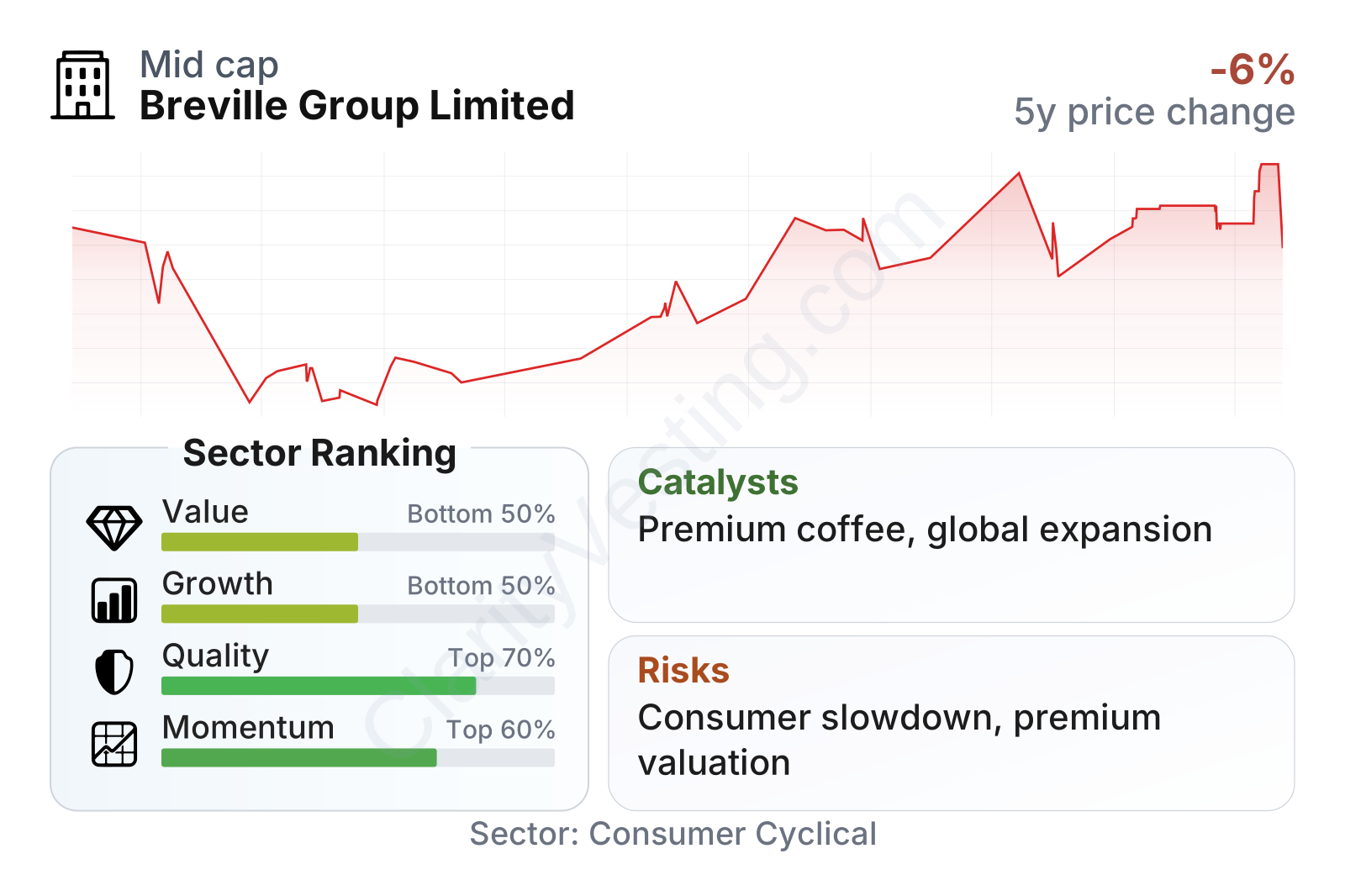
Breville sits in the mid-cap range and shows a mixed but generally solid profile. Quality metrics are comfortably above many sector peers: operating margin is around 12% versus a sector median near 9%, profit margin is roughly 8% versus about 5%, and leverage is low with debt to equity near 14% versus a sector median around 75%. Net debt is effectively absent relative to EBIT, which gives the company financial flexibility. The weaker area is growth relative to the broader sector, with recent revenue growth near 2% and a five-year revenue-per-share growth rate around 5%, both below median. Market performance has been strong, however, with share price momentum over three years far ahead of the sector.
Growth
Breville operates in a consumer appliance segment that is mature in basic functionality but still capable of growth through premiumization, coffee culture, product innovation, and international expansion. That makes it less of a pure high-growth industry and more of a category where a strong brand can steadily gain share over time. The most attractive part of the market is specialty coffee equipment for home use, where consumers often trade up rather than simply replace old devices with the cheapest option.
Breville’s strategy appears coherent for long-term growth. The company has spent years building a premium identity around design-led appliances and has pushed that model internationally. Its acquisition history, including coffee-adjacent brands such as Baratza and Lelit, also fits this direction by deepening its position in prosumer and enthusiast coffee equipment. That matters because coffee tends to support higher engagement, stronger brand loyalty, and often better pricing than more commoditized appliances.
Growth has not been spectacular in the most recent year, and it trails the median company in the sector. Even so, the longer trend still points upward: revenue has expanded from roughly $1.4 billion in fiscal 2022 to above $1.8 billion in fiscal 2026, while earnings have also improved. This suggests Breville is still growing, but in a measured way rather than through rapid volume surges.
Cash generation is an important positive. Trailing free cash flow is above $300 million, which is strong for a company of this size. That gives Breville room to fund product development, support brand-building, manage inventory cycles, and potentially pursue selective acquisitions without depending heavily on debt markets. Even though the five-year free-cash-flow growth rate is weak, current cash generation looks healthy enough to support the business model.
A meaningful catalyst is the continued shift toward premium home coffee equipment. Consumers increasingly replicate café-style drinks at home, and Breville is positioned directly in that trend through espresso machines, grinders, and complementary tools. Another catalyst is geographic expansion: if the company can keep broadening distribution in underpenetrated markets while preserving its premium positioning, revenue can continue to compound without needing dramatic changes to its core identity.
Recent company reporting also indicates ongoing product launches and continued investment in international brand development. That is not a single transformative event, but it does support the idea that management is still building distribution and category depth rather than simply harvesting a mature franchise.
Risks
This article is for informational purposes only and does not constitute financial advice. Some content is AI-generated. See Disclaimer